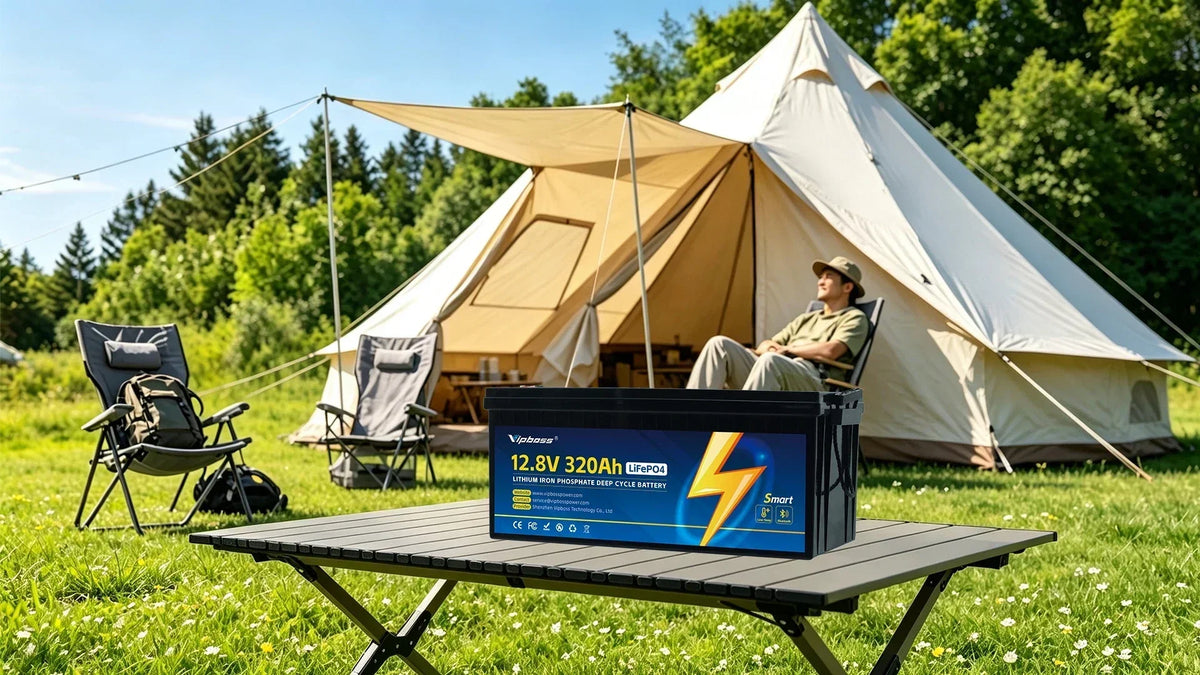

Choose a 12 volt deep cycle battery based on daily energy use, trip length, charging access, current demand, and available space. The battery should cover overnight loads and leave enough reserve for poor weather or an extra day away from shore power.
Why Do Campers Need a Deep Cycle Battery?
Campers need a deep cycle battery because refrigerators, pumps, fans, lights, and control boards draw steady power for many hours. Deep cycle batteries support repeated discharge and recharge cycles. Starter batteries focus on a short burst of current for engine cranking.
Deep cycle batteries for campers commonly run:
- Interior and exterior lights
- A 12V refrigerator
- Water pumps
- Vent or furnace fans
- USB outlets and device chargers
- Small appliances connected to an inverter
A separate house battery keeps camping loads away from the vehicle starting supply. Deep-cycle batteries are built for repeated cycling and steady energy use, which fits equipment that runs throughout the day and night.
What Should You Consider When Choosing a 12V Deep Cycle Battery for Camping?
Check usable energy, current output, physical size, charging compatibility, temperature limits, and monitoring features.
- Daily energy use: Add the watt-hours consumed across all devices during a typical day.
- Time between charges: Count the days between shore power, vehicle charging, or useful solar input.
- Battery chemistry: Compare usable capacity, weight, charging profile, cycle life, and maintenance needs.
- Continuous current: Compare the battery management system limit with all loads that may run at the same time.
- Physical fit: Measure the battery tray, compartment height, cable reach, terminal position, and weight limit.
- Temperature range: Look for low-temperature charging protection for cold-weather trips.
- Charging setup: Confirm that the converter, solar controller, and portable charger support the selected chemistry.
- Battery monitoring: Bluetooth data or a shunt monitor can show current flow, voltage, charge level, and energy use.
A battery with enough capacity can still be a poor match when its case, terminal layout, or charging profile conflicts with the camper. Check the full electrical setup before choosing a model.

How Much Power Can a 12V Deep Cycle Battery Provide While Camping?
Stored energy depends on battery voltage and amp-hour capacity:
Watt-hours = volts × amp-hours
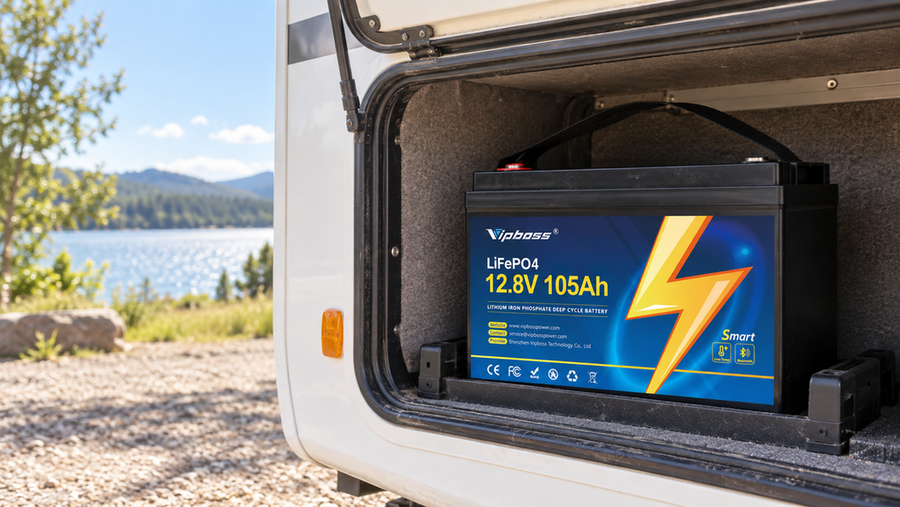
A 12V 100Ah battery stores about 1,200Wh of rated energy. A 12.8V 105Ah LiFePO4 battery stores 1,344Wh. The same calculation appears in a battery capacity reference.
Rated energy and energy delivered to appliances can differ. Inverter losses, wiring losses, temperature, and operating reserve reduce the final amount available.
Use four steps to estimate daily demand:
- List each device and its wattage.
- Estimate daily operating time.
- Multiply wattage by operating hours.
- Add every result and allow room for system losses and longer stays.
For example, 120Wh of lighting, 480Wh of refrigeration, 180Wh of laptop use, and 60Wh of phone charging total 840Wh per day. A 1,344Wh battery leaves 504Wh of rated capacity before system losses and operating reserve.
A plug-in electricity monitor can measure the power use of 120V appliances connected through an inverter. Use a battery shunt or DC power meter for devices wired directly to the 12V system.
Which Battery Capacity Works Best for Different Camping Setups?
Match battery capacity to measured daily watt-hours and the time available for recharging. The ranges below provide a planning reference for common camping loads.
| Camping Setup | Common Loads | Example Planning Range | Approximate Rated Energy |
|---|---|---|---|
| Tent or small utility trailer | Lights, phones, a fan, and a small cooler | 50Ah to 100Ah | 600Wh to 1,280Wh |
| Teardrop or weekend camper | Refrigerator, lights, pump, and personal devices | 100Ah to 150Ah | 1,280Wh to 1,920Wh |
| Travel trailer | Refrigerator, pump, furnace fan, laptops, and small inverter loads | 200Ah to 250Ah | 2,560Wh to 3,200Wh |
| Longer off-grid RV stays | Larger appliance mix and several days between full charges | 300Ah to 400Ah | 3,840Wh to 5,120Wh |
Treat these ranges as planning references. Refrigerator type, outdoor temperature, inverter use, appliance run time, and charging frequency can all change the capacity needed for a deep cycle battery for camper trailer use.

Can a 12V Deep Cycle Battery Work With Solar Panels and RV Systems?
Yes, a 12V deep cycle battery can work with solar panels and RV systems when every charging source uses the correct voltage and battery profile.
A complete system may include:
- Solar panels
- A solar charge controller
- An RV converter
- A battery monitor
- An inverter for 120V appliances
The charge controller regulates panel output before power reaches the battery. Current 12V LiFePO4 battery options list charging requirements for several capacities. One current 12.8V 105Ah battery uses a charging range of 14.2V to 14.6V.
The RV converter also needs a compatible charging profile. Some converters designed around lead-acid batteries use voltage settings that differ from LiFePO4 charging requirements.
Solar output changes with cloud cover, shade, season, panel angle, and daylight hours. A 300W solar array with four peak sun hours has a theoretical daily output of 1,200Wh before controller, wiring, temperature, and charging losses.
More information about pairing daytime production with stored power appears in solar and battery storage basics. Size the battery around overnight use and periods with limited sunlight.
Choose a 12V Deep Cycle Battery That Matches Your Camping Needs
Review your daily energy use, charging options, available space, and current demand before buying. Choose a 12 volt deep cycle RV battery that covers overnight loads and leaves enough reserve for longer stops. Calculate your daily watt-hours, check your existing equipment, and choose a battery that fits the way you camp.
12V Deepcycle Battery for Camping FAQs
Q1: Why Does a Camper Battery Drain When Nothing Appears to Be Running?
Small standby loads may keep drawing power after the main appliances are turned off. Propane detectors, stereo memory, USB outlets, inverters, control boards, and display panels may stay active around the clock. Use a clamp meter or shunt monitor to check current draw, then remove one fuse at a time to identify the active circuit.
Q2: Should You Disconnect a Trailer Battery When It Is Not in Use?
Yes, you can disconnect a trailer battery during storage when no required safety or charging circuit depends on it. Check whether the breakaway system, solar controller, alarm, or maintenance charger still needs battery power. Store the battery at the charge level listed in its manual and check its condition during long storage periods.
Q3: What Is the Average Lifespan of a Deep Cycle Battery?
A deep cycle battery can last from a few years to more than ten years. Chemistry, temperature, charging accuracy, discharge depth, and storage habits affect service life. For camping energy storage, compare the cycle rating, warranty length, and conditions attached to both figures. LiFePO4 models often carry higher cycle ratings than traditional lead-acid batteries.
Q4: How Can You Tell a Deep Cycle Battery From a Starter Battery?
Check the product label and specification sheet. Deep cycle models usually highlight amp-hours, watt-hours, cycle life, and continuous discharge current. Starter batteries place greater focus on cold cranking amps and cranking amps. Some marine batteries combine starting and cycling functions, so review the rated use before installing one as a camper or trailer battery.
Q5: How Do I Know When a Deep Cycle Battery Is Fully Charged?
Check the charger status and battery monitor after charging current has dropped near the end of the cycle. Voltage readings can be misleading while the battery is charging or powering equipment. For a LiFePO4 battery, follow the full-charge voltage and charging instructions listed in its manual rather than using a lead-acid voltage chart.