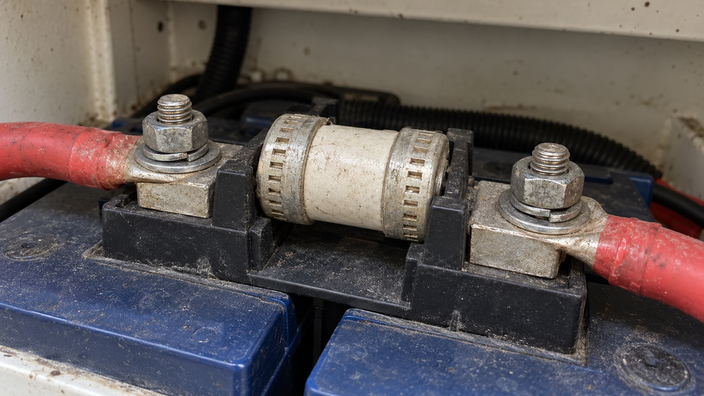

Use a Class T fuse when installation rules or connected equipment require it, or when the system's high or unknown prospective fault current makes the interrupt rating of other permitted devices inadequate. Do not choose Class T merely because the battery is LiFePO4. When another permitted protective device is correctly DC-rated, protects the conductor, carries the expected load and surge, and can interrupt the available fault current, Class T is not required.
What determines the fuse choice?
Check the installation requirements and equipment instructions first. Then assess the system voltage, the load, conductor protection, and the available fault current. The selected device must be suitable for the voltage and circuit, protect the conductors as required, and have an interrupting rating adequate for the fault current it may need to stop.
Pay particular attention to fault current. When significant fault current is possible, the fuse's interrupting-current capacity matters, as the U.S. Department of Energy's electrical safety handbook explains. That guidance supports checking interrupting capacity; it does not establish a Class T requirement for LiFePO4 systems.
For example, the Vipboss 12V 105Ah LiFePO4 battery is rated at 12.8V. That voltage is one input when assessing protective-device suitability; it does not by itself determine the fuse type.
Make the decision for your installation

- Check the rules and instructions. Follow the requirements that apply to your location and installation, along with the battery and connected-equipment instructions.
- Identify the circuit conditions. Determine the system voltage, expected load, and conductor protection needs.
- Compare fault current with interrupting rating. Select a protective device whose interrupting rating is adequate for the available fault current and whose other ratings suit the circuit.
If a Class T fuse meets those requirements, it may be the right choice. If another device meets them and is permitted by the applicable rules and equipment instructions, the battery chemistry alone does not rule it out. The final choice depends on the installation, not the LiFePO4 label.
FAQs
Does LiFePO4 chemistry alone mean a system needs a Class T fuse?
No. Fuse type depends on applicable installation rules and whether the protective device suits the circuit, including its available fault current and the device's interrupting rating.
Why does a fuse's interrupting rating matter in a LiFePO4 system?
It must be adequate for the available fault current the fuse may need to stop, particularly where significant fault current is possible.