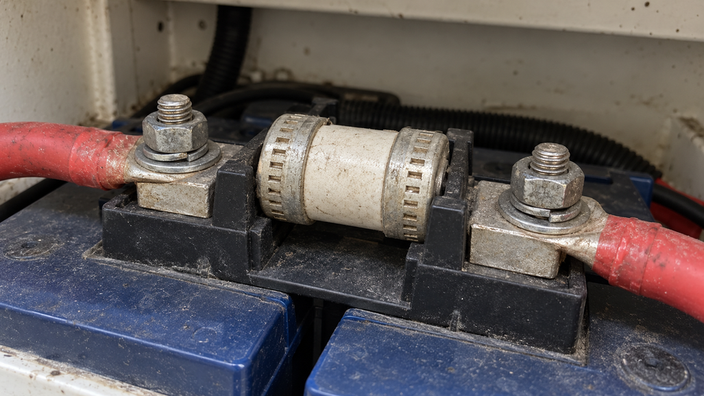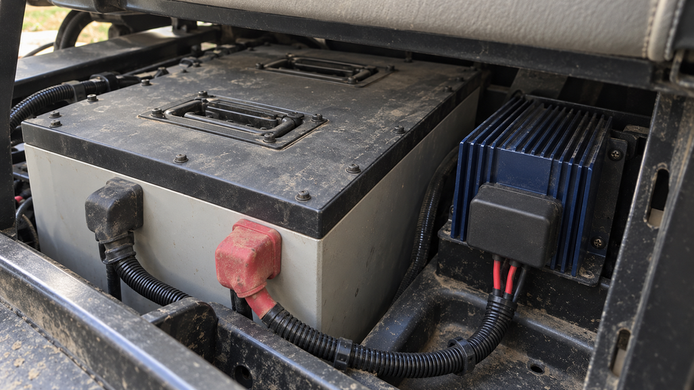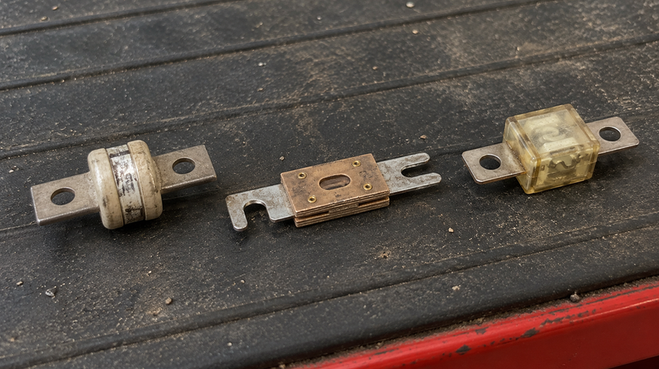

For a lithium battery bank, Class T is usually the best default main fuse when available fault current is high or unknown. Choose MRBF when installation space is tight and the exact fuse's DC interrupt rating is adequate. Choose ANL when its lower-cost, holder-mounted format fits the installation and its exact interrupt rating still exceeds the available fault current. In every case, size the fuse for the cable and load—not from the battery's amp-hour capacity or BMS rating.
The practical difference is more than fuse amperage

The amp number printed on a fuse tells you how much current it is designed to carry under specified conditions. It does not tell you how much short-circuit current the fuse can safely interrupt. That second value is the interrupt rating, also called breaking capacity or AIC.
A fuse's interrupt rating must be at least as high as the available short-circuit current. Its DC voltage rating must also cover the circuit. A fuse with the right amp rating but inadequate interrupt capacity is not an acceptable main-battery fuse.
The values below illustrate why the exact series matters:
| Fuse type | Example DC interrupt rating | Installation format | Best fit |
|---|---|---|---|
| Class T | Littelfuse JLLN: 20 kA DC for 35–1200A models; 50 kA DC for 1–30A models | Dedicated Class T holder or block | High-energy banks, inverter systems, parallel batteries, or unknown/high fault current |
| ANL | Blue Sea 100A ANL: 6 kA at 80V DC; Eaton ANL-80: 2.7 kA at 80V DC | Bolted fuse in a separate ANL block | Systems whose calculated fault current is below the exact fuse's rating and where a larger block is acceptable |
| MRBF | Blue Sea MRBF: 10 kA at 14V, 5 kA at 32V, and 2 kA at 58V DC | Compact fuse used with a terminal fuse block | Space-constrained, near-battery protection when the exact voltage-dependent interrupt rating is sufficient |
These are series-specific examples, not universal ratings for every Class T, ANL, or MRBF fuse. Published JLLN, 100A ANL, and MRBF specifications show that interrupt capacity changes with fuse series and DC voltage. Always check the data sheet for the exact part number you intend to install.
Choose Class T when fault energy is the main concern
Class T is the conservative choice for a main fuse near a lithium battery bank because commonly available Class T series combine high DC interrupt capacity with fast, current-limiting short-circuit response. The JLLN series, for example, is DC-rated and provides a 20 kA interrupt rating through the amperage range most often encountered in large battery and inverter circuits.
That extra interrupt margin matters when the system includes:
- multiple batteries in parallel;
- short, heavy battery cables;
- a large inverter or other high-current equipment;
- a battery manufacturer that does not publish prospective short-circuit current; or
- a design whose available fault current has not yet been established.
Class T is not automatically the correct amp rating, and the family name is not a substitute for checking the selected fuse. It still needs a compatible holder, a sufficient DC voltage rating, a suitable time-current curve, and an amp rating that protects the installed cable without opening during permitted surge current.
Choose MRBF when compact placement is the priority
MRBF can provide a clean, compact way to place overcurrent protection close to a battery or bus connection. The cited Blue Sea MRBF series covers 30–300A and publishes different interrupt ratings at 14V, 32V, and 58V DC. That voltage dependence is important: quoting its 10 kA rating at 14V does not establish a 10 kA rating at 48V.
MRBF is a reasonable main-fuse choice when all of the following are true:
- the exact MRBF rating covers the system's maximum voltage;
- its interrupt capacity exceeds the available fault current at the installation point;
- its time-current behavior carries the normal load and allowed surge;
- the cable is protected at the selected amp rating; and
- the approved terminal fuse block fits the battery connection and enclosure.
Do not place a bare MRBF directly under a battery-terminal bolt unless the fuse and battery manufacturers explicitly approve that arrangement. Use the fuse maker's approved terminal fuse block and installation method.
Choose ANL only after checking the available fault current
ANL is widely available, easy to inspect, and offered in useful high-current ratings. A separate ANL block can also be convenient when the fuse needs to be mounted away from the battery terminal. Its limitation is that many ANL products have a lower DC interrupt rating than the Class T examples above.
That does not make ANL inherently unsafe. It means the selection must be demonstrated with numbers. One published 100A ANL example is rated to interrupt 6 kA at 80V DC, while another ANL series is rated at 2.7 kA at 80V DC. Do not transfer the rating of one manufacturer's ANL fuse to another ANL product.
Use ANL only when the exact fuse and holder are DC-rated for the system and the documented interrupt rating exceeds the available short-circuit current. If that current is unknown, switching to Class T is the more defensible choice; it does not eliminate the need to verify the design, but it provides substantially more interrupt margin in the cited series.
Size the selected fuse for the circuit

Choosing the fuse family and choosing the amp rating are separate decisions. Work through them in this order:
- Follow the equipment requirement. If the inverter, charger, or other connected equipment specifies a fuse type and rating, begin there.
- Calculate maximum continuous current. Include the loads that can operate together and use the equipment's lowest expected input voltage and efficiency where applicable.
- Check permitted surge duration. Compare startup or inverter surge with the exact fuse's time-current curve.
- Protect the cable. The selected amp rating must not exceed the protection allowed for the installed conductor, insulation, temperature, bundling, and routing.
- Check maximum DC voltage. Verify both the fuse and holder at the battery bank's highest possible voltage.
- Check interrupt capacity. Confirm that it exceeds the prospective short-circuit current at the fuse location.
- Verify the complete assembly. Holder rating, terminal size, torque, environmental protection, and placement are part of the design.
If the available fault current is not published, obtain it from the battery manufacturer or have the installed system evaluated by a qualified DC designer. Do not substitute the BMS continuous-current rating for this value.
Apply the checks to a specific battery system
The battery model is one input to the decision, not the decision itself. Its voltage establishes the required DC voltage rating; the connected equipment and cable determine the fuse amp rating; and the prospective fault current determines the interrupt rating needed at the fuse location. Terminal size matters only after the fuse family and approved holder have passed those electrical checks.
Take the Vipboss 12V 105Ah Bluetooth LiFePO4 battery as an example. Its published 100A BMS rating and M8 terminal bolts describe battery limits and connection hardware. They do not automatically call for a 100A fuse, establish available fault current, or prove that a terminal-mounted MRBF block will fit the finished installation.
For a single-battery system with a modest DC load, MRBF may be the most compact choice if the approved block fits, the fuse protects the installed cable, and its voltage-dependent interrupt rating exceeds the available fault current. ANL can also be appropriate when the same checks pass and a separate block is preferred. For a large inverter, parallel bank, or installation with unknown fault current, Class T is the more defensible starting point. In all three cases, verify the exact fuse, holder, cable, equipment surge, and terminal arrangement before energizing the system.
FAQs
Which fuse is the better starting point when battery fault current is high or unknown?
Class T is generally the more defensible starting point because commonly used Class T series offer greater DC interrupt capacity than many ANL or MRBF examples. You must still verify the exact fuse's voltage, interrupt, ampere, and time-current ratings for the installed circuit.
When is an MRBF fuse a better choice?
MRBF is useful when compact protection close to a battery or bus connection is important and the approved terminal block fits. Use it only when the exact fuse's voltage-dependent interrupt rating exceeds the available fault current and its ampere rating protects the cable while carrying the expected load.
Can an ANL fuse replace a Class T fuse?
Only when the exact ANL fuse and holder meet the circuit's DC voltage requirement, interrupt the available fault current, protect the conductor, and carry the permitted load and surge. Matching the Class T fuse's ampere rating alone does not establish equivalence.