
An inverter turns stored DC power into AC for standard outlets, while a converter turns AC or higher-voltage DC into well-regulated DC. Knowing which device handles which direction of power flow keeps off-grid and lithium systems efficient, safe, and predictable.
You flip on the TV in your camper, the lights dip, and a faint hot-electronics smell creeps out from the power compartment. The difference between the right and wrong power boxes in that moment is the difference between a short, stressful movie night and hours of quiet, reliable power on the same battery. By the end, you’ll know exactly which box should feed what and how to match them so your upgraded battery system runs cool, quiet, and for as long as you planned.
The Core Difference: Which Way Is the Power Flowing?
In electrical engineering, any device that changes voltage, current type, or frequency is broadly a power converter, whether it is stepping AC down to a low-voltage DC rail or reshaping DC into AC for a motor drive. That whole family of gear includes DC–DC, DC–AC, AC–DC, and AC–AC converters, all of which fall under the umbrella of electric power conversion. Power converter is therefore the generic term; inverter is the specialist.
Within that family, an inverter is the converter that always takes DC in and outputs AC, the mirror-image role of a rectifier that takes AC in and outputs DC. High-voltage power electronics literature is explicit about this: converter is the big category, inverter is the DC-to-AC branch inside it, with common output waveforms ranging from simple square wave to low-distortion sine wave for sensitive loads. The difference between high-voltage converters and inverters lays this out clearly.
Everyday off-grid language simplifies this even further. In most camper and RV contexts, “converter” is shorthand for a box that takes shore or generator AC and turns it into 12 V DC to charge batteries and run lights and fans, while “inverter” does the opposite by letting the battery run standard AC outlets. A typical rig arrives from the factory with a converter, and higher-end or upgraded rigs add an inverter so AC appliances can run away from hookups. Real-world RV power setups in inverter-versus-converter guides for owners describe this pattern directly.
You can summarize the off-grid distinction like this:
Device |
Primary job |
Typical direction |
Common sources |
Common loads |
Inverter |
Turn stored battery or solar power into outlet-style power |
DC → AC |
Batteries, solar DC bus |
Household AC appliances, tools, chargers |
Converter |
Turn plug power or one DC level into well-regulated DC |
Mostly AC → DC (plus DC → DC) |
Shore power, generator, alternator, higher-voltage DC |
Battery charging, 12 V lighting, fans, pumps, electronics |
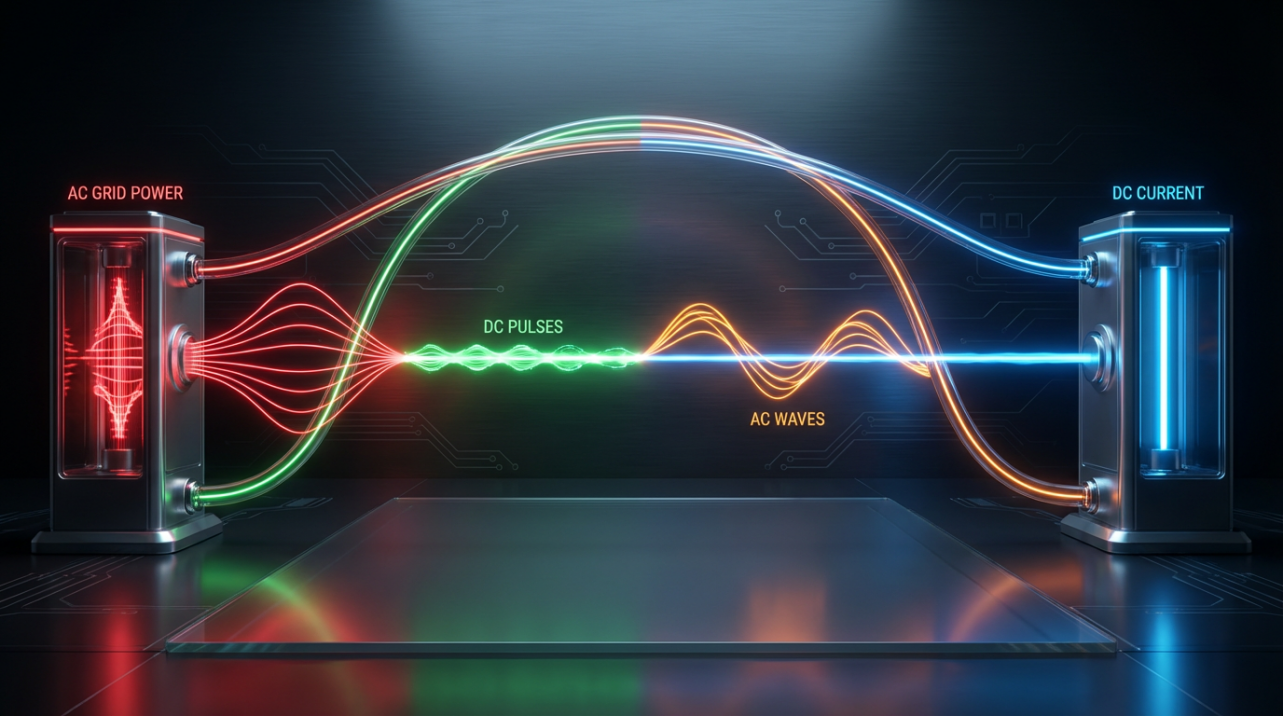
If you remember nothing else, remember the direction: an inverter pushes power from the DC side to the AC side, while a converter pushes power from AC (or higher-voltage DC) down into the DC side.
Why Off-Grid Lithium Systems Almost Always Need Both
Most serious off-grid or overland systems juggle multiple power sources and loads at once. Batteries, solar panels, and alternators provide DC; shore hookups and generators feed in AC; lights, fans, pumps, and many electronics are DC; refrigerators, microwaves, and air conditioners are typically AC. The only way to keep this ecosystem both flexible and safe is to give each “direction” its specialist device: converters looking after battery charging and DC loads, and inverters delivering clean AC from the battery bank. Off-the-shelf RVs usually ship with an AC–DC converter for 12 V systems, and owners add an inverter when they want household appliances without plugging in.
In a lithium retrofit, that division matters even more. A modern inverter-charger combines both roles in one box: it uses AC-to-DC conversion to charge your battery when grid or generator power is present, then flips around and runs as a DC-to-AC inverter when you unplug. Dedicated solar and battery inverters in home systems follow the same pattern, converting DC from panels and batteries to AC for the home while also handling AC-to-DC charging and battery management. Solar and battery inverters show how these dual-role devices sit between sources, storage, and loads.
Off-grid cabins typically lean on a solar inverter to turn panel DC into AC and a charge controller or integrated charger stage to look after the battery, often bundled into a hybrid inverter that speaks fluently to both the battery and the grid. In vans or campers, you see the same pattern with different packaging: a shore-power converter/charger feeds the battery and 12 V panel, while an inverter supplies a small AC subpanel or dedicated outlets for a microwave, induction cooktop, or work tools.

Inverter Deep Dive: Turning Battery DC into Appliance-Friendly AC
At heart, an inverter takes direct current from a battery, solar array, or DC bus and uses high-speed electronics to flip it back and forth in a controlled way so the output looks like the AC your home outlets expect. Inverters do more than just flip polarity; they regulate output voltage and frequency so fridges, laptops, and compressors see a stable, grid-like power source instead of a crude, choppy approximation. The core function and importance of converting DC from batteries and solar into AC for standard loads is covered thoroughly in practical inverter primers, and Function of an inverter emphasizes this role.
The quality of that AC waveform is what separates bargain-box units from serious gear. Square-wave inverters are electrically simple and cheap, but their blocky output can make motors buzz, run hot, or even fail early, and they are rarely a good idea for modern electronics. Modified sine designs use stepped waveforms that behave better but still introduce significant distortion and can cut AC motor efficiency by roughly a fifth, which shows up as extra heat and noise. Pure sine wave inverters approximate utility power closely enough that sensitive electronics, modern fridges, and variable-speed compressors run as intended, which is why they are the default recommendation for whole-rig or whole-cabin use. Real-world inverter comparisons aimed at RV and off-grid users consistently highlight these three output classes and recommend pure sine wave for anything beyond the simplest loads, and RV inverter vs converter usage echoes this guidance.

Every conversion step costs you some energy. Even good inverters typically waste a few percent of input power as heat in semiconductors and magnetics, which is why high-efficiency designs and good thermal management are such a focus in high-voltage converter and inverter applications. The difference between high-voltage converters and inverters describes those efficiency and heat-management tradeoffs. On a small battery bank, that loss is tangible: if your loads total 500 W and your inverter is 90% efficient, your battery actually has to supply about 556 W. The smaller your battery and the lower your system voltage, the more every wasted watt hurts runtime.
A simple runtime example makes this concrete. Suppose you have a 12 V, 100 Ah battery (about 1,200 Wh) and you run a 100 W TV and 40 W of lights, 140 W total, through an inverter at roughly 90% efficiency. The battery sees about 155 W of draw, so 1,200 Wh divided by 155 W gives a theoretical runtime of just under 8 hours if you are willing to empty the battery. In practice, you protect the battery by not draining it all the way, especially if it is not a deep-cycle lithium pack, so targeting 70–80% usable capacity yields a realistic 5½–6¼ hours. That matches detailed worked examples where an 89 W TV on a 12 V battery draws around 9 A through a typical inverter and delivers about 5 hours of healthy runtime from a 60 Ah battery when you stop short of full discharge.
For heavier loads, the DC-side currents climb fast. Practical inverter guides for boats and off-grid systems note that a good rule of thumb at 12 V is that the DC current is about ten times the AC current at 120 V, so an 8 A appliance can pull around 80 A from the battery bank. When you size an inverter and wiring for a 1,500–2,000 W system, you are dealing with triple-digit amps on the DC side, which drives cable size, fuse ratings, and where you physically mount the hardware to keep voltage drop and heat under control.
Converter Deep Dive: Charging and DC Optimization
Where an inverter is a specialist, a converter is the generalist that reshapes power in several ways. In formal power electronics, converters are grouped into AC–DC rectifiers, DC–DC converters that step voltage up or down, AC–AC converters that change voltage and sometimes frequency, and DC–AC inverters as a special case. Power converter provides this overall map, and high-voltage converter discussions add detail on how each class is used to adjust voltage, frequency, or current type in real equipment. The difference between high-voltage converters and inverters covers these categories explicitly.
In RVs and many off-grid vehicles, “converter” nearly always means an AC-to-DC unit that turns 120 V AC shore or generator power into something like 13–14 V DC to charge the house battery and run 12 V loads. It rectifies the incoming AC, smooths it with capacitors, and then regulates the output so lights and pumps see the right voltage and the battery is charged at a controlled rate. Typical RV power centers combine a DC distribution panel, fuses, and this converter stage so that plugging in lights up your 12 V system and tops off the battery without a separate charger. Owner-focused overviews of inverter and converter roles in RVs describe converters exactly this way, and RV inverter vs converter usage is one such example.
DC-to-DC converters show up in two especially important spots for lithium retrofits. The first is alternator charging, where a dedicated DC-DC “B2B” charger takes variable-voltage alternator output from the engine side and shapes it into a proper multi-stage charge for a lithium house bank, rather than tying the two systems together crudely. The second is when you intentionally run a 24 V (or higher) house system to keep currents manageable for a big inverter, then use a 24-to-12 V converter to feed legacy 12 V loads. Experienced van builders running 24 V house inverters with strong surge capacity explicitly recommend this pattern: keep the big inverter and batteries at 24 V, then add a DC-DC converter for 12 V loads so they never see the higher charging voltage directly. A detailed Ford Transit alternator-charging discussion walks through this logic in depth, and B2B DC–DC vs inverter charging discussion includes these examples.
Converters do their job quietly but are just as critical as inverters. They protect sensitive electronics by holding voltage in a narrow band, they prevent overcharging by capping current and voltage during battery charging, and they make it possible to mix system voltages on one rig without rewiring every device. Their downsides are similar to inverters: they generate heat, can introduce electrical noise if badly designed, and have finite overload capacity, so you must size them for both continuous draw and realistic headroom.
How to Choose What You Really Need for Your Upgrade
The first deciding factor is where your energy comes from most of the time. If you spend nights plugged into shore power and rarely dry camp, a robust converter or inverter-charger that can charge your lithium bank correctly and feed all DC loads may matter more than a large inverter. If you mostly live off solar and batteries, the inverter that will carry your AC loads all evening becomes central, and you can often downsize or simplify the shore-power converter stage. Solar power platforms aimed at flexible off-grid and grid-tied use highlight how central the inverter is to making battery and panel DC usable throughout the home, and Role of inverters in solar systems explains this focus.
Next, look hard at your actual loads. A rig built around DC LED lighting, a DC fridge, fans, and USB-charged electronics can often get away with a small “just-in-case” inverter that only runs a laptop brick now and then, while most of the energy stays on the DC side. The moment you add a microwave, induction cooktop, air conditioner, or power tools, you commit to a pure sine inverter with enough continuous and surge rating to cover those devices starting and running together. Practical RV and camper upgrade guides stress matching inverter size and waveform quality to the sum of appliance wattage and sensitivity rather than picking a number in isolation, and RV inverter vs converter usage frames selection this way.
Then, consider how you will charge and protect your lithium bank. Lithium chemistries are far more tolerant of partial discharge than lead-acid, but they also expect a tighter charge profile. Battery inverters and hybrid inverters aimed at home and business use bundle an AC-to-DC charger and a battery management system so charge and discharge timing and rates are controlled instead of left to chance. Solar and battery inverters describe these integrated battery inverters and hybrid inverter setups. In a vehicle, a good DC-DC charger or inverter-charger fills the same role, ensuring your alternator, solar input, and shore-power charging all respect the limits of the pack you paid for.
Finally, pick a system voltage and integration style that make sense for your peak loads. If your inverter needs to support a couple of kilowatts of surge for tools or rooftop AC, running the house bank at 24 V or even 48 V and using a DC-DC converter for 12 V circuits dramatically cuts current and cable size. Real-world builds that compare high-output DC-DC charging to running a 12 V inverter into a 24 V inverter-charger for battery charging focus heavily on this current reduction and the resulting stress on alternators, fuses, and cabling. B2B DC–DC vs inverter charging discussion illustrates these tradeoffs with concrete numbers.

Worked Example: Planning a Small Off-Grid Entertainment Setup
Imagine a small cabin or camper with a 12 V, 60 Ah battery, a TV rated at about 90 W, and some LED lighting around 30 W. You want to watch about three hours of TV in the evening with the lights on. The combined load is roughly 120 W. Through a typical inverter running at about 80–90% efficiency, the battery sees around 135–150 W. If you multiply 150 W by three hours, you get 450 Wh; divided by 12 V, that is about 37.5 Ah from the battery.
On paper, your 60 Ah battery could cover that, but you do not want to drain it to empty every night. Using only the top three quarters of its capacity keeps the depth of discharge around 75%, which matches practical recommendations for avoiding premature wear in starter-type batteries and is a sensible target even for many deep-cycle designs. That leaves about 45 Ah comfortably usable, so the three-hour movie-and-lights plan fits with a little margin. This aligns with more detailed worked examples where an 89 W TV and a modest inverter draw about 9 A from a 12 V battery and real-world users see roughly five hours of viewing from a 60 Ah battery when they avoid draining it flat.
Now layer in the converter. When you plug into grid power or run a small generator, an AC-to-DC converter or inverter-charger will push energy back into the battery and run the lights directly from its DC output, turning your off-grid setup into a hybrid system that can tap whichever source is available. If you later add solar, a charge controller becomes a specialized DC-DC converter from panel voltage down to the battery, while the inverter stays in place to supply AC outlets. Each box has its own lane and direction, and they work together instead of fighting or duplicating each other.
Common Mistakes to Avoid
One of the fastest ways to damage gear is to assume a converter can be used “in reverse” as a cheap inverter. Standard RV and bench converters are one-way devices; they are not designed to generate AC and have no safe means to feed power back toward the grid side. Some modern units are explicitly labeled as combo inverter-chargers or “converter–inverters,” with both AC outlets and DC charging functions built in, but that dual capability has to be designed in rather than improvised. Owner resources on inverter-versus-converter equipment emphasize that a plain converter alone is not an inverter and should never be wired as if it were, and RV inverter vs converter usage makes this point explicit.
Another common trap is underestimating DC currents on low-voltage systems. Builders see a 1,500 W inverter and assume the battery draw will be “about 15 amps” because they are thinking in AC terms, when in reality, at 12 V DC and under load, they are looking at well over 100 A including wiring losses. Alternator-charging experiments from van builders show that pushing a couple of kilowatts through a 12 V inverter can approach or exceed 150 A on the vehicle side, which is enough to stress alternators, wiring, and fuses if not planned carefully. The Ford Transit alternator-charging comparison mentioned earlier demonstrates this with measured currents and recommends staying around 1,800 W from a single alternator to preserve headroom, and B2B DC–DC vs inverter charging discussion is a useful reality check.
The last mistake is treating all waveforms as equal. Running laptops, variable-speed fridges, or control boards on a cheap square-wave or rough modified sine inverter invites subtle glitches, misfires, and heat buildup that shorten life or cause mysterious behavior. Guides that compare output types consistently reserve square-wave designs for the most basic resistive loads and recommend pure sine wave when you are powering high-end or sensitive gear in homes, offices, and remote sites. RV inverter vs converter usage and Function of an inverter both highlight this.
Closing
Think of your system as a two-way highway: converters move energy into the battery and DC bus in a controlled way, and inverters move it out to your AC world cleanly and efficiently. Once you keep those directions straight, you can size each box on purpose, choose waveforms that treat your appliances kindly, and build a lithium-powered setup that runs the way you expect when the grid goes dark.