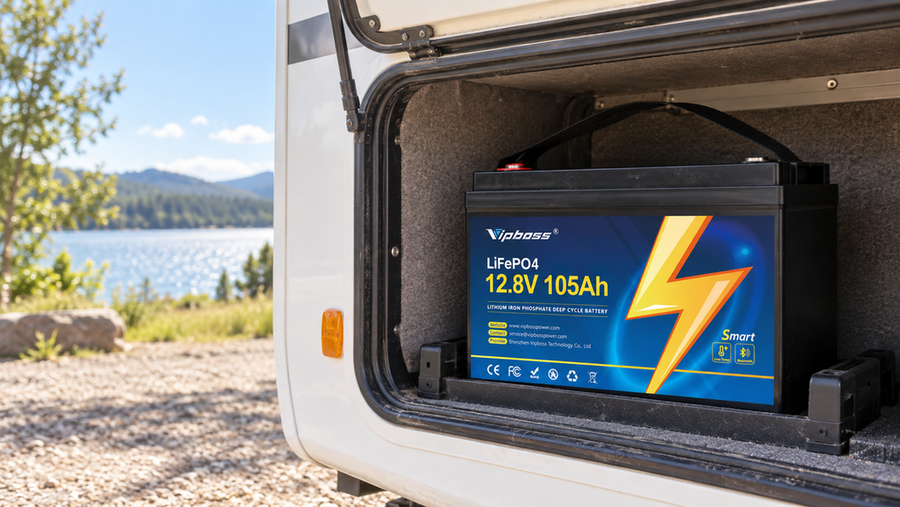

If you use your RV mainly on weekends, LiFePO4 is usually a smarter, more forgiving battery upgrade than AGM, even if you are not cycling it every day. It is designed to sit for long stretches, sip power efficiently, and deliver more usable energy, greater safety, and a much longer lifespan each time you head out.
Picture this: you roll into camp Friday night, drop the stabilizers, and by Sunday your fridge is still cold, lights bright, and battery monitor barely budged. Then the rig sits for weeks in the driveway, plugged in sometimes, ignored most of the time. Many weekend RVers follow this pattern, and forum posts from “weekend warriors” echo the same question: if the existing AGM bank never drops below about 50% and rooftop solar keeps up, why pay for lithium? The answer is that LiFePO4 is engineered for long calendar life, deep usable capacity, low self-discharge, and zero maintenance that line up well with intermittent use. This guide explains why, using real-world examples and manufacturer data so you can decide whether a lithium upgrade makes sense for your rig and budget.
Weekend Warrior Reality Check
A lot of short-trip RVers have setups like the “weekend warrior” described in a popular trailer forum: two to three nights at a time, mostly boondocking, with rooftop solar that keeps the batteries floating around half full. The existing lead-acid or AGM bank never seems stressed, and that makes lithium feel like overkill.
Traditional flooded and AGM lead-acid batteries are cheap and familiar, and in a light-duty pattern they can feel “good enough.” Atlantic Battery Systems points out that these batteries are widely available and come in RV-friendly group sizes that drop into existing trays. Large-Battery notes that AGM improves safety and vibration resistance compared with flooded cells, which is why so many RVs ship with them from the factory.
The problem is that this chemistry is short on cycle life and long-term robustness. Multiple manufacturers, including Redodo and ECO-Worthy, put typical lead-acid lifespan around 300–500 cycles and roughly three to five years of service before capacity noticeably fades, even when you baby them. By contrast, LiFePO4 packs commonly deliver 2,000–5,000 or more cycles, with several RV-focused batteries rated for 10 or more years and, in OKMO’s case, up to about 15,000 cycles for a 12 V 200 Ah pack. You may not cycle your bank every day, but calendar age, heat, sulfation, and sitting partially charged still catch up to AGM long before they seriously threaten a quality LiFePO4 pack.
Why LiFePO4 Loves Intermittent Use
Calendar life, not cycle life, is the real limiter
For a weekend-only rig, the limiting factor is almost never the published cycle count. If you camp 20 weekends a year and drain the bank once each trip, that is about 20 full cycles annually. Even an AGM with 400–600 rated cycles looks fine on paper. But real-world data from ECO-Worthy and other vendors show those AGM batteries still age out in a few years due to partial state-of-charge storage, higher internal corrosion, and less forgiving chemistry.
LiFePO4 changes the math. Articles from Powerurus, WattCycle, and lithium-focused suppliers consistently put LiFePO4 in the thousands-of-cycles range, often 3,000–5,000 or more, with many RV packs designed to deliver a decade or longer of use. That means a weekend warrior might tap only a few hundred cycles over 10 years, leaving plenty of margin before the battery reaches 80% of its original capacity. In practice, you buy once, then stop thinking about house batteries for a very long time, instead of planning on two or three AGM replacement rounds.
Sitting in storage without babysitting
Intermittent use also stresses how a battery behaves when it is ignored. Lead-acid and AGM chemistry self-discharge faster and are more prone to long-term damage when left partially charged. Redodo notes that these batteries need regular charge management to avoid sulfation and capacity loss, which is hard to guarantee when the RV sits behind the house.
LiFePO4 is far more tolerant of sitting. Manufacturers such as WattCycle and POWEREPUBLIC highlight self-discharge of only about 2–3% per month and emphasize that LiFePO4 packs are essentially maintenance-free. Visual Communication Guy’s lithium battery guide recommends storing lithium around 50–70% state of charge in a cool, dry space and simply checking it periodically. For a rig that might sit from Thanksgiving to Easter, losing only a small share of charge per month, with no water levels to check and no corrosion to scrub, fits a weekend pattern much better than a battery that needs constant pampering.

Real Weekend Numbers: LiFePO4 vs AGM
One of the big misconceptions in the weekend crowd is that “I never go below 50%, so I don’t need lithium.” What really matters is usable capacity and how close you run to the edge on bad-weather weekends or with heavier loads.
Powerurus uses a simple benchmark: a 12.8 V, 100 Ah LiFePO4 battery stores about 1,280 Wh and can run a 50 W refrigerator for roughly 24 hours. Lead-acid and AGM, by contrast, are generally limited to about 50% depth of discharge if you want decent life, while LiFePO4 routinely delivers 80–100% depth of discharge without accelerated wear, according to multiple sources, including ECO-Worthy and Redodo. That means the same 100 Ah rating yields very different usable energy.
A weekend-sized comparison looks like this:
Battery type |
Rated capacity |
Typical safe usable share |
Approximate usable energy |
AGM/lead-acid deep cycle |
100 Ah at 12 V |
About 50% |
Roughly 600 Wh |
LiFePO4 |
100 Ah at 12.8 V |
About 80–100% |
Roughly 1,000–1,280 Wh |
Using the Powerurus example, a 100 Ah LiFePO4 pack can keep a 50 W fridge cold for about a day and still have headroom for lights and device charging. A same-size AGM would run out of healthy depth of discharge roughly halfway through that timeline. On a typical two-night boondocking trip with extra fan use, cloudy skies, or friends plugging in more gear than usual, that extra buffer is the difference between a relaxed Sunday morning and firing up a generator or anxiously watching voltage on your phone.

For the forum-style “I’ve never gone below about 50%” user, that safe margin exists because you have never pushed the system hard. Upgrading to LiFePO4 does not just cover your current loads; it gives you room for growth: a bigger 12 V fridge, a CPAP machine, a laptop-heavy remote work weekend, or running a high-efficiency heater longer on a cold night.
Weight, Safety, and Space in a Part-Time Rig
Weekend rigs are often towing near the comfortable limit of the truck or carrying a lot of bikes, kayaks, and toys. Battery weight is not glamorous, but it counts. ECO-Worthy shows that a 100 Ah LiFePO4 pack can weigh around 22–30 lb, while comparable lead-acid or AGM batteries are commonly in the 60–70 lb range. Redodo cites similar numbers for their 12 V 100 Ah mini LiFePO4, which replaces a much heavier lead-acid battery while saving about half the space.
Replacing two 70 lb AGMs with a pair of roughly 25–30 lb LiFePO4 units can drop 70–90 lb off the tongue or rear bumper.

That is not just easier on your back when you swap batteries; it improves handling and gives you that weight back for water, cargo, or another e-bike.
Safety is another quiet advantage, especially when the RV spends most of its life parked next to your house or in a storage lot. LiFePO4 chemistry is inherently more stable than many lithium chemistries and avoids liquid acid and hydrogen off-gassing that traditional lead-acid batteries can produce, as highlighted by ECO-Worthy, WattCycle, and several portable power station makers. Built-in Battery Management Systems in RV-focused packs from companies like Redodo, OKMO, and RELiON monitor temperature, voltage, and current to prevent overcharge, deep discharge, and short circuits. For a battery that lives under a bed or inside a storage cabinet year-round, that stability is worth a lot.
Cost and Upgrade Strategy for Weekend RVers
The lifetime cost picture
The up-front price tag is what stalls many weekend warriors. AGM is clearly cheaper to buy. But when you stretch the timeline out to 10 years, the story changes. Powerurus compares LiFePO4 and lead-acid over a decade and concludes that one LiFePO4 battery can save about $800.00 in replacement costs versus replacing comparable lead-acid batteries several times. Other sources echo that lead-acid typically lasts only three to five years, while LiFePO4 often runs a decade or more before meaningful capacity loss.
For intermittent users, this matters because time, not cycles, is what kills batteries. On a 10-year horizon, you are reasonably likely to purchase AGM house batteries at least twice, maybe three times, while a quality LiFePO4 pack from a reputable maker such as RELiON, Redodo, ECO-Worthy, OKMO, or WattCycle should still be in service with thousands of cycles remaining. When you factor in the extra usable energy, faster charging from limited generator or solar windows, and zero ongoing maintenance, the per-year cost difference often shrinks or disappears.
When AGM still makes sense
There are scenarios where sticking with AGM is rational. If you almost always camp in full-service campgrounds with hookups, rarely boondock, live in a mild climate, and your budget is tight, an AGM replacement can keep you rolling at minimal upfront cost. Atlantic Battery Systems notes that conventional lead-acid is inexpensive and widely supported by existing converters and chargers, which simplifies ownership for casual users.
The key is to be honest about how often you really camp away from hookups, how much you hate generator noise, and whether you see your rig evolving toward more off-grid capability. If your answer is “never” on all three, AGM is still a respectable choice.
A smart, minimal LiFePO4 upgrade path
For many weekend RVers, the best path is a focused, right-sized LiFePO4 upgrade rather than an oversized, expensive system. Manufacturer guidance from Golden Cell, Powerurus, and RELiON suggests starting by calculating daily energy use in watt-hours across your core loads, then choosing a pack sized to that number with some buffer. In practice, a 12 V, 100–200 Ah LiFePO4 battery is enough for a typical weekend rig with an efficient fridge, LED lighting, water pump, and electronics charging.
You do not have to rebuild everything at once, but you do need to verify system compatibility. Atlantic Battery Systems and Herewin’s compatibility guide stress that your existing converter or charger and solar charge controller must support a LiFePO4 profile, generally with higher bulk and absorption voltage and appropriate current limits. Many modern RV chargers are adjustable or have a lithium setting; older units may need replacement. If your weekend style already includes rooftop solar, pairing LiFePO4 with a lithium-capable MPPT controller unlocks much faster, more complete charging between drives and during short sunny windows.
Storage strategy is simple: charge your lithium bank to around 50–70%, park the RV in a cool, shaded spot, and check it a few times a year. Visual Communication Guy and RELiON both recommend this partial-charge storage approach to maximize lifespan. Compared with trickle-charging an AGM all winter and worrying about sulfation or drying cells, this is a huge reduction in mental overhead.
Quick FAQ for Weekend RVers Considering LiFePO4
Will LiFePO4 be “wasted” if I only camp a few weekends a year?
No. High cycle life means LiFePO4 is overbuilt for your use rather than underused. With thousands of cycles available and a typical 10-year or longer service life, weekend use barely scratches the surface. What you notice most is the stronger voltage, deeper usable capacity on the few trips you do take, and the fact that you stop buying and babysitting new batteries every few seasons.
Do I need a huge bank if I only stay two or three nights?
Probably not. Examples from Powerurus, RELiON, and other RV battery specialists show that a single 100–200 Ah LiFePO4 pack is often enough for weekend boondocking with efficient appliances. Because you can safely use 80–100% of that rated capacity and recharge three to five times faster than with lead-acid, you often get the same or better runtime from a smaller, lighter bank than your current AGM setup, especially when paired with rooftop or portable solar.
Is LiFePO4 safe inside the RV if it sits for months?
Yes, when you choose a reputable, RV-rated pack with an integrated Battery Management System and follow basic installation guidance. ECO-Worthy, WattCycle, Duromax, and several RV-focused manufacturers emphasize the strong thermal stability, non-toxic materials, and lack of off-gassing in LiFePO4 chemistry. That is why more RV builders and van upfitters are moving batteries inside the living space: it is safer, cleaner, and better for cold-weather performance than leaving heavy lead-acid batteries exposed to the elements.
A weekend RV lifestyle is all about maximum freedom in a limited window, and your power system should match that mindset. LiFePO4 batteries deliver deep, reliable capacity on the weekends you use the rig and fade quietly into the background for all the weeks you do not, without the weight, maintenance, and short lifespan penalties of AGM. If you plan to keep your RV for years and value quiet, dependable off-grid power whenever you finally get out of town, upgrading to a right-sized LiFePO4 bank is one of the most effective power upgrades you can make.
References
- https://www.microair.net/blogs/news/10-easy-ways-to-make-your-rv-more-energy-efficient
- https://atlanticbatterysystems.com/the-ultimate-guide-to-rv-batteries-powering-your-adventure/
- https://www.goldencellpower.com/maximizing-efficiency-with-lifepo4-lithium-batteries-in-rvs/
- https://planarheaters.com/why-use-lithium-batteries-power-camping-equipment/?srsltid=AfmBOop3KJDM5O32buXNn5y8lA5k-fRTTtVzmENHDfndw0rzg8jrPaMH
- https://www.relionbattery.com/blog/how-to-optimize-lithium-battery-storage-in-your-van-or-rv?srsltid=AfmBOoq7LSg-1hBGLIEiNxu-imVQZGf6NIeQOTNyGmsEaGzpfIbo-3qM
- https://www.ritarpower.com/industry_information/Application-of-LiFePO4-Batteries-in-RVs-Powering-the-Mobile-Lifestyle_620.html
- https://www.anernstore.com/blogs/diy-solar-guides/round-trip-efficiency-lifepo4-battery
- https://www.duromaxpower.com/blogs/news/the-benefits-of-lifepo4-batteries-in-portable-power-stations?srsltid=AfmBOooJ7D5rU1ag75xKQClrPH9yVwz9p5ZW0HlWc_lV1zdi3zmWvEi_
- https://uk.eco-worthy.com/blogs/lithium-battery/lithium-batteries-for-rvs-safety-benefits-lifepo4?srsltid=AfmBOorBubUhxvyHdFhjVyAYYyOfShXyiQBK4knHiiIPMFxIuuNQDirj
- https://www.forestriverforums.com/threads/thinking-of-going-to-a-lith-batt.354942/