
“Grid-forming” sounds like a specification for the utility grid, but its homeowner meaning is more concrete: the inverter can create and regulate the local AC voltage and frequency that appliances and other inverters need when the utility signal disappears.
That can be the difference between a battery that stops with the grid and a battery system that can operate an electrically isolated home during an outage. It does not, by itself, tell you how long the battery will run, how many appliances it can start, or whether the whole house is backed up.
The short definition
A grid-forming battery inverter acts as a voltage source for a local electrical network. It establishes the reference—the target voltage waveform and frequency—and adjusts its output as loads and other sources change.
A grid-following inverter takes the opposite role. It synchronizes to an existing voltage and frequency, then injects power into that reference. This is a normal and useful behavior while the utility grid is present, but it is a problem when there is no reference to follow. The U.S. Department of Energy’s explanation of grid-forming inverters describes this distinction in the context of restarting power systems.
In a home battery installation, “forming” therefore describes the inverter’s control role, not the battery chemistry or energy capacity.
What changes during a blackout

A correctly designed backup system generally has to perform these jobs in sequence:
- Detect the utility outage.
- Disconnect the home from the utility. This prevents the home system from energizing utility lines while line workers may assume they are de-energized. This protective behavior is commonly called anti-islanding.
- Establish a local AC reference. The grid-forming inverter supplies the voltage and frequency for the backed-up circuits.
- Supply loads within its limits. The battery provides stored DC energy, which the inverter converts to AC power.
- Coordinate other sources if supported. Solar equipment may be able to synchronize to the newly formed local network, but that depends on the specific inverter, controls, wiring, and operating limits.
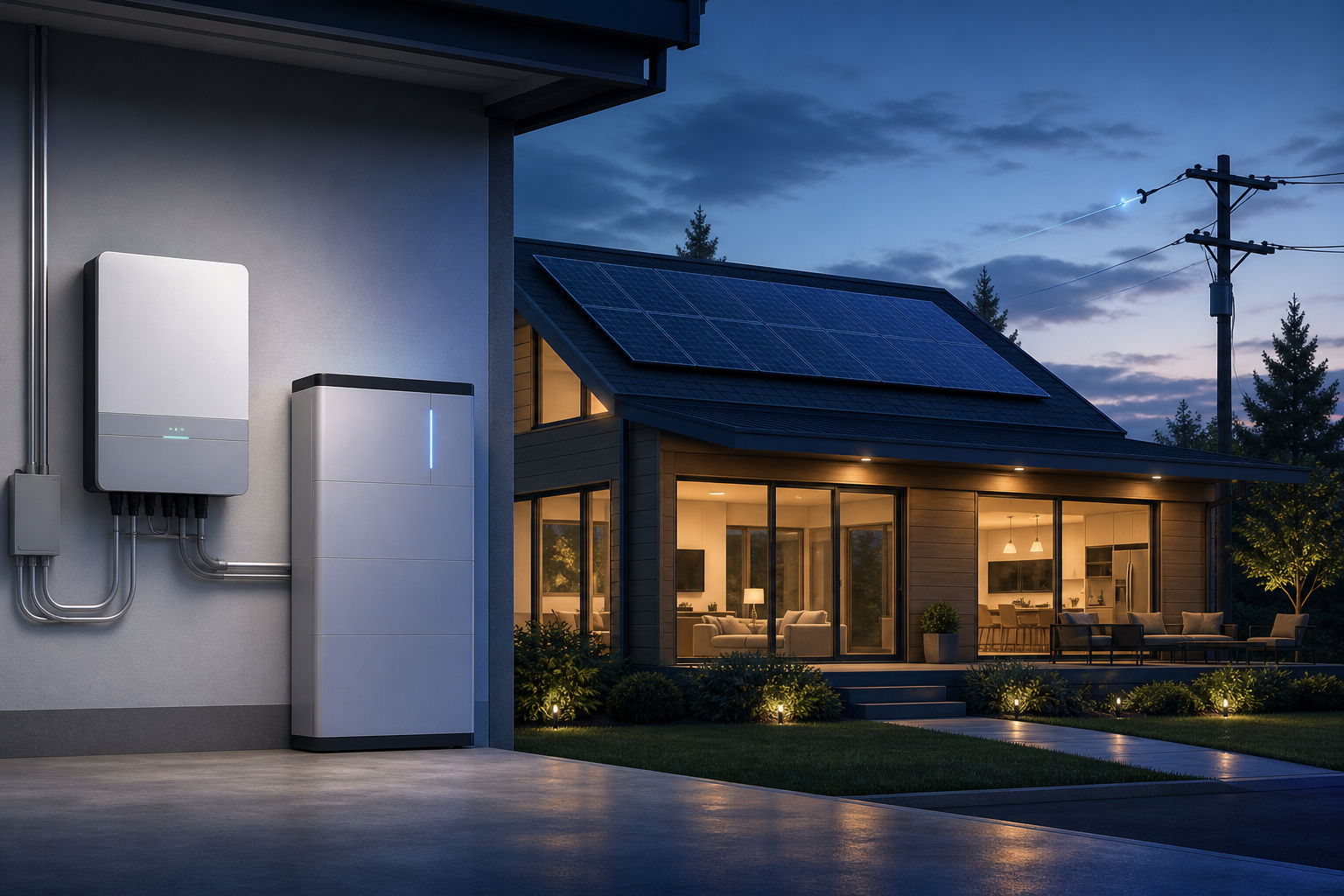
The result is an islanded local network: it is separated from the utility but still has a controlled electrical reference. A practical overview of the equipment involved in safe solar islanding includes the inverter, battery, transfer or backup interface, protected circuits, communications, and code-compliant grounding and bonding.
Grid-forming is not the same as “whole-home backup”
These terms answer different questions:
| Term | Question it answers |
|---|---|
| Grid-forming | Can the inverter establish and regulate the local AC reference without the utility? |
| Backup | Can the system supply power when the utility fails? |
| Whole-home backup | Are all—or nearly all—home circuits connected and supported? |
| Battery capacity | How much energy is stored, usually expressed in kilowatt-hours? |
| Inverter power | How much power can be delivered at once, usually expressed in kilowatts? |
A system can be grid-forming yet back up only a critical-loads panel. That may be intentional: refrigeration, lighting, communications, and selected outlets can be easier to support than every electric heater, range, pump, and vehicle charger at once.
The inverter’s continuous output, short-duration surge capability, battery discharge limits, wiring, protective devices, and load-management controls all matter. A large battery does not compensate for an inverter that cannot deliver the required instantaneous power. Conversely, a powerful inverter cannot keep loads running after the battery is depleted.
Why the phrase matters for solar-plus-battery systems
A conventional grid-tied solar inverter normally shuts down when it detects a utility outage. That is a safety feature, not necessarily a fault: without the utility reference, it must not continue energizing the grid.
A grid-forming battery inverter can provide a local reference after isolation. If the solar inverter is compatible with that local network and the system is designed for it, solar may continue serving loads or charging the battery during an outage. Some systems instead curtail solar when the battery is full or when loads are low. Do not assume that the words “grid-forming” guarantee solar operation in every outage; check the complete system documentation.
What grid-forming does not promise
It does not guarantee uninterrupted power
“Grid-forming” says what the inverter can do electrically. It does not establish the transfer time between grid-connected and backup operation. If sensitive equipment must remain on, verify the system’s documented transfer behavior and consider appropriate power protection.
It does not guarantee motor starting
A well pump, refrigerator compressor, heat pump, or workshop tool can demand a high starting current. The inverter may have a surge rating, but the actual result depends on the appliance, duration, battery state, temperature, and system configuration. Ask for a load assessment rather than relying on the label alone.
It does not mean unlimited off-grid operation
Grid-forming controls cannot create energy. Runtime depends on stored energy, present load, conversion losses, reserve settings, and any solar or generator input. Heavy loads can shorten runtime quickly.
It does not make installation a DIY wiring change
Safe islanded operation requires the home to be isolated from the utility and requires compatible equipment, correct protection, grounding and bonding, communications, permits, and local-code compliance. The transfer equipment and the inverter’s approved operating modes are part of the design—not optional accessories.
How to evaluate a home battery inverter claim

Ask the installer or manufacturer these specific questions:
- What exact operating mode forms the island? Is it available during an outage, or only as a grid-connected control feature?
- What equipment performs the utility disconnect? Confirm the backup gateway, transfer switch, or equivalent interface and its approved configuration.
- Which circuits are backed up? Request a one-line diagram showing the protected panel and any load-shedding devices.
- What are the continuous and surge power limits? Compare them with the running and starting demands of pumps, compressors, heating equipment, and chargers.
- Can solar operate while the grid is down? If yes, ask how excess solar is managed and what happens when the battery reaches its limit.
- What happens at low battery state of charge? The system may shed loads, stop supplying the island, or reserve energy for restart; the manual should say which.
- What is the documented transfer behavior? Do not substitute a general “backup” claim for a specification relevant to sensitive loads.
- Is the complete combination approved? Battery, inverter, backup interface, solar inverter, and communications should be treated as one system.
The most useful evidence is the exact model’s installation manual and backup specification, not a generic webpage describing a product family or the word “grid-forming” in isolation.
The bottom line
For a home battery inverter, grid-forming means the inverter can establish the local electrical reference after the home is safely separated from the utility. That capability is what makes an islanded backup network possible.
It is an important building block, but it is only one part of blackout performance. To know what a system will actually do, check the isolation hardware, backed-up circuits, inverter power and surge limits, battery energy, solar compatibility, transfer behavior, and local installation requirements together.