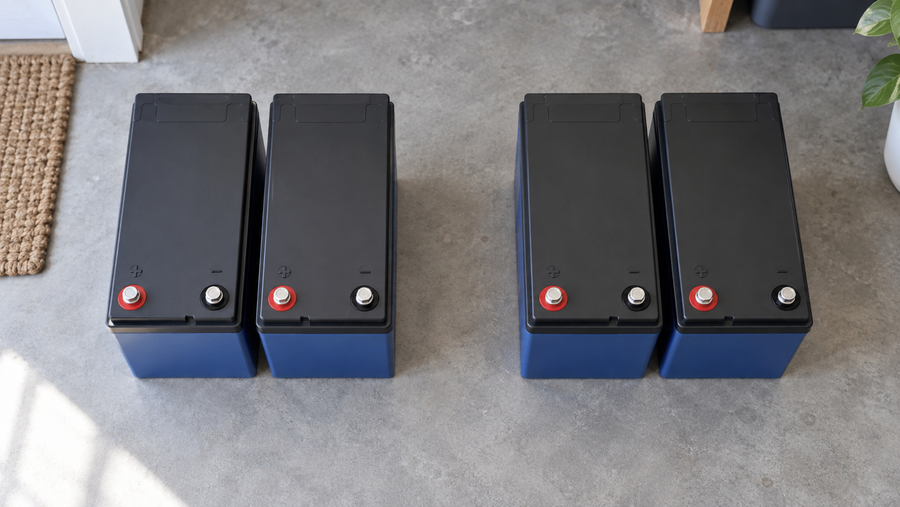

Many home solar and backup systems waste energy because the inverter and battery are poorly matched, not because the panels or batteries are inherently bad.
When the inverter and battery are in sync on power, voltage, and control, you get longer backup, cooler-running equipment, and far fewer surprises when the grid drops. Picture this: the lights dip when the air conditioner starts, the “big” battery bank is flat before midnight, and your monitoring app never shows the system hitting the numbers you were promised. Installers and manufacturers who troubleshoot problem jobs every week see the same pattern repeat: the inverter and battery were bought as separate boxes, not as one coordinated system. This guide shows how to tell whether that is happening in your home and how to fix it so your storage actually delivers the performance you paid for.
What “Matching” Really Means Between Inverter and Battery
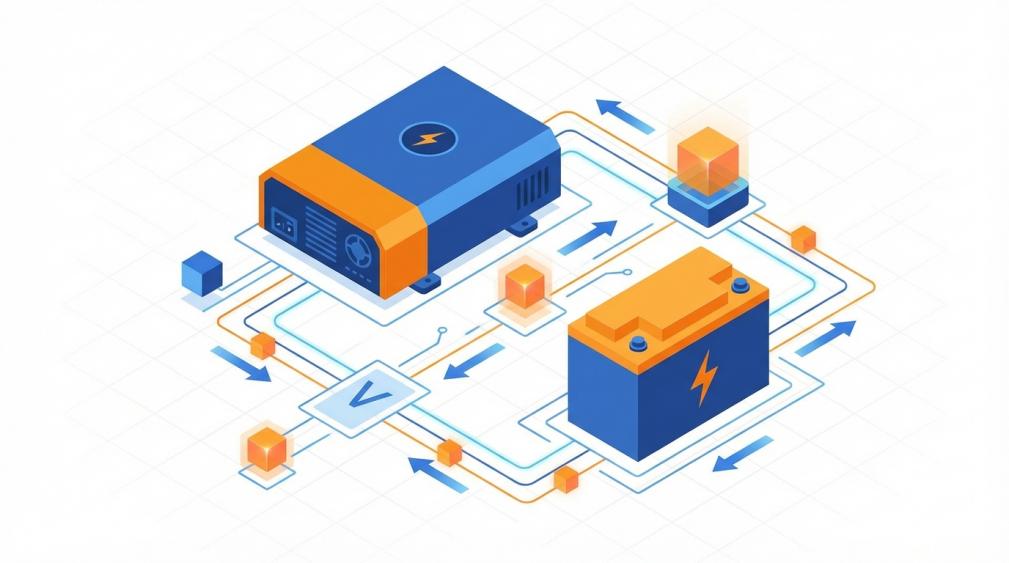
At the simplest level, the battery is your fuel tank and the inverter is the engine that turns stored energy into usable household power. A battery storage system holds direct current from solar or the grid, and the inverter converts it to alternating current for your home loads while controlling when and how the battery charges and discharges, as noted in guidance from Innotinum and Sigenergy. If any part of that chain is mismatched, you burn through energy faster than you should or leave expensive capacity idle.
There are three dimensions to getting this match right. The first is power versus capacity. Inverters are rated in kilowatts, which tell you how much power they can deliver at a moment, while batteries are rated in kilowatt-hours, which tell you how long they can sustain that power. Growatt’s residential storage guidance gives a practical rule of thumb: a 5 kilowatt hybrid inverter usually pairs well with about 5 to 10 kilowatt-hours of storage, and a home using roughly 20 kilowatt-hours per day often needs a battery of around 5 to 7 kilowatt-hours for several hours of backup. If you hang a tiny battery on a strong inverter, the system can technically hit its power rating, but only for a very short time before the battery is drained. If the battery is oversized relative to the inverter, a large chunk of storage may never be used at higher loads and takes a long time to recharge.
The second dimension is electrical compatibility. The battery’s nominal voltage, charge and discharge limits, and safety ratings must line up with what the inverter is designed to handle. Innotinum emphasizes that a 48 volt inverter needs a 48 volt battery setup; too low and the inverter may not even start, too high and you risk overvoltage trips or damage. The inverter’s charge and discharge current must also stay inside the battery’s C-rate limits or the battery management system will throttle or shut down to protect itself, wasting your inverter’s potential and making the whole system feel sluggish and inefficient.
The third dimension is communication and control. Modern lithium batteries and hybrid inverters talk to each other over protocols such as CAN or RS485 so the inverter knows the true state of charge, health, and safe operating window of the battery. Innotinum and Sigenergy both warn that if these devices cannot communicate properly, you see nuisance shutdowns, incorrect state-of-charge readings, and conservative charge profiles that leave capacity unused. Smart controls go even further: brands like Growatt, Enphase, and Sigenergy now use apps and AI scheduling to stack charging during low-tariff periods and discharging during high-tariff periods, which only works well when the battery and inverter are designed as a team.

How Mismatch Turns Into Low Efficiency
Energy efficiency in a home storage system is not just about a “high efficiency” label on the inverter box. It is the product of every stage from panel to battery to inverter to load. Enphase and SolarReviews point out that round-trip battery efficiency and inverter conversion efficiency together dictate how much of the energy you store you can actually use. Solar.com notes that many AC-coupled battery systems end up around 85 to 90 percent round-trip because the power is converted from DC to AC and back again, while well-designed DC-coupled systems can push toward the high 90s. If your inverter and battery are poorly matched, you add extra conversion steps, force components to run outside their sweet spot, and multiply those losses.
Consider a common scenario built around the Growatt and Innotinum guidance. A homeowner installs a 5 kilowatt hybrid inverter with a 5 kilowatt-hour battery because it was marketed as a neat “kit.” On paper it looks balanced, but the actual evening load is closer to 4 kilowatts when the air conditioner, oven, and a few other appliances run together. In that case, even if the battery and inverter each run at about 95 percent efficiency, the homeowner only gets roughly 4.5 kilowatt-hours of usable energy from that battery cycle, which means a bit more than an hour of heavy use before the system drops back to the grid. The result is a system that technically works but feels weak, and it may cycle the battery deeper and more often than needed, which hurts lifespan.
The opposite problem shows up when the battery is too large for the inverter’s power rating. Innotinum recommends on the order of 6.6 kilowatt-hours or more for a 3.6 kilowatt inverter and around 13.2 kilowatt-hours or more for a 5 to 6 kilowatt unit. If you pair a much larger battery with a small inverter, the inverter cannot pull energy out quickly enough to support demanding loads, so heavy appliances are still blocked even though a lot of stored energy is sitting in the cabinet. Charging a very large battery through a small inverter or charger also takes longer, so the system may spend more time idling or hovering near partial state of charge, where some chemistries are less efficient and less healthy over the long term.
There is a topology angle as well. AMECO and Solar.com explain that DC-coupled systems store panel output directly in the battery and invert it once for the house, while AC-coupled systems often convert panel output to AC, then back to DC for the battery, then to AC again for loads. If you take a battery designed to work most efficiently in a DC-coupled hybrid setup and instead bolt it onto an AC-only inverter through an extra inverter stage, each extra conversion can shave a few percent off your usable energy. Over thousands of cycles, those small percentages turn into very real losses and shorter effective backup time.

Quick Reality Check: Is Your Inverter–Battery Pairing Right?
It is worth doing a fast audit of your system with the data you already have. Start by checking the nameplate on your inverter or its datasheet. Note the continuous power rating in kilowatts and the supported battery voltage range. Then look at your battery label or app for total usable capacity in kilowatt-hours, nominal voltage, and supported chemistries.
If your inverter is rated around 5 kilowatts and your battery is only about 4 or 5 kilowatt-hours, you have a short-range sprinter. Growatt’s example of a 20 kilowatt-hour-per-day home using 5 to 7 kilowatt-hours of storage for several hours of backup is already a modest design. If you are seeing your battery go from full to empty in about an hour whenever you use normal evening loads, that ratio is likely too tight. In practical terms, many hybrid systems feel much more solid when the battery capacity in kilowatt-hours is at least equal to the inverter rating in kilowatts and often closer to double if you want two to four hours of robust backup, especially with motor loads.
Next, think about the kinds of loads you are asking the system to handle. Leaptrend’s inverter guidance and Tripplite’s buying guide both stress that motor-driven appliances such as refrigerators, air conditioners, pumps, and power tools draw two to three times their running power for a few seconds at startup. Solar-electric specialists explain that high-frequency inverters with limited surge capability may only tolerate 25 to 50 percent overload briefly, while heavier transformer-based units can sometimes deliver surges up to about three times their continuous rating for short periods. If your battery is small, your inverter has modest surge capability, and you are trying to start an air conditioner alongside other loads, you can see dimming lights, chattering relays, or outright inverter trips even though average energy consumption looks fine on paper.
Finally, look at behavior over a typical week in your monitoring app. If the battery often stops charging at a lower-than-advertised state of charge, or the inverter refuses to discharge below a very conservative threshold, your battery and inverter may not be sharing accurate information about state of charge and allowable depth of discharge. Innotinum and Growatt both emphasize that correctly configured communication between inverter and battery allows lithium iron phosphate batteries to use a depth of discharge around 90 percent or more while maintaining safety. Without that integration, systems often default to shallow cycling, which protects the battery but wastes a large slice of capacity and makes your storage feel underpowered.

Picking Batteries and Inverters That Actually Work Together
Once you know whether your current pairing is mismatched, the next step is choosing the right combination for upgrades or new projects. Across sources like Enphase, Solar.com, Nature’s Generator, SolarReviews, and AMECO, there is strong agreement on one point: for most modern homes, lithium-ion batteries, and especially lithium iron phosphate designs, have become the standard. These batteries offer high usable depth of discharge, compact size, fast charging, and long cycle life. Enphase notes that modern lithium systems commonly reach 80 to 98 percent usable depth of discharge and last on the order of 5 to 20 years depending on chemistry and quality. Solar.com further points out that lithium iron phosphate batteries can reach very high cycle counts with near full usable capacity and have very low fire risk compared with older chemistries.
Lead-acid deep-cycle batteries still have a place in budget-constrained or small systems, but both AMECO and SolarReviews highlight their limitations: lower depth of discharge, bulkier form factor, and shorter lifespans of only a few years in many residential applications. That means the apparent savings at purchase can disappear once you factor in replacements and maintenance over a decade or more. For a serious whole-home or off-grid setup, the efficiency and durability of lithium iron phosphate paired with an inverter designed to work with that chemistry is usually the better value.
Hybrid or battery-ready inverters deserve special attention. Liniotech and Sigenergy describe hybrid inverters as the “brain” of the system, handling solar, grid, and battery in one unit. Good hybrids are not only efficient, often in the mid to high 90s, but also explicitly support lithium iron phosphate batteries at common system voltages such as 48 volts. They expose compatible communication options, support modular battery expansion, and are certified to safety standards such as UL 1973 and UL 9540 for the U.S. market. Choosing such an inverter means you are not locked into a single proprietary battery brand, while still enjoying tightly integrated control.
For many readers, the most practical comparison is simply how different combinations behave in day-to-day use. The table below summarizes key contrasts that repeatedly show up across manufacturer and installer guidance for home systems.
Aspect |
Lead-acid deep-cycle bank with generic inverter |
Lithium iron phosphate battery with matched hybrid inverter |
Usable capacity and runtime |
Often limited to about half nameplate capacity to protect lifespan; shorter backup windows and more frequent deep discharges |
Commonly usable to around 90 percent of capacity when properly integrated, giving longer, more consistent backup |
Round-trip efficiency |
Moderate efficiency with more losses in charging and discharging; frequent replacements reduce lifetime performance |
High battery and inverter efficiency together, especially in DC-coupled setups, translate into more usable energy per cycle |
Maintenance and reliability |
Regular checks, water topping, corrosion cleaning, and higher sensitivity to temperature and depth of discharge |
Minimal routine maintenance; integrated monitoring apps, smart scheduling, and protective firmware optimize operation automatically |
This comparison is not about brand loyalty. It reflects a broad industry shift: most modern high-performing residential systems, whether they come from Nature’s Generator, Enphase, Sigenergy, or other suppliers, are built around lithium iron phosphate storage and hybrid inverters that are explicitly designed to work together.
Designing for Whole-Home Backup Without Wasting Power
If your goal is true whole-home backup rather than just keeping a few lights on, matching inverter and battery becomes even more critical. EcoFlow’s whole-home compatibility guidance highlights that U.S. homes with split-phase service need an inverter that can supply both 120 volt and 240 volt loads so that central air conditioners, well pumps, and other large appliances can run. That immediately raises the bar for inverter power rating and surge capability, and it raises the stakes for getting battery sizing right.
In practical terms, you start by looking at your highest combined load during realistic peak moments, not just the average. Liniotech advises reviewing a full year of utility bills to understand peak usage and patterns instead of sizing from a single low month. Tripplite’s buying guide suggests adding up the wattage of all devices that might run at the same time and then adding headroom for surges and future expansion. Once you have that target, you can align it with battery capacity so that, for example, a 10 kilowatt split-phase inverter designed to start a central air conditioner has at least around 20 kilowatt-hours of storage if you want several hours of robust backup for the whole home.
Commissioning matters as much as sizing. EcoFlow recommends a simple but revealing test: start the air conditioner, microwave, and laundry cycle together to mimic a real-world peak event. If lights dim or breakers chatter during this test, there are three likely remedies that all tie back to matching: increase surge headroom with a stronger inverter or parallel units, rebalance loads between phases, or adjust start delays so the inverter and battery are not hit all at once.
A Practical Upgrade Path for an Existing System
Many homeowners are not starting from scratch; they are trying to rescue an underperforming system. The most effective path usually begins with a clear picture of what you have, followed by targeted changes rather than a full rip-and-replace.
Begin by documenting the essentials: inverter model and power rating, battery model, chemistry, and usable capacity, and whether the system is AC- or DC-coupled. Use your monitoring data to estimate how much energy you actually use from the battery on a typical evening and how long it lasts. Compare that to the guidelines from Growatt and Innotinum. If you discover a 5 kilowatt inverter feeding from only a 4 kilowatt-hour battery, or a small inverter buried under a massive battery bank that takes all day to charge, you have found a likely root cause of low efficiency.
Next, decide whether the bottleneck is more on the inverter side or the battery side. If your inverter is non-hybrid, offers only basic modified sine wave output, or lacks communication with the battery, upgrading to a modern pure sine wave hybrid inverter can unlock better efficiency and battery control. Livfast and Sigenergy both emphasize that high-quality inverters bring faster, smarter charging, built-in protections against overcharge and deep discharge, and app-based monitoring that helps you spot problems early. If your inverter is solid but the battery is obviously undersized, adding additional modules from the same battery family to reach a better ratio between kilowatts and kilowatt-hours is often the cleaner move.
Throughout this process, safe installation is non-negotiable. Livfast’s safety guidance stresses that improper mounting, poor ventilation, undersized wiring, and missing grounding can all cause overheating, voltage drops, and even fire risk. A professional installer familiar with hybrid systems will not only size and connect equipment correctly but will also update firmware, configure communication parameters, and set appropriate charge and discharge limits so the inverter and battery work together rather than against each other.
FAQ
Can I just add a bigger battery to my existing inverter to get more backup time?
You can often add battery capacity, especially if your inverter already supports modular expansion, but there are limits and trade-offs. Innotinum and Growatt both recommend matching inverter power and battery capacity within reasonable ranges so that the inverter can charge and discharge efficiently. If you bolt a very large battery bank onto a small inverter, you may gain some extra runtime at low loads, but high-demand appliances still will not run, and charging that larger bank through a small inverter or charger can take so long that you never fully replenish it between outages. Before adding batteries, confirm that your inverter supports the chemistry, voltage, and communication protocol of the new modules and that the manufacturer explicitly approves the combination.
What is more important for efficiency: upgrading the inverter or the battery?
Both matter, but in many underperforming systems, upgrading the inverter uncovers the biggest efficiency gains. Liniotech and Sigenergy highlight that high-efficiency hybrid inverters not only waste less energy in conversion but also manage when and how batteries charge and discharge, which directly affects round-trip efficiency and battery life. At the same time, AMECO, Solar.com, and SolarReviews show that moving from older lead-acid banks to modern lithium iron phosphate storage can dramatically increase usable capacity and reduce losses, especially when paired with a suitable hybrid inverter. In practice, the best path is to identify your current bottleneck and plan toward a matched pair: an efficient inverter that is explicitly designed to work with the battery chemistry and capacity you need.
How do I know if my system is AC- or DC-coupled and why does it matter?
If your battery has its own separate inverter box and connects into your home wiring much like an appliance, you are likely looking at an AC-coupled system. If the same inverter manages both solar panels and batteries directly on the DC side, it is probably a hybrid, DC-coupled design. AMECO and Solar.com note that AC-coupled systems are easier to retrofit but typically lose more energy in multiple conversion steps, often ending up around the mid 80s to about 90 percent round-trip efficiency. DC-coupled systems require more planning and compatible hardware up front but can reach much higher overall efficiency. Knowing which architecture you have helps you understand where losses are happening and what kind of upgrade—battery, inverter, or full hybrid swap—will deliver the biggest efficiency jump.
When the inverter, battery, and real-world loads are finally lined up, your system stops limping and starts behaving like a true power upgrade: longer, steadier backup, better use of every kilowatt-hour you store, and a home that stays comfortable and lit when the grid does not.
References
- https://www.svcenergy.com/how-to-choose-inverter-and-battery-combination-for-home.html
- https://www.aforenergy.com/choosing-the-right-home-inverter-the-ultimate-guide/
- https://www.amecosolar.com/blog/understanding-solar-batteries-why-are-they-important-for-solar-users
- https://tripplite.eaton.com/products/inverter-buying-guide
- https://innotinum.com/blogs/precautions-when-pairing-battery-energy-storage-systems-with-inverters
- https://www.solarreviews.com/blog/types-of-solar-batteries
- https://diysolarforum.com/threads/inverter-recommendation-for-home-battery-backup.100475/
- https://www.ecoflow.com/us/blog/inverter-battery-for-home-whole-home-compatibility
- https://en.growatt.com/media/news/how-to-size-and-pair-a-battery-with-your-inverter-in-2025
- https://leaptrend.com/blogs/news/what-should-you-not-plug-into-an-inverter