
The short answer: start with energy use, not floor area
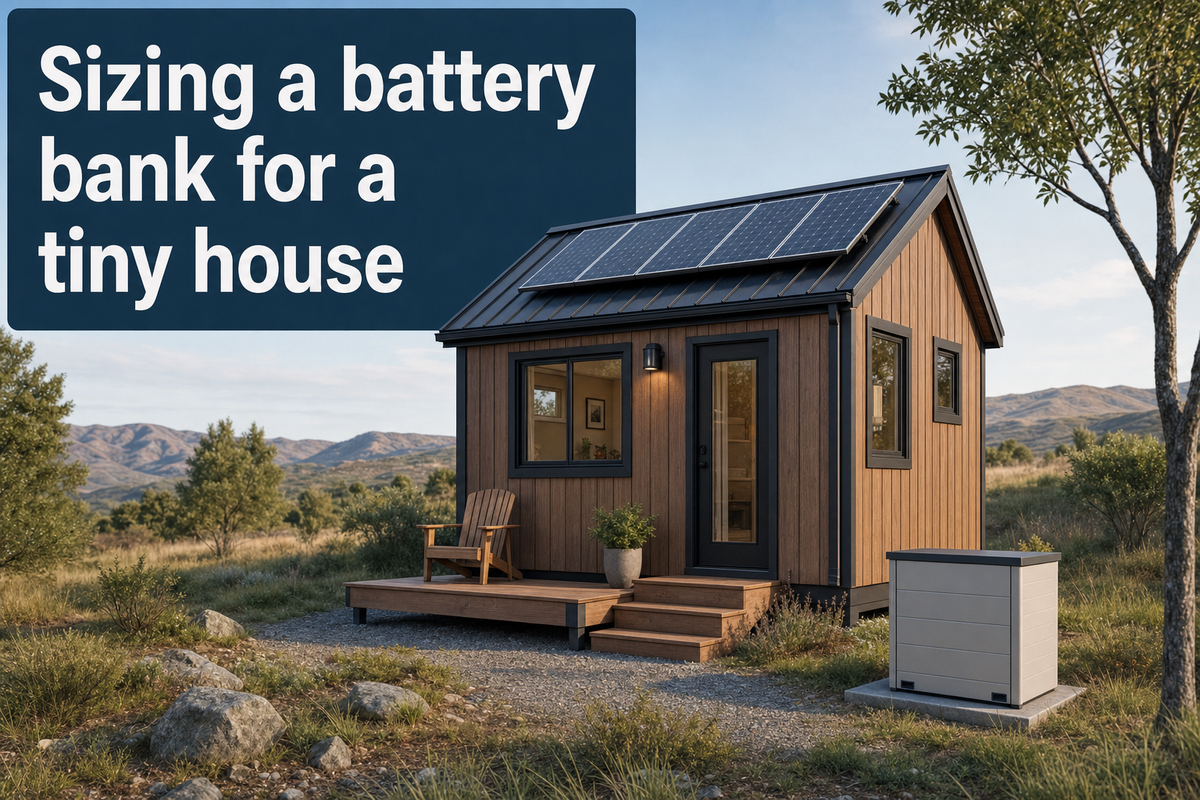
A 400-square-foot tiny house does not have one correct battery-bank size. Two homes with the same footprint can differ dramatically: an efficient home with a propane refrigerator and no electric heating may use a few kilowatt-hours per day, while one with electric water heating, cooking, heating, or air conditioning can use several times more.
For an off-grid design, estimate the bank in this order:
- Add up daily electricity use in watt-hours (Wh).
- Choose how many days of autonomy you need.
- Correct for battery depth of discharge (DoD) and system losses.
- Convert the result to amp-hours (Ah) at your system voltage.
- Check power, charging, temperature, aging, and expansion—not just energy.
A useful planning formula is:
Nominal battery energy (Wh) = daily load (Wh) × autonomy days ÷ (usable DoD × system efficiency)
The number is a design estimate, not a substitute for matching the battery, inverter, charger, protection, and wiring to one another and to local requirements.
Build a realistic daily-load estimate

Make a list of every electrical load. For each item, record its running watts and expected hours per day:
Daily energy (Wh) = watts × hours per day
For cycling appliances, use measured consumption where possible rather than multiplying the nameplate maximum by 24 hours. A plug-in energy meter can help with AC appliances; DC loads should be measured or estimated from their actual duty cycle.
Here is an illustrative, not universal, load schedule for a modest 400-square-foot house:
| Load | Assumed daily energy |
|---|---|
| LED lighting | 240 Wh |
| Refrigerator | 1,000 Wh |
| Laptop, router, and device charging | 500 Wh |
| Water pump | 300 Wh |
| Efficient cooking and small appliances | 700 Wh |
| Ventilation and controls | 260 Wh |
| Total | 3,000 Wh (3 kWh) |
The assumptions matter more than the square-foot number. If electric resistance heat, an electric water heater, a clothes dryer, or air conditioning is on the system, model it separately; those loads can dominate the result. Also include inverter standby draw and other always-on devices if they are not already included in your measurements.
For a new system, measure a comparable home over representative days if you can. Size from high-use and cold-weather periods rather than a low-use weekend.
Work a 400-square-foot example
Suppose the load estimate is 3 kWh per day and you want two days of autonomy. Assume, for planning, an 80% usable DoD and 90% overall battery-to-load efficiency:
3 kWh × 2 ÷ (0.80 × 0.90) = 8.33 kWh nominal battery capacity
That means an approximately 8.3-kWh nameplate bank is the calculated starting point for this specific example. It is not “the battery size for a 400-square-foot house.” If the same house uses 5 kWh per day, the result becomes 13.9 kWh under the same assumptions. If you need one day rather than two, it becomes half as large.
A design may add further margin for aging, unusually cloudy weather, cold temperatures, or loads that were underestimated. Do not hide that margin inside a precise-looking answer: state the assumption and then round up to the next compatible battery configuration.
Convert kilowatt-hours to amp-hours
Battery banks are often sold by voltage and amp-hours, while household energy use is discussed in kWh. Convert with:
Amp-hours = nominal battery Wh ÷ nominal system volts
For the 8.33-kWh example:
- At 12 V: about 694 Ah
- At 24 V: about 347 Ah
- At 48 V: about 174 Ah
These are equivalent energy figures, not interchangeable installation instructions. A higher-voltage architecture carries the same power at lower current, but the choice depends on inverter voltage, battery modules, DC loads, cable runs, fault protection, and applicable electrical requirements. A qualified designer should verify the complete DC system.
Choose autonomy deliberately
“Two days of backup” means the bank can support the modeled loads for two days without useful solar charging, after the DoD and efficiency limits are applied. It does not guarantee comfort if you add a large unmodeled load.
Choose the target by asking:
- Can a generator or grid connection provide backup during extended bad weather?
- What is the local winter solar pattern?
- Are refrigeration, communications, water, medical equipment, or heating essential?
- Can nonessential loads be switched off when the battery is low?
- Is the higher cost and weight of extra storage justified by the reliability gained?
One day may suit a system with dependable backup and flexible loads. Two or more days may make sense where backup is difficult or critical loads must continue. The best answer is a stated autonomy target, not a generic “tiny-house” recommendation.
Do not confuse capacity with power

Battery energy answers “how long?” It does not answer “can the system start and run everything at once?”
List simultaneous loads and check:
- continuous inverter output for the running watts;
- surge capability for motor or compressor starts;
- battery continuous and peak discharge-current limits;
- the voltage drop and current rating of the DC conductors and protection;
- whether the battery-management system can support the requested current.
A small bank can have enough kWh for a day but still trip an inverter when a pump and refrigerator start together. Conversely, a large bank does not make an undersized inverter safe.
Check whether solar can refill the bank
Battery sizing and solar-array sizing are linked. A bank that can cover two cloudy days still needs enough charging power to replace the energy used and serve the house on normal days. Compare the array’s location-specific production with daily load, conversion losses, seasonal conditions, and charge-controller limits.
If the array regularly cannot refill the bank after ordinary use, adding batteries alone may create more empty storage rather than more resilience. A generator, load management, a larger array, or a different operating plan may be the better fix.
Account for chemistry, temperature, and aging
Use the battery manufacturer’s permitted DoD, charging-temperature limits, current limits, and installation instructions—not a generic chemistry rule. DoD affects service life, and temperature affects available capacity. For a model-specific example, the Victron Lithium Smart manual explains that its nominal capacity rating is based on 25°C and that capacity is reduced at lower temperatures; its cycle-life information also varies with DoD. Treat the battery datasheet and manual as the controlling source for the selected model.
Plan for capacity fade over the system’s life. If the bank must deliver a specified amount of energy years from now, the initial design may need additional capacity or a defined replacement threshold. Keep batteries within the manufacturer’s operating range and never rely on a calculated margin to override a BMS, charger, or inverter limit.
A practical sizing worksheet
Fill in these values before selecting equipment:
| Input | Your value |
|---|---|
| Measured or estimated daily load | ___ Wh/day |
| Desired autonomy | ___ days |
| Allowed usable DoD from battery documentation | ___ |
| Overall design efficiency | ___ |
| Nominal battery energy needed | daily load × days ÷ (DoD × efficiency) |
| Chosen system voltage | ___ V |
| Nominal bank capacity |
required Wh ÷ volts Ah |
| Maximum simultaneous load | ___ W |
| Largest starting surge | ___ W |
Then have the complete design checked for battery compatibility, inverter and charger settings, disconnects, overcurrent protection, grounding, ventilation or thermal management, enclosure, and local code. Those details can change the practical equipment choice even when the energy arithmetic is sound.
Bottom line
For a 400-square-foot tiny house, calculate from actual appliances and operating habits. In the illustrative 3-kWh-per-day case, two days of autonomy with 80% usable DoD and 90% efficiency produces about 8.3 kWh of nominal battery capacity—roughly 174 Ah at 48 V, before any additional design margin. Change the load, autonomy, chemistry, or system voltage and the answer changes. The reliable battery bank is the one sized as part of a complete, measured system rather than chosen from the house’s floor area.