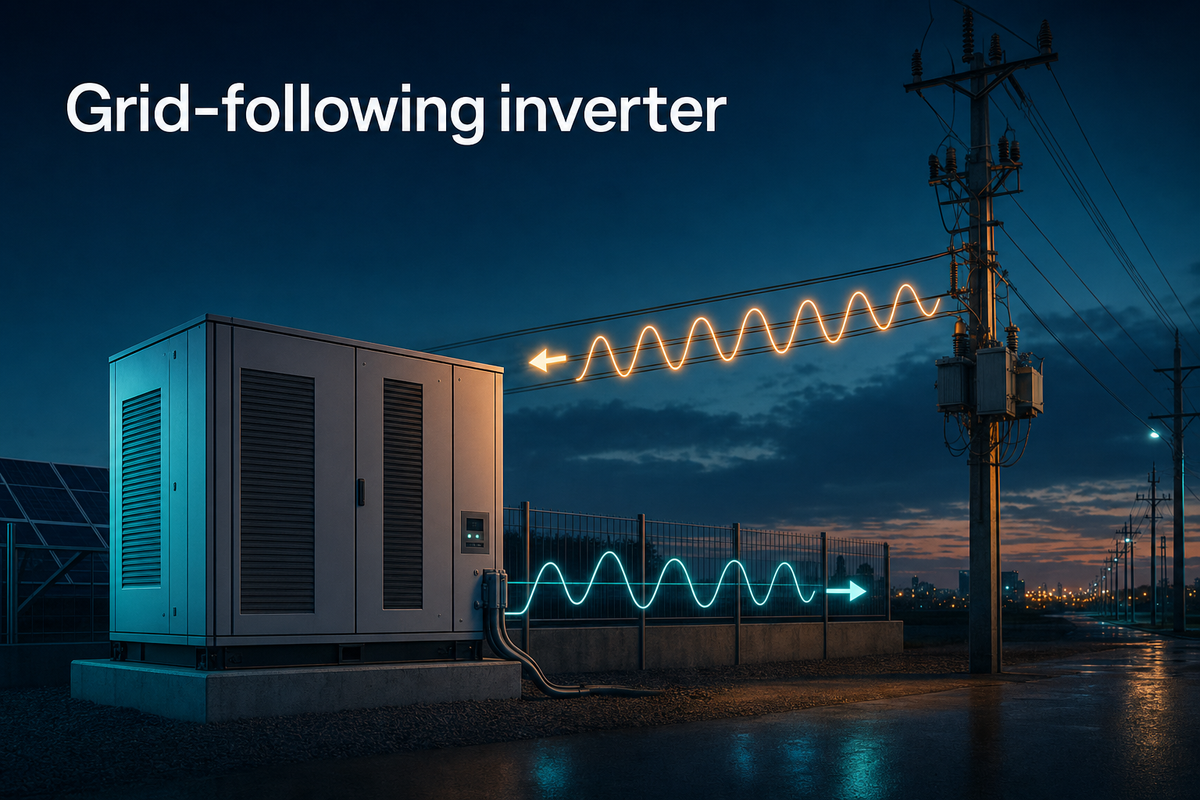

A grid-following inverter can convert DC power into AC power, but conversion is not the same as creating a usable electrical grid. Its control system is designed to measure an existing AC waveform, synchronize with it, and inject current into that waveform. If the grid disappears, the reference it follows disappears too—and safety controls should prevent the inverter from energizing the disconnected network.
That is why a solar or battery inverter may stop producing during an outage even when its DC source still has energy. The limitation is not necessarily the battery or panels. It is the inverter’s operating mode, the missing voltage reference, and the need to avoid unintentional islanding.
What “grid-following” actually means

An AC grid has a voltage magnitude, frequency, and phase angle. Those properties describe the waveform at a connection point: how large it is, how quickly it repeats, and where each cycle is in time.
A grid-following inverter measures that waveform and synchronizes its internal control to it, commonly with a phase-locked loop (PLL). It then controls the current it sends into the network. Its commands can determine how much real power it supplies and how it exchanges reactive current, but the surrounding grid supplies the fundamental reference that tells the inverter when and how to place that current.
A useful analogy is a musician playing along with an established beat. The musician can add volume or change the notes, but does not establish the tempo for the whole performance. A grid-following inverter is similarly built to join an energized electrical system, not to define one from nothing.
This distinction is about control behavior, not simply the energy source. A solar inverter, battery inverter, or other power-electronic converter may be grid-following or may include a different control mode. The label tells you how it synchronizes and regulates its AC side.
What the inverter loses when the grid goes down
During a normal outage, the utility waveform may vanish, collapse, become severely abnormal, or be separated from the local circuit by a protective device. In each case, the inverter can no longer assume that the voltage it measures is a valid, stiff reference.
Three related problems follow:
- No reliable phase reference: The PLL cannot safely track a missing or badly distorted waveform.
- No guaranteed frequency reference: Without the network’s frequency-setting source, the inverter cannot simply choose a frequency and assume that local loads will remain stable.
- No controlled relationship with the wider system: The inverter cannot know that a line has been intentionally de-energized elsewhere, or that utility workers may be working on it, merely because local loads still happen to measure a voltage.
A small local load can sometimes make a disconnected circuit look deceptively normal for a short time. For example, generation and demand could be close enough that voltage and frequency do not immediately move far outside normal ranges. That condition is called an unintentional island. It is precisely why “the lights might still be able to run” is not a safe operating test.
Why it must not keep energizing the line

A grid-tied inverter is required to detect abnormal conditions and cease energizing when an unintentional island or other disconnection condition is detected. This is the purpose of anti-islanding protection.
The protection and interconnection system can monitor quantities such as voltage, frequency, phase behavior, and changes over time. Depending on the equipment and applicable requirements, it may also use an active detection method that introduces a controlled perturbation and observes how the local circuit responds. A strong utility grid tends to hold its waveform steady; an isolated local circuit responds differently.
The exact detection and reconnection behavior depends on the inverter, interconnection equipment, and applicable certification or utility requirements. It should not be reduced to a universal timing claim. The engineering requirement is the important point: a distributed energy resource must not unintentionally continue feeding an isolated section of the utility network. The IEEE 1547.1 interconnection test overview describes tests for unintentional islanding, loss of phase, and delayed reconnection.
This shutdown protects more than the inverter. A line that utility personnel believe is de-energized must not be re-energized unexpectedly by a customer-owned source. It also helps prevent unstable voltage or frequency conditions and reduces the chance that equipment will be connected together out of synchronism when the utility returns.
Why a grid-forming inverter changes the answer

A grid-forming inverter is designed to establish an AC voltage reference rather than merely follow one. Its controls can regulate a local voltage waveform and adjust frequency or power-sharing behavior according to their design. That makes grid-forming control relevant to microgrids, black-start sequences, and backup systems.
The contrast is straightforward:
| Control mode | Primary relationship to the AC system | Can it create the reference by itself? |
|---|---|---|
| Grid-following | Measures an existing waveform and injects synchronized current | Generally no |
| Grid-forming | Regulates a voltage waveform for other devices to follow | Designed to do so, within its limits |
The distinction is supported in technical literature: grid-following controls depend on a PLL for synchronization to the grid voltage, while grid-forming controls use voltage-source behavior and control relationships such as power-frequency droop. This technical paper on unified grid-forming and grid-following control also shows that real systems can combine or transition between control strategies.
“Grid-forming” does not mean “an unlimited emergency generator.” A backup system still needs an energy source, suitable power and surge ratings, protection, controls, and a safe way to separate the backed-up circuits from the utility. Loads must remain within the system’s voltage, frequency, current, and energy limits. Some systems use a grid-forming battery inverter to provide the local reference while other inverters operate in grid-following mode; the complete system design determines what can run.
Why a battery does not automatically provide backup
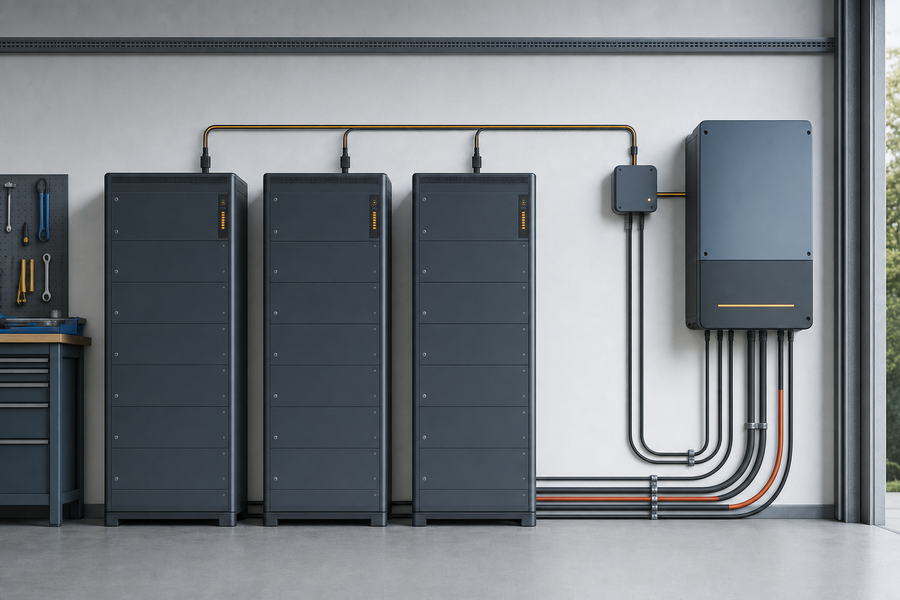
A battery stores DC energy. A grid-following inverter can use that energy to produce AC current when an acceptable grid waveform is present. But the battery does not, by itself, answer the control and safety questions on the AC side.
For backup operation, a system typically needs coordinated functions that can:
- Detect the utility outage.
- Isolate the protected loads from the utility conductors using approved transfer or interconnection equipment.
- Establish a local AC reference with an appropriate inverter or another source.
- Dispatch available energy while controlling voltage, frequency, current, and load priorities.
- Synchronize and reconnect to the utility only under permitted conditions.
The exact architecture varies. Some installations have a dedicated backup output; some use a transfer switch and a separate inverter; some can operate as a microgrid. A conventional grid-following PV inverter connected on the utility side of a system’s isolation equipment is not automatically converted into a backup source just because a battery is added.
What happens when the utility returns
After an outage trip, the inverter normally does not reconnect the instant it senses a voltage. It must confirm that the grid conditions are acceptable and that the reconnection process complies with the equipment and interconnection settings. This prevents a source from closing onto a waveform that is out of range or out of synchronism.
A backup system has a second coordination problem: the local source may be forming the voltage while the utility is absent, but it must not connect those two electrical systems together until their conditions are suitable. That is why transfer equipment, synchronization checks, and commissioning requirements matter even when the energy source is a battery.
The practical takeaway
A grid-following inverter needs the grid because the grid provides the AC voltage, frequency, and phase reference that its controls are built to track. When that reference is lost, anti-islanding protection should stop the inverter from energizing the circuit rather than allowing it to guess at a stable island.
If you need power during an outage, look for a complete, approved backup architecture—not merely an inverter with a DC source. The key questions are whether the system can isolate from the utility, which device forms the local AC reference, which circuits are backed up, and how reconnection is controlled. Those details, rather than the presence of solar panels or a battery alone, determine whether the system can safely operate when the grid cannot.