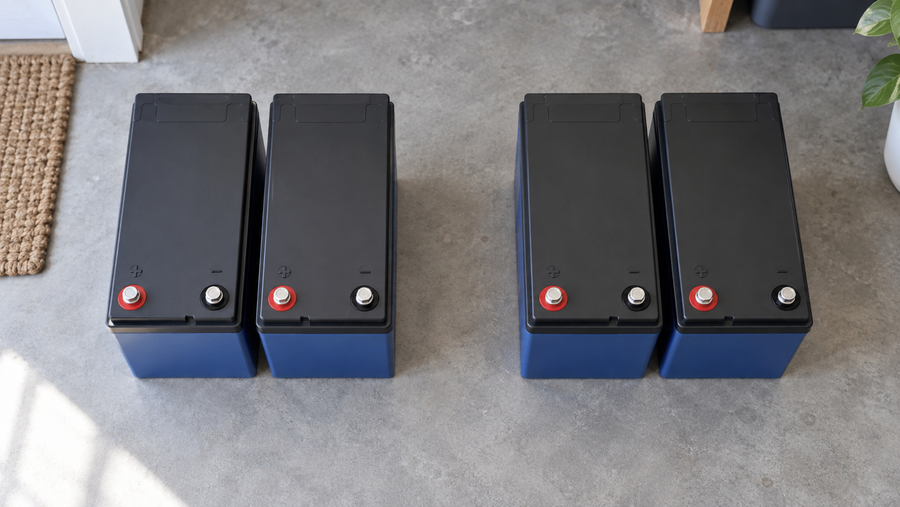

An NEV should not be charged by a recreational-cart rule of thumb. A golf-cart-derived NEV used for neighborhood transportation may make several short trips, run road equipment and accessories, carry passengers, climb hills, and need enough reserve to get home reliably. The right charging habit comes from the vehicle's real duty cycle, battery chemistry, pack and BMS requirements, and approved charger---not from a matching voltage label or the fact that both vehicles resemble golf carts.
A recreational cart can also have demanding use, and an NEV is not automatically a daily-charge vehicle. The important distinction is whether the vehicle is being used as occasional recreation or recurring transportation with less predictable energy demand.
Start with the Duty Cycle, Not the NEV Label

Two vehicles can have the same nominal pack voltage yet need different charging plans.
A recreational cart might make a few predictable loops around a course or property with limited accessory use. An NEV may instead make several neighborhood errands in one day, sit between trips, then be needed again after dark with lights, signals, wipers, heaters, or other installed equipment in use.
That does not mean every street-driven NEV consumes more energy than every recreational cart. Terrain, payload, weather, battery condition, driving behavior, route length, and accessory use all matter. The practical difference is that transportation use leaves less room for guesswork.
For one week, record:
- Number of trips per day
- Approximate distance or time driven
- Passenger and cargo load
- Hills, stop-and-go driving, and route changes
- Accessories used during each trip
- Battery or charge-status indication before and after use
- Whether the vehicle must remain available for an unexpected return trip
This record helps identify whether the vehicle needs a routine post-use charging decision, a planned opportunity charge, or simply closer range tracking. It also creates a baseline: a sudden change in range or charge time is easier to notice when normal use is documented.
Set the Routine by Battery Chemistry

"Golf cart battery" is not a chemistry. Flooded lead-acid, AGM, gel, lithium-ion, and LiFePO4 packs should not be treated as interchangeable systems, even when they share a nominal voltage.
Use the battery label and documentation to identify the exact battery type, then follow the battery manufacturer's instructions for routine charging, partial use, storage, maintenance, and any equalization procedure. Do not carry a lead-acid maintenance habit into a lithium conversion, and do not assume that a lithium pack should follow a flooded-battery schedule.
| Battery Type Identified on the Label | Charging Decision to Verify | Assumption to Avoid |
|---|---|---|
| Flooded lead-acid | Approved charging completion, maintenance, ventilation, and storage instructions | That it follows the same routine as AGM, gel, or lithium |
| AGM or gel lead-acid | Exact charger profile and storage instructions for that battery | That all sealed lead-acid batteries use the same settings |
| Lithium or LiFePO4 | Approved charger, BMS requirements, temperature limits, and storage routine | That any charger labeled with the same voltage is suitable |
| Unknown or mixed battery system | Battery and vehicle documentation before charging | That connector fit or prior use proves compatibility |
There is a specific reason not to give blanket "partial-charge" advice for lead-acid systems. In a published test of a conventional VRLA lead-acid control cell, sustained high-rate partial-state-of-charge operation was associated with hard sulfation and eventual failure behavior. The finding is limited to tested single cells, not complete golf-cart packs or lithium batteries, but it reinforces the need to follow the instructions for the exact battery rather than borrowing a routine from another chemistry or vehicle type. The VRLA lead-acid study does not establish a universal schedule for NEVs.
For a lithium upgrade, it is especially important to review which lead-acid maintenance habits can harm lithium batteries before applying an older cart routine to a new pack.
Verify the Charger as a Pack-and-Vehicle System

A charger is compatible only when the complete charging system is compatible. Nominal voltage, a familiar plug shape, or a charger that appeared to work once are not enough.
Before charging an NEV, verify all of the following against the battery, charger, and vehicle documentation:
- Battery chemistry: The charger must be approved for the battery type installed.
- Pack nominal voltage: Confirm the complete pack rating, not just the voltage of one battery module.
- Charge profile and current capability: Use the charger profile and output rating specified or approved for the battery pack.
- Connector and polarity: A connector that physically fits does not confirm correct wiring or polarity.
- Vehicle charge-port arrangement: Check whether the vehicle uses an interlock, charge-port wiring, communication connection, or other vehicle-specific requirement.
- BMS compatibility: For lithium and LiFePO4 packs, verify that the charger and battery-management system are intended to operate together.
- Manufacturer approval: If the vehicle was converted, confirm that the charger remains appropriate for the replacement battery system.
Do not bypass a BMS, safety interlock, fault indicator, connector, or charging cutoff to force a charge. A charging interruption can be a normal, documented protective response---or a sign that the system needs diagnosis. The correct next step is confirmation from the battery or vehicle manufacturer, not improvisation.
Build Separate Plans for Daily Use and Storage
Daily transportation and long-term storage are different operating conditions. They should not share one automatic rule such as "always plug it in overnight" or "never charge until nearly empty."
For an NEV Used Most Days
After the final trip, compare the day's use with the battery maker's approved routine. A vehicle that made multiple trips with accessories, passengers, or hills may need a different charging decision than one used for a short, low-demand outing.
Use the documented instructions to determine:
- Whether the pack should be charged after that use
- Whether a full charge is expected before the next trip
- Whether the charger may remain connected after completion
- Whether the battery or charger has a required cooldown, temperature, or inspection condition
- What charge indication or fault status should be checked before relying on the vehicle again
The goal is not to charge more often by default. It is to maintain an appropriate, documented range reserve for how the NEV is actually used.
For a Vehicle Parked for Weeks or Months
Storage should follow the battery manufacturer's storage procedure, not the daily-use routine. Confirm the required storage charge condition, whether the battery should remain connected to the vehicle, whether maintenance charging is permitted, and how often the system should be inspected.
Do not assume that every lithium pack may remain continuously connected, or that every lead-acid system requires continuous maintenance charging. Those choices depend on the battery type, charger behavior, BMS, storage conditions, and documented instructions.
If the vehicle was converted from several lead-acid batteries to a single lithium pack, verify the full installation arrangement rather than focusing only on the battery label. The pack configuration, charger, cabling, and vehicle charging connection all remain part of the decision.
Make the Charging Location Part of the Plan
A reliable charging routine also depends on the location where charging occurs. Before relying on a garage, shed, maintenance area, or community charging point, inspect the condition of the outlet, plug, charger cable, connector, and visible wiring.
Use the location and electrical supply specified in the charger and vehicle documentation. Consider whether the circuit is appropriate for the charger's stated requirements and whether it is shared with other loads. Avoid treating an extension cord as a permanent charging solution; use one only when the charger or vehicle manufacturer permits that arrangement.
For flooded lead-acid batteries, follow the manufacturer's ventilation instructions. For every chemistry, avoid charging with damaged cords, loose connectors, cracked housings, exposed wiring, or visible battery damage.
A clean, dry, accessible charging space also makes inspection easier. If you cannot clearly see the charger indicators, cable routing, and battery area, it is harder to spot an abnormal condition before it becomes a reliability problem.
Treat Changes in Behavior as Stop Signs
Do not normalize a problem because the vehicle still moves. Pause routine charging and arrange qualified diagnosis if you notice:
- Unusual heat from the battery, charger, cable, plug, or connector
- Odor, leakage, swelling, corrosion, or physical damage
- Damaged insulation, loose wiring, or a discolored outlet or plug
- Repeated charger or BMS fault indications
- A meaningful increase or decrease in normal charging time
- A noticeable reduction in range under comparable use
- A charge-status display that behaves differently from its established pattern
- A charger that will not begin, will not complete, or repeatedly stops without a documented explanation
One symptom does not identify the cause. A shorter range could involve the battery, charger, wiring, accessories, route, load, or another vehicle-system issue. The safe response is to inspect, verify documentation, and correct faults before depending on the NEV for street travel.
The decision chain is simple: document the vehicle's real duty cycle, identify the exact battery chemistry, verify charger-and-pack compatibility, follow the approved daily or storage routine, and investigate warning signs before the next trip. If those documented needs point toward a LiFePO4 conversion, review verified Vipboss compatibility and support resources before selecting or installing a replacement system.