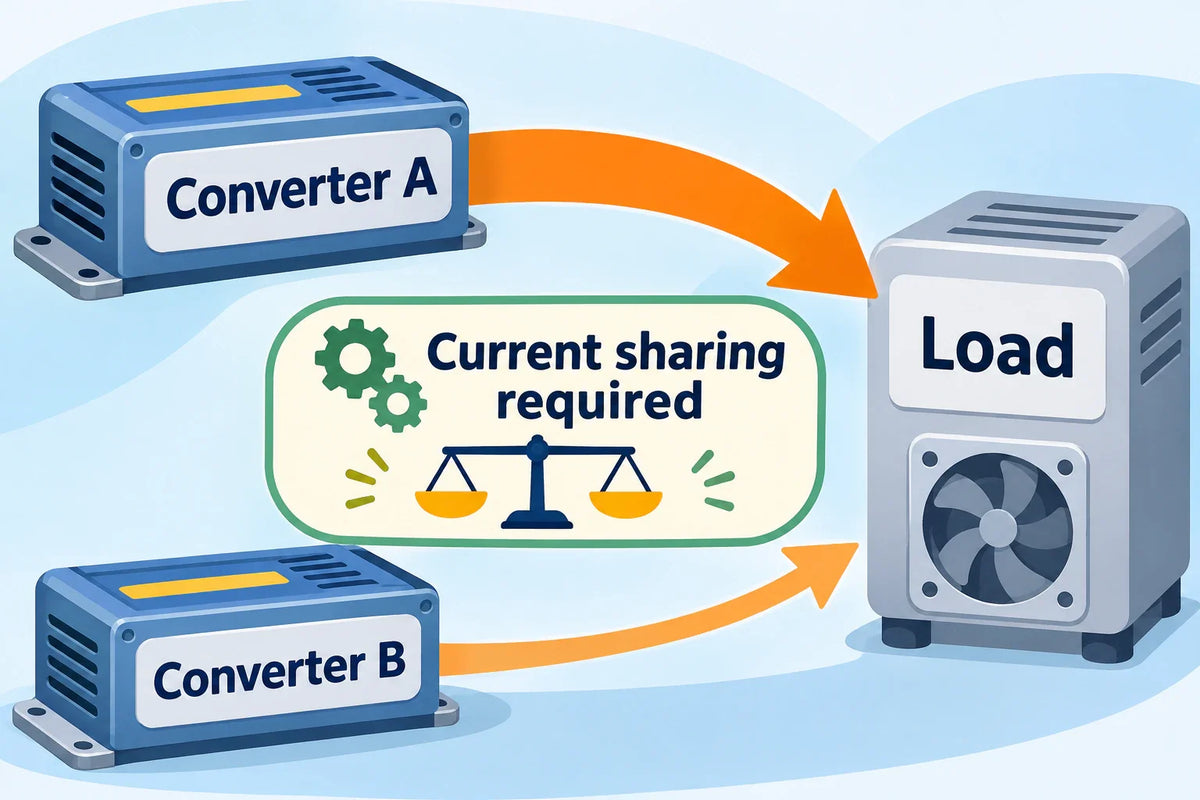

Yes, DC-DC converters can be paralleled for more current, but only as a system designed to share current. Two ordinary converters with the same output-voltage label do not automatically become one larger converter when their outputs are joined. If you need more current and have no supported sharing arrangement, use one converter rated for the full load.
Why matching labels do not add up
Real converters have output-voltage tolerances. The unit regulating at a slightly higher voltage may supply most of the load while the other contributes little, even when both say “12 V, 10 A.” Texas Instruments explains this behavior and describes a ballast-resistor solution for a specific set of assumptions. That circuit is an engineering example, not a universal instruction to add resistors to any pair.
Suppose a load needs 15 A and you have two 10 A units. Their labels total 20 A, but that arithmetic does not ensure each unit stays below 10 A. If one reaches its current limit, output voltage may sag or cycle instead of remaining stable. Use the combined continuous rating of a designed sharing arrangement, including its stated operating conditions.
Choose the arrangement that meets your goal
| Goal and equipment | Decision | Reason |
|---|---|---|
| More current; converters have an explicit parallel or current-sharing mode | Use the supported arrangement and its combined rating | The control scheme is intended to divide the load. |
| More current; ordinary converters merely have matching voltage ratings | Do not join the outputs on that basis | Nominal voltage equality does not ensure balanced branch currents. Choose one adequately rated converter or an engineered sharing system. |
| Operation after one supply fails | Design for redundancy separately | Remaining capacity and isolation of a failed branch are additional requirements. |

Purpose-built designs can share load through a control loop, droop behavior or another engineered method. A TI parallel-converter design shows coordinated power stages. An Analog Devices load-sharing and isolation example shows why redundancy needs additional design. These illustrate architectures; neither is a wiring recipe for unrelated off-the-shelf units.
A practical selection and acceptance check
- Define the load. Establish its required output voltage range, continuous current, startup or peak demand and tolerance for an interruption. This startup-versus-running-load guide explains why peak and running loads differ.
- Pick a capacity path. Use a single converter if one meets the load. Otherwise choose converters or a complete system with an explicit sharing method and a combined continuous rating. Do not create a rating by adding individual nameplates.
- Check conditions that affect the choice. Confirm the selected system's input range, cooling or derating, startup behavior, overload response and restart behavior against the load's needs. If the load must stay powered after a fault, specify and assess that separately.
- Verify the installed system. Under its intended load, measure output voltage and each converter's branch current, including startup and expected high load. Confirm that neither branch exceeds its stated limit and the output stays within the load's acceptable range. This verifies the built arrangement; it does not authorize an unsupported connection.

Final decision: Parallel converters for higher current when the combination is designed and rated for it. Otherwise, use one converter with adequate capacity. Specify fault tolerance separately if the load needs it.
FAQs
Can I connect two identical DC-DC converters in parallel?
Only if those units are intended for a supported sharing arrangement. Identical model numbers and nominal output voltage alone do not establish balanced current.
Will two 10 A converters give me 20 A?
Not automatically. Use the combined continuous rating of a supported configuration. Output tolerance, current sharing and thermal limits can prevent the simple sum from being usable.
Can diodes make unsupported converters share current?
Diode OR-ing can isolate branches in a power system, but isolation alone is not a current-sharing design or proof of a higher usable rating. Treat sharing and fault isolation as separate functions.
Does paralleling provide backup if one converter fails?
No automatic backup follows from paralleling. The remaining capacity must meet the load, and the failed branch must be isolated without an unacceptable interruption.