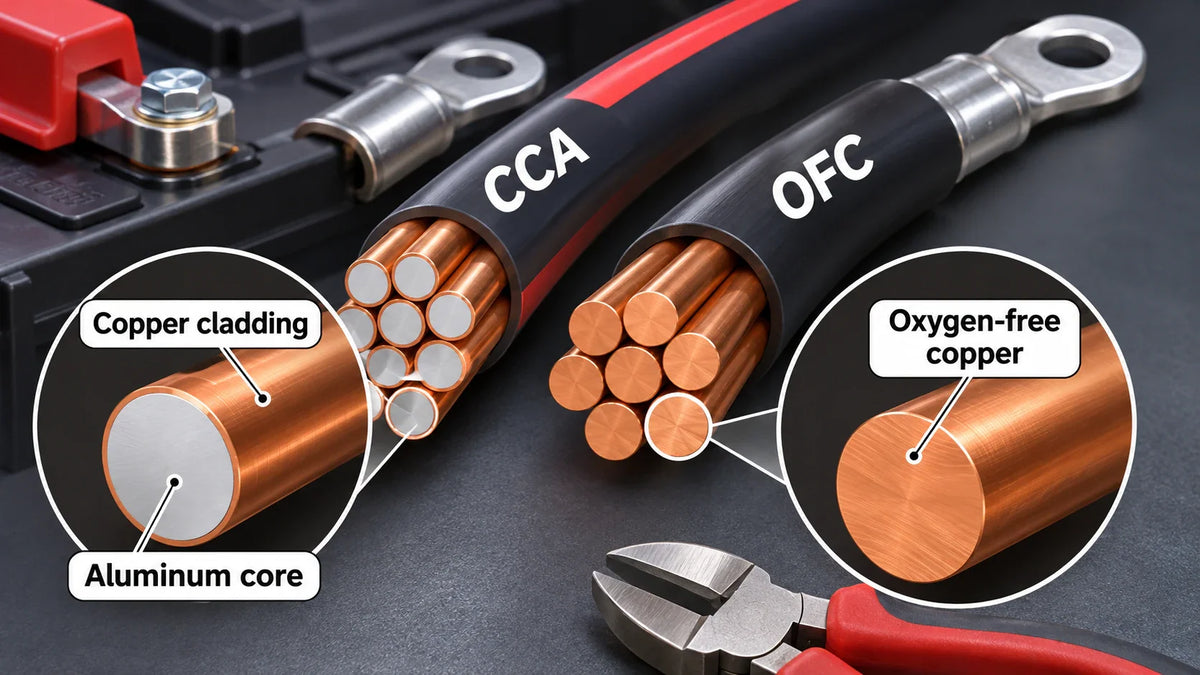

CCA battery cable has an aluminum core covered with copper, while OFC cable uses oxygen-free copper as its conductor material. To compare electrical performance, compare published resistance per unit length only when conductor size and construction basis are comparable. Lower resistance per length means less resistance over the same cable length, which informs voltage drop and heating at the same current; it does not by itself settle application suitability or cable gauge.
What is inside each cable?
| Label | Conductor described | What the label alone cannot establish |
|---|---|---|
| CCA | Aluminum core with bonded copper cladding | Finished-cable resistance, required gauge, or suitability for the installation |
| OFC | Oxygen-free copper conductor material | Complete cable construction, application rating, or an automatic conductivity advantage over ordinary copper |
CCA means copper-clad aluminum: copper is bonded around an aluminum core. Its copper-colored surface does not mean the conductor is solid copper. In the studied copper-clad building-wire sample, the aluminum core accounted for most of the reported conductivity, with the copper cladding contributing a smaller share; that estimate describes that sample, not a battery-cable specification. The building-wire analysis estimates the conductivity contributions of the core and cladding.
OFC means oxygen-free copper. It identifies a copper grade, not a complete cable construction or application rating. The listed oxygen-free and oxygen-containing copper grades have the same specified minimum conductivity under the stated conditions, so OFC should not be assumed to be universally more conductive than ordinary copper.
How to compare electrical specifications
For the same conductor geometry and length, resistance depends on the conductor material and construction. Resistance affects voltage drop and the heat produced when current flows. Published resistance per length gives a useful comparison: if two cables use the same stated conductor size and their ratings share a comparable basis, the lower figure means less resistance over an equal length. At the same current, that means lower voltage drop and less resistive heating in that comparison.
CCA battery-cable tables publish resistance per length for listed sizes. Use a listed value for the CCA cable, then compare it with an OFC cable rating for the same stated conductor size and a comparable construction basis. The CCA cable tables provide resistance ratings for their listed sizes. The evidence here does not provide a matched OFC rating, so it cannot support a numerical head-to-head result or a universal ranking of CCA and OFC.
Conductivity figures can also help compare conductor materials when they use the same measurement basis and conditions. A material-grade figure is not a finished-cable rating: size and construction affect the resistance of the complete conductor. Do not compare unlike sizes or treat a building-wire estimate as a battery-cable specification.
Check construction and application documentation
1. Identify the conductor. Look for documentation that names the conductor material and construction rather than relying on cable color or a broad label. For CCA, the documentation should identify copper-clad aluminum; for OFC, it should identify oxygen-free copper.

2. Compare like-for-like electrical ratings. Check resistance per length for the same stated conductor size and a comparable construction basis. If sizes differ or the rating basis is unclear, the figures do not establish which cable has lower resistance in a like-for-like comparison. Interpret only what the published figures and their stated conditions allow.
3. Match the documented application to your intended use. Treat an application list as the stated scope for that cable or product family. Compare the connection and use you have in mind with the applications named in the documentation. A listed application shows that the use is within the documented scope; it does not establish every requirement of a particular installation. If the use is not listed, or the description is too vague to tell whether it is covered, the material label alone does not establish suitability.
For example, one documented marine battery-cable product family uses finely stranded, tinned copper and lists battery or generator connections to starters, switches, windlasses, and inverters. That cable family's specification lists its construction and applications. This example describes that product family, not a universal requirement for external battery cables or a blanket suitability rule for every installation.
Material choice does not by itself determine cable gauge. Gauge is a separate sizing question; this explanation of why short, high-current runs may still need thick cable covers that next step.
FAQs
How can resistance-per-length ratings help compare CCA and OFC battery cables?
Compare ratings only when the stated conductor size and construction basis are comparable; the lower resistance per length means less resistance over the same cable length. At the same current, that comparison also indicates lower voltage drop and less resistive heating, but it does not by itself establish application suitability or cable gauge.
Does a cable's listed application guarantee that it suits every installation?
No. A listed application shows that the use is within the documented scope for that cable or product family, but it does not establish every requirement of a particular installation.
Does an OFC label prove a finished cable has the lowest resistance?
No. OFC names a copper grade, not the resistance of a finished cable. Compare published resistance per length for cables with the same stated conductor size and a comparable construction basis.