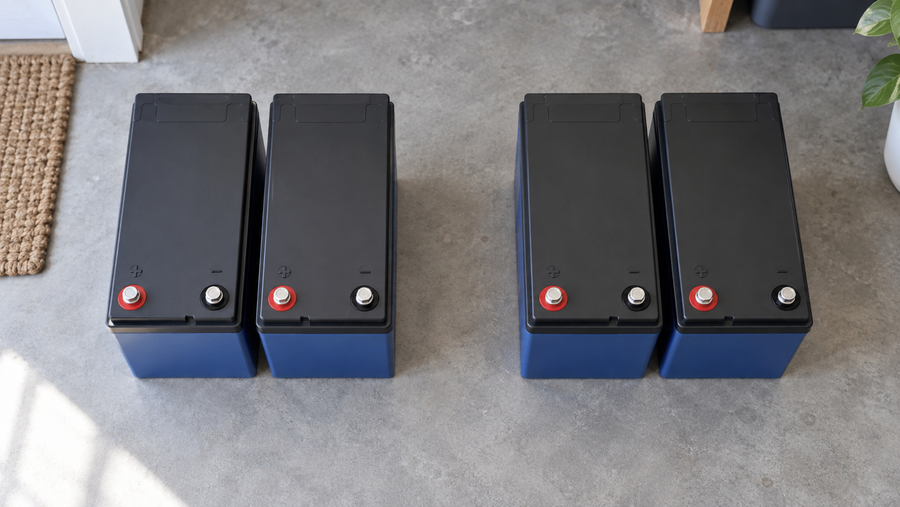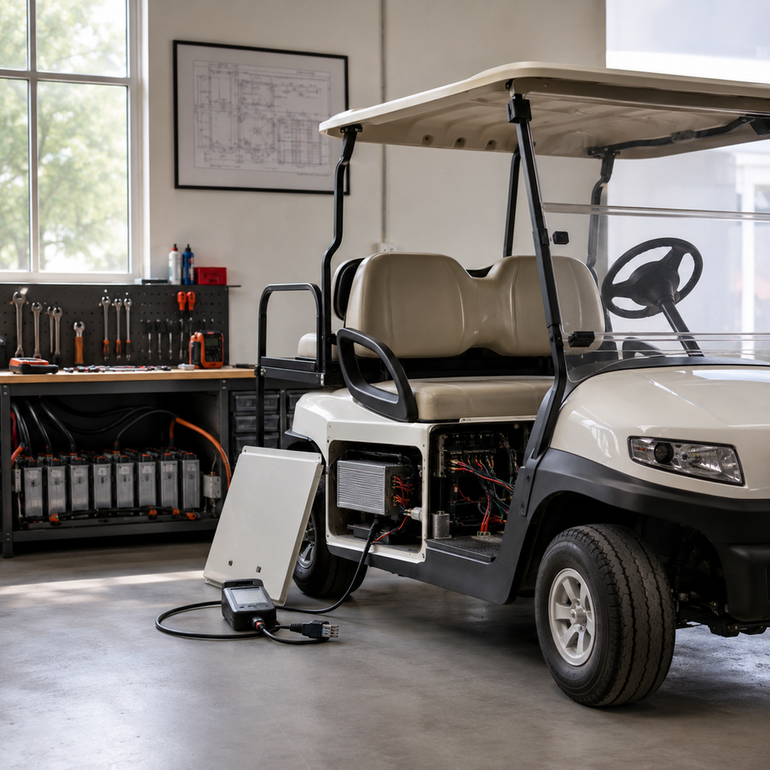

Reprogramming is not automatically required after a LiFePO4 conversion. If the exact controller provides programmable drive settings, begin by identifying its model-specific documentation and access method. For a harsh launch, soften acceleration ramp and throttle response before pursuing more current. Never use universal current, cutoff, or regenerative-braking values: each setting must remain within the documented limits of the battery, BMS, controller, motor, cables, fuse, solenoid, and vehicle.
Confirm the Controller and Programming Access First

A golf-cart controller interprets throttle position and regulates power delivered to the motor. That makes it central to launch feel, but it does not mean every controller can be tuned---or that every available menu item applies to your cart.
Before connecting a handset or software, record:
- Controller manufacturer, model number, serial number, and firmware or software version
- Cart system voltage and motor type
- Battery label, nominal voltage, and documented BMS continuous-discharge limit
- Battery/BMS charge limits if regenerative braking is enabled
- Motor plate information
- Ratings for the fuse, cables, main solenoid, and other high-current components
- Original controller settings, fault codes, and current drive symptoms
Controller documentation can be specific to both a model and a software version. Do not select a programming tool based on the cart brand alone. For example, Alltrax separates controller families by motor application and lists distinct software resources, but the correct tool and available parameters still depend on the exact controller.
Proceed only when you can identify the controller, its compatible programming method, and the meaning of each parameter. If access is restricted, the parameter names are unclear, or the documentation does not match the installed hardware, leave the settings unchanged.
Tune the Settings That Affect Launch Feel

Battery-current limit and motor-current limit are separate controller functions. They should not be treated as interchangeable "power" settings.
| Parameter | What the Driver Feels | What It Must Respect |
|---|---|---|
| Battery-current limit | How strongly the controller draws from the pack under demand | The battery's and BMS's documented continuous-discharge capability, plus the vehicle's high-current components |
| Motor-current or torque limit | Low-speed pulling force and initial torque | Controller, motor, drivetrain, cable, solenoid, fuse, and battery-system limits |
| Acceleration ramp | How quickly torque arrives after pedal input | Drivetrain tolerance and the desired smoothness of the launch |
| Throttle mapping | How sensitive the cart feels to the first part of pedal travel | Safe, predictable pedal control and the controller's documented configuration range |
Start with Pedal Response and Acceleration Ramp
If the cart lunges when the pedal first moves but otherwise drives normally, begin with a less aggressive throttle map and a gentler acceleration ramp. Throttle mapping changes pedal sensitivity, while acceleration control changes how abruptly torque is applied.
This approach addresses the driver's complaint directly. Raising a current limit may increase available demand without solving an overly sensitive pedal map or abrupt torque ramp.
Make only settings that the controller documentation explicitly identifies. Some controllers allow adjustment of acceleration curves, throttle response, speed limits, and regenerative-braking levels; others may expose only a limited set of options.
Treat Current Limits as Protection Settings
Set the battery-current limit from the exact battery and BMS documentation---not from the pack's voltage, amp-hour rating, or an advertised peak capability. A battery's energy capacity does not, by itself, state its permitted discharge current.
Motor-current settings also need restraint. They influence torque and load behavior, but higher motor current is not a universal upgrade. The motor, controller, drivetrain, cables, fuse, solenoid, and pack must all be suitable for the commanded load.
If a BMS disconnect occurs during acceleration, climbing, or heavy loading, do not assume the cure is a higher controller setting. Compare the controller's configured demand with the documented battery/BMS limits and inspect the rest of the high-current path.
Use a Conservative Tune-Test-Review Process

A smooth lithium transition is best approached as a controlled adjustment, not a full rewrite of the controller configuration.
- Save the baseline. Record all accessible settings, current fault codes, and the cart's behavior before changes.
- Change one parameter group. For a harsh launch, adjust throttle response or acceleration ramp first. Do not simultaneously alter current limits, cutoff behavior, and regen.
- Test at low load. On level ground, check for a predictable initial launch, smooth moderate acceleration, and normal pedal response.
- Review under appropriate load. If safe for the location and vehicle, observe behavior during a moderate hill or passenger/load test.
- Inspect before keeping the change. Watch for fault codes, voltage sag, BMS disconnects, hot cables, solenoid chatter, or abnormal heat. Retain the change only if behavior is predictable and no warning signs appear.
Programming cannot correct damaged connections, undersized cables, failing solenoids, incorrect fusing, a weak motor, or an incompatible controller. Those are component problems, not tuning opportunities.
Leave Cutoff and Regen Settings Within Verified Limits
Low-voltage behavior and regenerative braking deserve more caution than a basic drivability adjustment.
Use lithium-specific voltage guidance from the exact battery and BMS documentation when reviewing low-voltage cutoff settings. Do not copy lead-acid values or use a generic cutoff number for a 36 V or 48 V cart.
Likewise, enable, reduce, or change regenerative braking only when the controller supports it and the battery system's allowable charging behavior has been verified. Regen is not simply a braking-feel setting; it involves the complete controller-and-battery system.
Stop programming and diagnose the installation if you encounter repeated BMS trips, abrupt power loss, unexplained slowing, recurring fault codes, overheated hardware, or a disagreement between component specifications. A lithium conversion paired with a high-speed module can present irregular acceleration behavior in some reported Club Car applications, so high-demand modifications require especially careful compatibility checks.
Program Only From Verified Limits
Before finalizing a controller profile:
- Identify the exact battery pack, BMS, controller, motor, and programming version.
- Match battery-current limit to the battery/BMS's documented continuous capability.
- Keep motor-current and torque settings within the limits of the complete drivetrain and high-current electrical path.
- Soften throttle mapping and acceleration ramp before chasing higher current.
- Use lithium-specific low-voltage guidance for the installed pack.
- Validate regenerative-braking compatibility before changing regen settings.
- Document the final configuration and road-test it methodically.
For a Vipboss LiFePO4 installation, review the documentation for the exact battery model---such as the 48 V 105 Ah golf cart conversion kit---and proceed only when its limits clearly align with the controller and vehicle hardware.