
This article compares lead-acid and LiFePO4 batteries in mobile and off-grid systems, explaining how weight, efficiency, and cycle life affect fuel use, runtime, and total cost. It also shows how to estimate your own fuel savings and runtime gains from upgrading.
Switching from lead-acid to LiFePO4 almost always cuts dead weight, reduces charge losses, and shortens generator runtime, so more of every gallon of gas turns into usable power instead of heat and ballast. The upfront price is higher, but the combination of lighter packs, higher efficiency, and far longer life usually wins on total cost and fuel burn.
Picture this: the truck is idling on soft ground, the generator is droning, and you can almost smell your fuel budget evaporating while a pair of old, heavy batteries refuse to top off. In controlled bench testing and field retrofits, swapping a roughly 300-plus pound lead battery bank for a lithium pack under 100 pounds has delivered more usable runtime per charge and noticeably fewer generator hours for the same loads. Here you will see where that extra fuel is going, how to put real numbers to your own system, and what it takes to move that weight and waste off your rig and into your fuel savings.
Why Heavy Batteries Burn More Fuel Than You Think
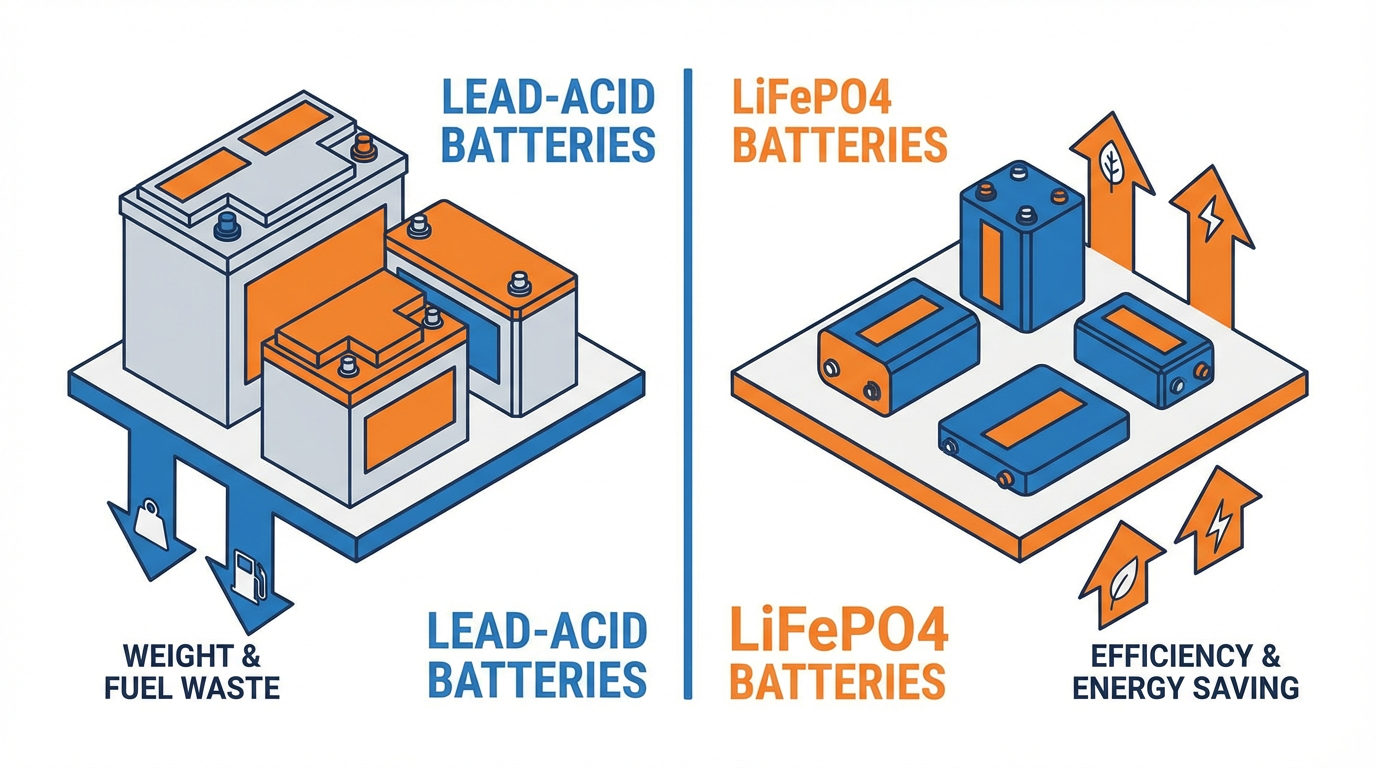
Every pound your engine has to move costs fuel. Traditional lead-acid batteries pack a lot of that weight into lead plates and liquid electrolyte. In many 12‑volt, 100‑amp‑hour formats, manufacturers report weights of around 60 pounds for lead-acid versus about 30 pounds for comparable LiFePO4 units, and some sealed lead-acid examples reach about 325 pounds where a LiFePO4 replacement is roughly 72 pounds. That means the lead bank can be twice the weight for a single case and up to about four times heavier in larger industrial sizes.
On a work truck, off-grid trailer, or boat, that battery mass is permanent cargo. It soaks up payload, slows acceleration, and forces the engine or tow vehicle to work harder on grades, soft soil, and stop‑and‑go job sites. In heavy equipment where attachments and tools already push weight limits, hauling an extra few hundred pounds of battery that delivers no extra usable energy is pure dead load. By moving the same rated storage into a lighter LiFePO4 bank, the fuel that used to move lead and acid can instead move tools, materials, or simply stay in the tank.

Weight is not the only penalty. Lead-acid chemistry is less efficient at storing and releasing energy. Multiple lab comparisons put typical lead-acid round-trip efficiency in the roughly 75–85 percent range, while LiFePO4 usually achieves around 92–95 percent. One detailed solar example shows that if you feed 10 kilowatt-hours into a LiFePO4 bank you get about 9.5 back, whereas a lead-acid bank returns only about 8. In other words, the lead system wastes roughly four times more energy as heat.

If that energy is coming from a generator, those extra kilowatt-hours are literally extra fuel burned for no additional work.
Real-World Numbers: Lead-Acid vs. LiFePO4 Side by Side
When you stack the two chemistries against each other on the metrics that matter for off-grid and mobile power, the pattern is consistent across manufacturer data and independent battery tests.
Lead-acid has a much shorter useful depth of discharge if you care about cycle life. To keep lifespan reasonable, most sources recommend using only about half of a lead-acid bank’s rated capacity on a routine basis. Go much deeper, and large lead sulfate crystals form on the plates, permanently stealing capacity. LiFePO4, by contrast, can usually be taken to around 80 percent of its capacity, and many designs tolerate even deeper discharge with only modest impact on life. That means a 100‑amp‑hour LiFePO4 pack can safely deliver roughly 80 amp‑hours day after day, whereas a 100‑amp‑hour lead-acid should only be counted on for about 50.
Cycle life magnifies this gap. Conventional deep-cycle lead-acid batteries often deliver only a few hundred full charge–discharge cycles when worked hard, with some lab models clustering around 300 cycles to about 80 percent remaining health. LiFePO4 packs in similar tests routinely reach several thousand cycles, with data sets showing up to roughly 4,000 cycles before hitting that same 80 percent threshold. Other long-term comparisons put lead-acid life in the range of 3–5 years, while LiFePO4 of similar capacity can run up to about 10 years in real service, especially in solar and RV duty.
Weight and physical volume tie directly into fuel use. Manufacturers and comparison reports give repeated examples where a LiFePO4 unit provides equal or greater usable capacity with only one-half to about one-quarter of the weight of a similar lead-acid unit. One sealed lead-acid example around 100 amp‑hours weighs about 60.4 pounds while a lithium unit of similar voltage and capacity is roughly 11 pounds in a different configuration; another pair shows about 325 pounds versus 72 pounds. In every case, the lithium chemistry packs more usable watt‑hours into significantly fewer pounds.
Maintenance is another hidden cost. Flooded lead-acid requires regular watering, terminal cleaning, and careful ventilation to avoid corrosive fumes and stratification, with inspection intervals as tight as weekly or monthly in heavy service. Improper watering or chronic undercharging shortens life dramatically. LiFePO4 batteries, by design, are mostly maintenance-free aside from proper charging and occasional state-of-charge checks. An integrated battery management system handles balancing and protects against overcharge, over-discharge, and excessive current, which keeps performance consistent and reduces technician hours and mistakes that lead to premature failure.

A quick comparison table helps visualize the tradeoffs:
Factor |
Lead-Acid (typical) |
LiFePO4 (typical) |
Fuel and uptime impact |
Usable capacity |
About 50% of nameplate to preserve life |
Around 80–100% usable, depending on design |
Lithium needs fewer amp‑hours installed for the same runtime |
Round-trip efficiency |
Roughly 75–85% |
Roughly 92–95% |
Lead wastes more charge energy as heat |
Weight |
Often 2–4 times heavier for similar capacity |
Often half to one-quarter of comparable lead-acid |
Lighter packs reduce dead load and towing fuel |
Cycle life |
A few hundred cycles, 3–5 years in many uses |
Several thousand cycles, up to about 10 years reported |
Fewer replacements and less fuel burned charging new packs |
Maintenance |
Regular watering, cleaning, ventilation required |
Effectively maintenance-free with built-in management |
Less labor and lower risk of life-shortening mistakes |
How That Translates Into Extra Fuel and Generator Hours
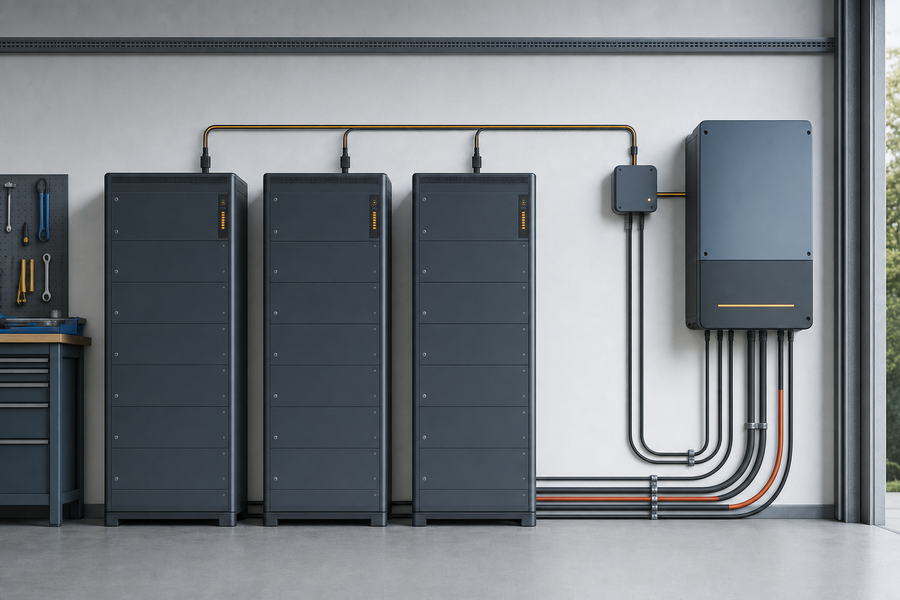
Consider an off-grid cabin or job trailer that needs about 5 kilowatt-hours of electricity every day for lights, tools, and small appliances. With a lead-acid bank, only about half of the rated capacity should be used regularly, so you size the bank to at least 10 kilowatt-hours of storage. With LiFePO4 providing a safe depth of discharge around 80 percent, the same 5 kilowatt-hours of daily demand only requires about 6.25 kilowatt-hours of installed capacity. Right away, the lithium bank can be smaller and lighter yet still meet the same load profile.
Now look at charging those banks with a generator. To deliver 5 kilowatt-hours of usable energy, a LiFePO4 system at roughly 95 percent efficiency needs only about 5.3 kilowatt-hours of charge input. A lead-acid system at around 80 percent efficiency needs about 6.25 kilowatt-hours of input for the same usable output. That is close to an 18 percent increase in energy that has to come from somewhere, usually from longer generator runtime or more solar panel area. Whatever your generator’s gallons-per-hour figure is, that additional charge energy shows up as additional fuel burned over the life of the system.
Because lead-acid must be oversized to stay shallow-cycled, the physical battery bank is bigger as well. In a trailer or RV, that might mean carrying four 60‑pound lead batteries to get sufficient usable capacity versus two or three lithium units around 30 pounds each. On a jobsite, it can mean a battery skid that weighs hundreds of pounds more than necessary. Every uphill climb, acceleration, or soft surface crossing translates that unnecessary battery mass straight into extra throttle and extra fuel.

When battery life is short, the fuel penalty does not end with the first bank. After a few hundred deep cycles, many lead-acid packs sag in capacity and must be replaced. New lead units start the whole cycle of charging losses and weight penalties over again. A LiFePO4 bank that keeps delivering thousands of cycles means fewer scrap batteries, fewer installations, and fewer break‑in charge cycles over the life of the equipment or off-grid system.
When Lead-Acid Still Makes Sense
There are still scenarios where lead-acid earns its place. In warehouse forklifts and some industrial vehicles, the battery’s weight is not a liability but a built‑in counterweight. Traditional lead-acid motive-power batteries have been refined for decades to provide predictable power, tolerate deep cycling, and use their mass to keep the truck stable with heavy forks in the air. In those applications, engineers actually design around a heavy pack, and the machine rarely travels far enough fast enough for the weight to drive fuel costs.
Lead-acid also works well where the battery sits in one place, is not cycled deeply, and budget is tight. Backup power systems for telecom and some building UPS installations often favor valve‑regulated lead-acid because the batteries spend most of their life on float charge, cycling only during outages. In those cases, cycle life and weight matter less than low upfront cost and easy recycling, and there is no generator-chasing trailer or tow vehicle constantly burning fuel to haul them around.
In heavy equipment, proven robustness is another point in lead-acid’s favor. Industrial articles emphasize that these batteries are tough, tolerant of vibration, and backed by mature supply and recycling networks. For some fleets, especially where charging infrastructure is built around lead and where operators are already trained in watering and maintenance, the simplest, lowest-cost option in the short term can still be a conventional pack.
Where LiFePO4 Delivers Maximum Fuel and Runtime Gains
The real wins for LiFePO4 appear wherever batteries are both cycled hard and hauled around. Off-grid solar cabins that rely on generator backup, RVs that tow through mountains, marine trolling systems that push against current and wind, and construction trailers that relocate frequently all sit in this category. In these environments, lighter packs, higher usable capacity, and superior efficiency compound into tangible fuel and uptime savings.
Manufacturers focused on marine, RV, and solar markets repeatedly recommend LiFePO4 for exactly these use cases. They point to deeper allowable discharge, far lower internal resistance, and better voltage stability under load, all of which mean more of the energy you paid to generate actually reaches your tools and appliances. Temperature tests at high heat levels around 131°F show lithium holding on to capacity and state of health significantly better than lead-acid, which helps when generators and inverters are packed into hot equipment bays.
Battery lab data for heavy‑duty applications backs this up. In controlled tests that compared multiple valve‑regulated lead-acid models with matching LiFePO4 units, the lithium batteries showed much lower internal resistance, tighter voltage curves during discharge, and cycle life that stretched from a few hundred cycles for lead to several thousand for LiFePO4. When analysts treated 80 percent remaining health as the end of life, lead-acid commonly ended near 300 cycles while LiFePO4 variants ran to around 4,000 cycles. For fleets, separate research into optimized chemistry selection and maintenance demonstrated that smarter choices and care can roughly double overall battery life and cut procurement costs by close to 30 percent, a trend that LiFePO4’s high cycle counts strongly support.
Combine fewer replacements, less wasted charge energy, and significantly less weight to haul, and the fuel savings become structural rather than marginal. Instead of paying again and again to recharge, haul, and replace heavy, inefficient packs, the system is tuned to convert as much of every gallon of gas or kilowatt-hour of solar into useful work as the chemistry allows.
How To Start Calculating Your Own Upgrade
The simplest way to quantify your fuel penalty is to start with three numbers: how many amp‑hours you currently have installed, how deeply you usually discharge those batteries, and roughly how many hours your generator runs or how often you refill the tank during a typical workweek. If your lead-acid bank is sized for shallow cycling but you are routinely running it down past the halfway mark, the real usable capacity is less than the label suggests, and the batteries are aging faster than they should.
From there, compare actual lead-acid usable capacity at about 50 percent depth of discharge to a LiFePO4 bank sized for around 80 percent. Many owners find that they can reduce the nominal amp‑hour rating of the bank when moving to LiFePO4 and still gain runtime, because more of the capacity is accessible and less is lost to voltage sag and inefficiency. Then apply the efficiency difference: for every 10 kilowatt-hours you feed into the charger now, a lithium bank may return roughly 1.5 kilowatt-hours more usable energy than lead-acid. Multiply that by your weekly or monthly charging sessions, and you have a direct line of sight into how much generator time and fuel is being spent on heat instead of power.
Finally, consider weight. Add up the published weights of your existing batteries and compare them to LiFePO4 replacements with equal or greater usable capacity. The difference is often measured in hundreds of pounds. On the road, that shows up as more throttle and higher fuel consumption. On a jobsite, it can mean the difference between staying within safe towing limits with one truck instead of moving to a larger, thirstier vehicle just to stay legal.
Closing Thoughts
If your batteries travel with you or cycle hard to keep remote loads alive, the extra fuel you are burning to move and recharge heavy, inefficient lead-acid packs is not trivial; it is built into every mile and every generator hour. Put real numbers to your capacity, efficiency, and weight, and you will quickly see where LiFePO4 can turn wasted fuel into extra runtime, payload, and margin on every job. Run that math once, size the upgrade correctly, and your next battery expense will not be at the gas pump.
References
- https://www.batterybuilders.com/lead-acid-batteries-overview/
- https://batteryfinds.com/lithium-iron-phosphate-batteries-vs-sealed-lead-acid-batteries/
- https://www.deltecenergysolutions.co.za/what-is-a-lead-acid-battery-proven-energy-storage-technology/
- https://industrial-batt.com/lead-acid-batteries/
- https://www.lubyequipment.com/tips-for-extending-equipment-battery-life/
- https://minutemanups.com/battle-of-the-batteries-lead-acid-vs-lithium-ion/
- https://www.onsitetruckaz.com/post/battery-management-for-heavy-duty-vehicles-maintenance-troubleshooting-and-replacement-tips
- https://www.ritarpower.com/industry_information/Pure-Lead-Batteries-for-Industrial-Equipment-Powering-Reliable-and-Efficient-Operations_531.html
- https://americanmotiveproducts.com/products/lead-acid-batteries/
- https://www.anernstore.com/blogs/diy-solar-guides/lifepo4-vs-lead-acid-efficiency?srsltid=AfmBOop5M1tJl7nanjG2-urdbahCX02c0LzHrL1z1ZzZ31a7D-xSV6ZT