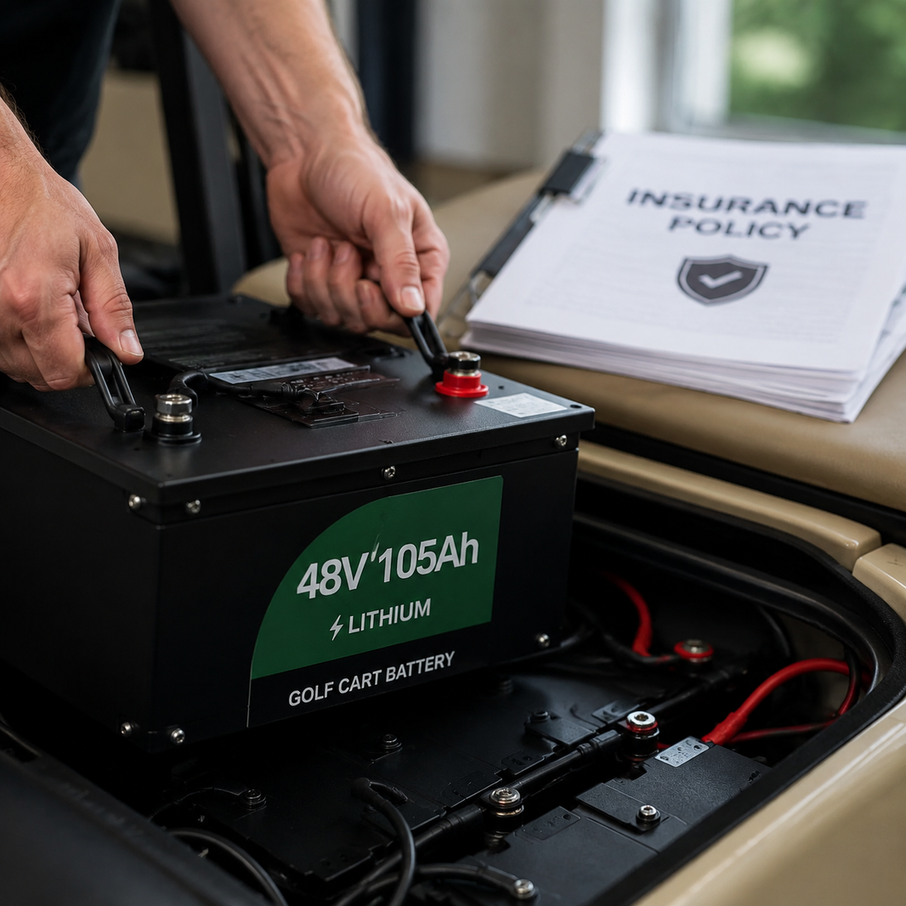

Usually, disclose a lithium or higher-capacity battery upgrade to your insurer before relying on the cart on public roads---particularly when the project also changes system voltage, charger, controller, motor, speed-limiter settings, expected use, or replacement value.
A battery-only swap does not automatically change a cart's registration, low-speed vehicle status, or insurance coverage. But it can create a mismatch between the vehicle you own, the vehicle described on the policy, and the vehicle permitted on the roads you use. Get the insurer's confirmation and keep a clear record of what was installed.
Start with the Vehicle's Actual Classification

"Street-legal golf cart" is a convenient description, not necessarily a legal or insurance classification. Before discussing the battery conversion, identify how the cart is titled, registered, and insured.
It may be described as:
- A conventional golf cart
- A low-speed vehicle (LSV)
- A neighborhood electric vehicle (NEV)
- Another registered motor vehicle category
- A recreational vehicle used only on private property or under local rules
Check these records together:
- The policy declarations page and endorsements
- The title and registration, if applicable
- The VIN
- The manufacturer's certification label
- The original sales paperwork or manufacturer certificate of origin
- Any prior inspection, conversion, or registration records
For federal LSV purposes, FMVSS No. 500 sets equipment and performance requirements. An LSV must have a VIN and specified road-safety equipment, and it must not exceed 25 mph in the prescribed one-mile test from a standing start. The federal low-speed vehicle standard is not proof that a particular modified cart remains compliant; it is the baseline standard that applies to vehicles in that category.
Lights, seat belts, mirrors, and a lithium battery do not by themselves transform an ordinary golf cart into an LSV. State treatment can be more specific. For example, Wisconsin distinguishes LSVs from ordinary golf carts and requires an NHTSA-compliance certification label for an LSV; it also lists four wheels, a top attainable speed above 20 mph and no more than 25 mph on a paved level surface, and a gross vehicle weight rating below 3,000 pounds. The state's LSV guidance also states that ordinary golf carts, ATVs, and UTVs cannot be registered there as LSVs for public-road use.
Your insurer needs the same starting point: not what the cart resembles, but what it is actually insured as.
Treat a Power-System Conversion as a Disclosure Decision
Aftermarket modifications may not be covered by every policy. That does not mean every lithium conversion is excluded, or that disclosure guarantees payment after a loss. It means the policy language, endorsements, exclusions, declared value, garaging location, and intended use matter.
The practical approach is to disclose the upgrade before routine public-road use resumes.
Changes Worth Reporting
Give the insurer a concise before-and-after description of the project, including changes to the battery, voltage, controller, motor, speed limiter, and installed cost. A like-for-like battery replacement may present fewer questions than a conversion that changes voltage or adds a controller and motor upgrade. Still, the insurer---not the battery owner---determines whether a particular change must be scheduled, endorsed, or reflected in the insured value.
Electrical modifications deserve particular care because improperly installed electrical components can create fire hazards and malfunctions. Documentation cannot establish that an installation was safe, but it gives the insurer a clear account of the parts, work, and configuration involved if a claim is later investigated.
Questions to Ask the Insurer
Ask the insurer for confirmation and save the reply with the policy, quote, endorsement, and conversion records.
Review Changes That Can Affect Road-Legal Use
Battery capacity alone is not the central road-legality question. The more important issue is whether the conversion changes specifications that affect the vehicle's classification or permitted operation.
For example, Wisconsin limits LSV operation to specified roads even when the vehicle is registered. Greater range may make longer trips practical, but it does not expand the roads on which the vehicle may lawfully operate. Florida provides another illustration of state variation: a golf cart modified to exceed 20 mph may be classified as an LSV under Florida law, potentially bringing registration, insurance, and safety-equipment requirements.
Neither example creates a nationwide rule. Ask your state DMV which specifications, labels, inspections, or filings apply to your vehicle as configured now. If the answer is unclear, pause public-road use until both the DMV and insurer have addressed the question.
If the battery conversion includes control-system work, retain the information needed to identify the final configuration. A record of the controller changes can be useful alongside the battery paperwork.
Build a Claim-Ready Conversion File

Create one dated folder---digital, paper, or both---that can be shared with an insurer, repair shop, buyer, or DMV. Include documentation of the modification details such as photos, receipts, and specification sheets for the battery, charger, controller, and motor. Keep the policy declarations, the insurer's written response, the VIN, title, registration, and certification-label photos.
The file is evidence of what was installed; it is not proof of safe installation, continuing LSV compliance, or guaranteed claim payment. It does, however, make it easier to correct a mismatch between the actual cart, the policy description, and the registration record.
State paperwork can also be specific. In Wisconsin, an LSV title and registration application requires the original title or manufacturer certificate or statement of origin, plus a photograph of the federal certification label. That requirement does not mean a replacement battery automatically requires retitling; it shows why the certification label and original vehicle documents should be preserved.
Before driving the upgraded cart on public roads, send the insurer the modification summary and supporting file, ask for written confirmation of coverage, and verify with the DMV that the cart's current configuration still fits the applicable registration and road-use rules.