
This guide explains how to size an off-grid battery bank by calculating your real energy use, choosing days of autonomy, and matching battery chemistry, solar array, and inverter for reliable year-round power.
To truly cut the cord from the grid, you need a battery bank sized to your real daily use, multiplied by at least a couple of days of backup, and adjusted for battery chemistry and system losses.
Picture a winter storm rolling in, your panels buried under clouds, and you watching the battery monitor drop while the nearest power pole is miles away. Undersize the bank and you're firing up a noisy generator every other night; oversize it and you tie up thousands of dollars in lithium that never cycles deeply. The good news is that with a simple, numbers-first approach drawn from proven off-grid sizing methods, you can calculate how many batteries you actually need and choose a setup that stays on through bad weather without blowing your budget.
What “True Off-Grid” Really Demands From Your Batteries
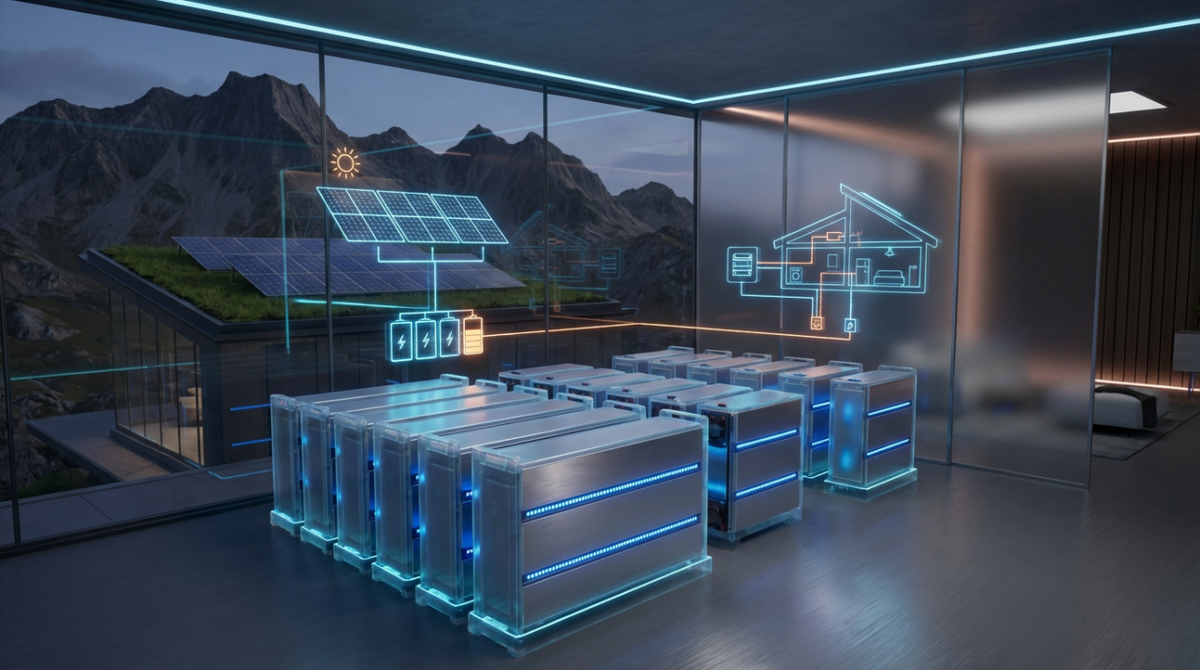
Going off-grid is very different from adding a backup battery to a grid-tied home. There is no utility safety net, so your battery bank becomes the core of the system, storing solar energy to bridge every night and every cloudy stretch, not just occasional outages. That is why off-grid guides treat storage as the heart of the design rather than an accessory add-on for panels you already own. Solar-battery sizing guides consistently start from the battery side because it has to carry both your evening peaks and your non-solar days.
Historically, off-grid homes leaned heavily on firewood, propane, and diesel generators to fill gaps, but that simply trades grid dependence for fuel dependence. Case studies of off-grid homes show that fuel storage, refueling trips, and maintenance quickly become a second job, which is why modern designs prioritize right-sized battery banks supported by solar so that generators are relegated to rare emergencies rather than daily life.

Step 1: Measure Your Real Daily Load
Before talking about how many batteries you need, you must know how many kilowatt-hours you want those batteries to deliver in a typical day. Every serious off-grid sizing method starts with a load assessment where you list each appliance, record its watts, estimate hours of use, and turn that into daily watt-hours using the simple watts-times-hours approach that off-grid battery references recommend for accurate planning. This same appliance-by-appliance method is used in off-grid battery guides from both preparedness and solar-design perspectives because guessing from a utility bill often hides when and how you use energy in real life.
A practical way to do this is to start with the big continuous loads. For example, one guide walks through a fridge around 150 watts running all day, LED lights, a laptop, and a small pump, and ends up at roughly 4.25 kilowatt-hours per day of usage for a modest off-grid setup, which is enough to power essentials but not electric heating or air conditioning. Another off-grid storage reference notes that the average U.S. home uses about 29.2 kilowatt-hours per day, highlighting why full-time off-grid homes usually either cut demand with efficient appliances or build very large battery banks backed by substantial solar generation.
Even small cabins add up faster than people expect. An example weekend cabin with lights, chargers, a laptop, camera, electric kettle, stove, and mini fridge lands above 4 kilowatt-hours per day before anyone plugs in extra comforts, showing that “just a few devices” can easily push daily consumption out of the minimalist zone highlighted in off-grid power-station examples from portable solar vendors like Jackery’s off-grid living guide.
Once you have the total in watt-hours, divide by 1,000 to get kilowatt-hours per day because every battery sizing formula you will use works in kilowatt-hours.

Step 2: Decide Your Days of Autonomy – Your Risk Dial
The next decision is how many days you want the system to run with little or no charging, often called days of autonomy. Off-grid battery guides for homes and cabins emphasize this as a core design choice, recommending that you decide how many consecutive cloudy or low-sun days you want to ride out before leaning on a generator or cutting loads. Both solar battery calculators and off-grid cabin sizing articles commonly land on about two to three days for most locations, with higher values for darker climates or very remote sites.
Several independent sources converge on similar ranges. Off-grid system calculators aimed at stand-alone homes suggest two to three days of autonomy and show examples where a 10 kilowatt-hour per day home with two days of autonomy and lead-acid batteries needs about 40 kilowatt-hours of storage, while off-grid battery guides for prepper-style systems walk through three-day designs to stay comfortable through extended cloudy periods. More technically oriented storage sizing articles also point to designs in the two- to five-day range depending on climate and risk tolerance, with three days often treated as a sensible starting point for full-time off-grid life.
To ground this with a concrete example, take a modest off-grid usage of about 4.25 kilowatt-hours per day from the earlier fridge plus lights plus laptop plus pump scenario. A three-day autonomy target means you want roughly 12.75 kilowatt-hours of usable energy in the batteries before considering losses, which is in line with off-grid preparedness examples that multiply daily use by three days and then compare the result to available lithium modules, concluding that a single 10 kilowatt-hour battery is usually not enough for comfort and reliability.
Step 3: Turn kWh into Battery Bank Size
Now you can translate daily use and days of autonomy into actual battery capacity. The key concept is that rated capacity and usable capacity are not the same; battery sizing articles consistently stress that what matters is the usable energy after you respect depth-of-discharge limits and efficiency losses, not the sticker number on the case. References on home storage sizing use examples like a 100 kilowatt-hour lead-acid system delivering only about 50 kilowatt-hours of usable energy versus lithium batteries that can typically deliver nearly all of their rated capacity, simply because recommended depth of discharge is very different.
Depth of discharge is how much of the battery’s stored energy you regularly use before recharging. Practical guidance from home-storage and off-grid battery references gives ballpark values of roughly 50 percent usable for traditional flooded and AGM lead-acid batteries, around 60 percent for some sealed variants, and up to 80–100 percent for lithium, especially lithium iron phosphate (LiFePO4) batteries that can handle thousands of cycles at higher depth of discharge without failing prematurely. Off-grid calculators aimed at lead-acid banks often multiply daily watt-hours by days of autonomy and then by two to account for that 50 percent usable limit, while lithium-focused guides use higher depth-of-discharge values and end up with significantly smaller required banks for the same load.
On top of depth of discharge, you need to account for system inefficiency. Battery and inverter efficiency are rarely perfect, so storage references commonly assume about 85–90 percent overall efficiency and recommend adding a buffer of 10–30 percent to cover losses and unexpected demand. One frequently cited formula for calculating required storage is to take daily energy use, multiply by days of autonomy, then divide by the product of depth of discharge and system efficiency, which is explicitly used in home-battery sizing examples from sources such as BSLBATT’s practical guide to storage capacity and off-grid cabin battery-sizing articles from Anern’s home battery storage sizing guidance.
Putting this together in a lithium-friendly way that many off-grid guides use, you can treat the steps as follows. First, compute usable energy: daily kilowatt-hours times days of autonomy. Second, add a 20 percent surplus for inefficiencies and future growth, an approach that matches recommendations in off-grid battery articles that advise adding 10–30 percent. Third, divide by your chosen depth of discharge to get the required rated battery capacity in kilowatt-hours.
Worked Example: Full-Time Efficient Home
Imagine you have an efficient off-grid home that uses about 10 kilowatt-hours per day, a figure that practical off-grid battery guides cite as a realistic target for a small family that has trimmed loads. You want three days of autonomy because you are in a region where multi-day cloudy stretches happen a few times each winter.
Start with usable energy. Ten kilowatt-hours per day times three days equals 30 kilowatt-hours. Next, add a 20 percent surplus for inefficiency and growth, similar to the buffer used in off-grid storage references that multiply base demand by 1.2 to account for losses and aging, giving 36 kilowatt-hours of usable energy.
If you choose LiFePO4 batteries with a conservative depth of discharge of 90 percent, you divide 36 by 0.9 and get about 40 kilowatt-hours of required rated capacity. That is squarely in the mid-30s to low-40s kilowatt-hour range that off-grid capacity formulas produce when you feed them a 10 kilowatt-hour per day, three-day autonomy design and assume lithium-level efficiency and depth of discharge as described in off-grid power-station sizing formulas and home battery-capacity examples.
If, instead, you use lead-acid batteries with about 50 percent usable depth of discharge, the same 36 kilowatt-hours of usable energy requires roughly 72 kilowatt-hours of rated capacity because you divide by 0.5 instead of 0.9. Off-grid lead-acid sizing guides effectively do the same thing by doubling the daily watt-hours times days-of-autonomy product to stay within the 50 percent depth-of-discharge limit that protects lifespan, which is why they often end up with battery banks two or more times larger than lithium for the same usable storage.
Translating that into how many batteries you need depends on the module size you choose. Home-scale storage and off-grid battery vendors commonly offer modular units in the 5, 10, and 15 kilowatt-hour range, and design guidance from storage manufacturers notes that 5 kilowatt-hour units suit small or modular systems while larger 10–15 kilowatt-hour blocks fit higher-consumption homes. For the lithium case at around 40 kilowatt-hours, you could use four 10 kilowatt-hour LiFePO4 units. For the equivalent 72 kilowatt-hours of lead-acid, you would be looking at roughly seven or eight 10 kilowatt-hour-equivalent lead-acid batteries, plus the extra space, weight, and maintenance they bring.
Battery Types and How They Change Your Battery Count
Your chemistry choice has as much impact on battery count as your energy use. Multiple off-grid and storage guides describe three main options: flooded or AGM lead-acid, lithium-ion (especially LiFePO4), and saltwater batteries, each with different usable depth of discharge, lifespan, and cost profile. Articles focused on off-grid cabins explicitly recommend LiFePO4 as the best choice today because of its strong safety, long cycle life, and good energy density, while comprehensive off-grid battery guides compare lead-acid and lithium and conclude that lithium’s higher usable capacity and longer life often reduce lifetime cost despite the higher initial price, a pattern reinforced in battery-selection guides like Suninone’s off-grid battery sizing article and DCHousePower’s off-grid cabin battery recommendations.
A simple way to compare them is in terms of how much usable energy you actually get per rated kilowatt-hour and the practical trade-offs.
Battery type |
Typical usable depth of discharge |
Relative lifespan under off-grid cycling |
Best fit |
Key trade-offs |
Flooded or AGM lead-acid |
Around half of rated capacity is usable in regular service |
Shorter; hundreds to low thousands of cycles |
Lowest upfront cost, occasional-use cabins, backup-oriented systems |
Heavy, bulkier banks, regular maintenance, ventilation needs, more batteries for the same usable kWh |
Lithium-ion (LiFePO4) |
Roughly 80–100 percent of rated capacity is usable within recommended limits |
Longer; thousands of cycles and often 10–15 years in well-designed systems |
Full-time off-grid homes, high-cycling cabins, systems where space and weight matter |
Higher upfront price, but fewer batteries, better efficiency, and lower lifetime cost |
Saltwater |
Up to full depth of discharge is possible |
Emerging; improving but less field history |
Eco-prioritized projects where non-toxic chemistry is a key goal |
Higher cost per kilowatt-hour and limited availability compared with lead-acid and lithium |
Because lithium lets you safely use a much larger share of the nameplate capacity, it directly cuts the number of batteries required. The earlier 40 kilowatt-hour lithium example versus the 72 kilowatt-hour lead-acid example shows this clearly: same home, same comfort level, nearly half the number of batteries if you choose LiFePO4 within recommended depth-of-discharge ranges.
Real-World Scale: Cabin vs Full-Time Home
A weekend cabin or tiny house with efficient appliances and no electric heating might land around 4.2 kilowatt-hours per day of usage. Using the same three-day autonomy and 20 percent buffer, you get 4.2 times three equals 12.6 kilowatt-hours, multiplied by 1.2 to roughly 15.1 kilowatt-hours of usable energy. Battery-sizing examples for similar cabins using the full depth-of-discharge and efficiency formula arrive at required capacities around 17.5 kilowatt-hours, depending on the exact assumptions for system losses and depth of discharge, which matches the range produced by the multi-day cabin example in Jackery’s off-grid cabin sizing discussion.
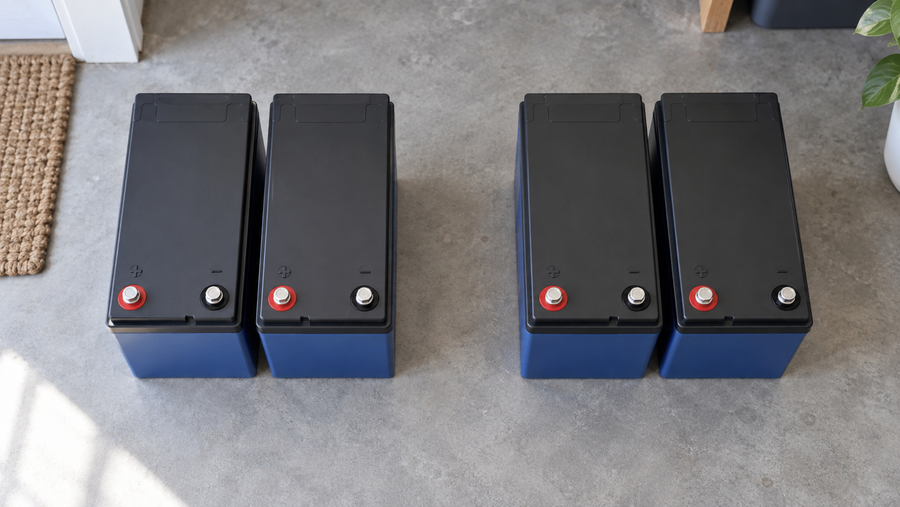
In practice, that means a cabin can comfortably run on three or four 5 kilowatt-hour LiFePO4 modules, or one to two 10 kilowatt-hour wall-mounted packs, provided the solar array is sized to refill them between visits. Case studies of 12-volt 100 amp-hour LiFePO4 batteries show that a single 1.2 kilowatt-hour module can keep a small cabin’s lights, efficient refrigerator, laptop, and phone charging going for weekend use, and that adding more identical 100 amp-hour batteries in parallel is an easy way to scale up storage as needs grow, as described in Anern’s 100 amp-hour off-grid case study.
For a full-time efficient home in the 10 kilowatt-hour per day range, the math we walked through earlier points to roughly 40 kilowatt-hours of lithium storage as a strong starting point for genuine off-grid comfort with three days of autonomy. That is often implemented as four 10 kilowatt-hour LiFePO4 batteries, which aligns with design guidance that 10–15 kilowatt-hour modules are well suited to higher-consumption homes.

If you prefer lead-acid and want the same autonomy and comfort, you would be looking at more than 70 kilowatt-hours of storage, which, in practical terms, is a bank in the range of seven or eight 10 kilowatt-hour-equivalent batteries once you respect the 50 percent depth-of-discharge limit and the need for extra capacity to cover inefficiencies, as shown in lead-acid-focused off-grid guides like Suninone’s off-grid battery sizing examples.
Do Not Oversize Batteries and Starve the Solar
True off-grid reliability does not come from batteries alone. Your solar array has to be big enough to power daytime loads and fully recharge the battery bank in your worst solar season, which is why standalone system calculators divide daily kilowatt-hour needs by average peak sun hours and then add 10–20 percent to account for losses and poor weather. For example, an off-grid calculator that works a 5 kilowatt-hour per day load in a four-peak-sun-hour location recommends about 1,250 watts of panels and then increases that by roughly 10–20 percent to land around 1.4–1.5 kilowatts, an approach mirrored in the altE Store off-grid system sizing calculator and similar guides that stress real-world losses.
Panel output also swings seasonally. Guides to off-grid batteries and solar note that winter sunlight can be far weaker and shorter than summer, with some locations seeing only a fraction of summer output. That is why solar and storage references recommend either oversizing the array, adding generator backup, or both, and why off-grid battery sizing discussions warn against building an enormous battery bank with an undersized array. You can end up with batteries that never fully charge in bad weather, shortening their life and failing to deliver the autonomy you paid for. Instead, many experts now suggest relatively larger solar arrays paired with right-sized battery banks, a shift echoed in off-grid design discussions and basic sizing guides.
The inverter also has to match the system. Off-grid battery tutorials describe choosing inverter size based on peak simultaneous load, adding up the watts of all devices that might run at once and picking an inverter with a continuous rating above that number and enough surge capacity to handle motor starts. Sizing references and off-grid calculators consistently remind readers that an undersized inverter can trip even if the batteries are full, while a massively oversized inverter wastes money and can be less efficient at very low loads.
FAQ
Can you go fully off-grid with just one battery?
Technically, yes, but for any home-like usage, a single battery is almost always inadequate. Off-grid battery guides show that even a modest system around 4.25 kilowatt-hours per day needs roughly 12.75 kilowatt-hours of usable storage for three days of autonomy, which already exceeds what a single 10 kilowatt-hour unit can safely deliver when you account for depth of discharge and inefficiencies, a point made clear in preparedness-style battery sizing examples such as BattlBox’s off-grid battery guide. For full-time off-grid homes in the 10 kilowatt-hour per day range, multi-battery banks are the norm, with lithium-based designs often starting around four 10 kilowatt-hour units to hit realistic autonomy targets.
Is it smarter to spend more on batteries or on solar panels?
Recent off-grid design discussions and solar-electric forums note a shift toward relatively larger solar arrays and more modest, well-sized battery banks because panels have become cheaper while batteries remain one of the most expensive components. Off-grid system calculators from sources like the altE Store and practical battery guides emphasize that your array must be large enough to fully recharge the bank during poor-sun seasons and that adding more panels often improves reliability more than simply stacking additional batteries that may rarely be charged to full. A balanced design uses enough solar to meet daily loads plus recharge needs, with a battery bank sized for your autonomy target and chemistry, not just maximized for its own sake.
Can you mix old and new batteries in an off-grid bank?
Off-grid battery wiring tutorials advise against mixing old and new batteries, especially in parallel, because the weaker, older batteries tend to drag down the performance of newer ones and can shorten the lifespan of the entire bank. Practical battery sizing guides on off-grid systems explain that mismatched batteries charge and discharge unevenly, causing imbalances that stress cells and reduce usable capacity over time, and they explicitly recommend building banks from matched batteries and adding capacity in matched sets if you expand later, as outlined in off-grid battery-wiring references such as this Instructables sizing and wiring guide.
Cutting the cord completely is not about guessing a battery count; it is about running the numbers on your loads, choosing a realistic autonomy target, picking the right chemistry, and matching it with a solar array and inverter that can keep up. Do that, and your battery bank stops being a gamble and becomes a predictable, upgradeable power plant that keeps your lights on and your generator quiet year after year.