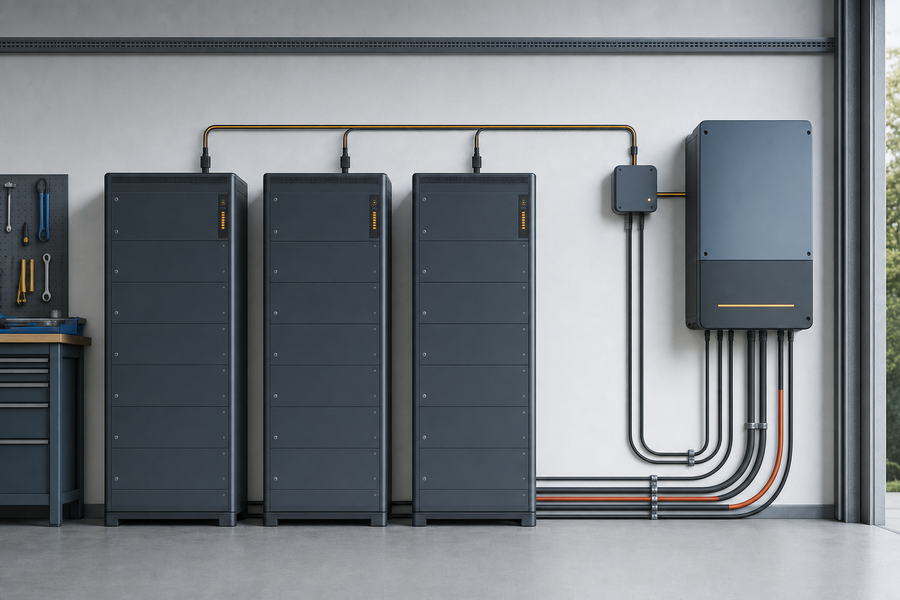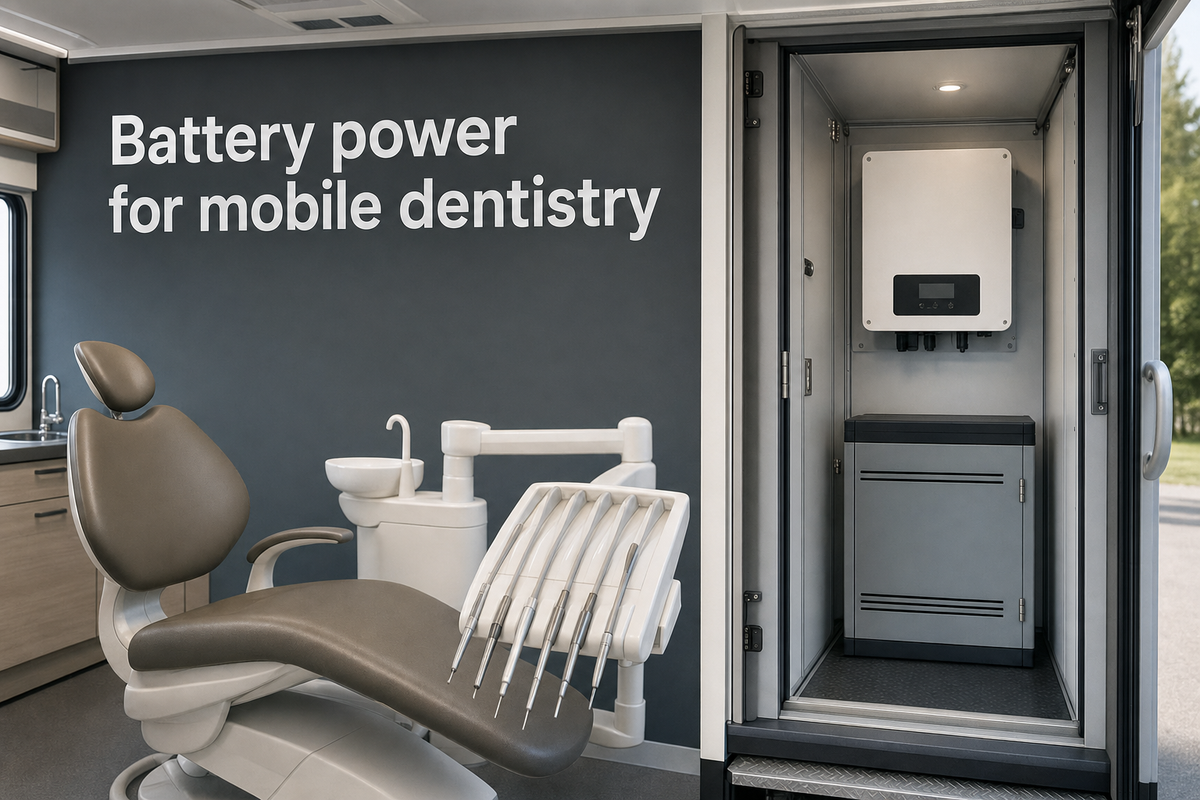

A mobile dental unit is not just a collection of small appliances. It may combine a compressor, suction, handpieces, lighting, controls, water systems, computers, imaging equipment, and charging electronics in a space where weight, heat, noise, and reliability all matter. The battery therefore has to be designed as part of the complete power chain—not selected by voltage or amp-hours alone.
The right system must deliver enough instantaneous power to start motor-driven equipment, enough usable energy for the planned treatment schedule, and clean, protected power that matches every connected device. It also needs a safe charging method, clear monitoring, and an installation that can withstand vehicle movement and clinical cleaning.
Start with the dental unit’s actual electrical loads

Begin with the equipment list for the exact unit. Do not size from the phrase “mobile dental unit”: configurations vary substantially.
Typical loads may include:
- An oil-free air compressor and air tank
- A suction pump or vacuum system
- High- and low-speed handpiece controls
- A three-way syringe and water pump or solenoid valves
- Operating lights
- A chair, if the unit includes one
- A laptop, monitor, networking equipment, or electronic records system
- An intraoral camera, curing light, scaler, or other accessory
- An X-ray generator or digital imaging system, if permitted and included in the design
- Ventilation, refrigeration, or auxiliary vehicle loads
A portable-unit project report describes a system built around compressed air, suction, dental tools, a battery, and an inverter. A commercial portable-unit manual likewise lists an integrated compressor, air tank, handpiece, water bottle, drain bottle, and foot control. Those examples show why the battery must be matched to the complete configuration rather than to the handpiece alone. They are examples, not universal specifications.
Collect the rated voltage, running watts or amps, and startup information from each manufacturer’s manual or nameplate. If a device lists only amps, record the voltage and whether the rating is running or maximum current. Ask the equipment supplier for startup or inrush current when a compressor, pump, X-ray system, or other motor-driven load is involved.
Separate power, energy, and surge capacity
Three different questions are often mixed together:
- How much power is needed at one moment? This is measured in watts or VA and determines inverter and wiring capacity.
- How much energy is needed over a session? This is measured in watt-hours and determines battery capacity.
- How much surge is needed at startup? This is a short-duration demand that can cause an inverter or battery-management system to trip even when the average load looks modest.
A compressor illustrates the problem. It may run intermittently, but its motor can demand substantially more power while starting. Suction pumps and other motors can behave similarly. A system that handles the average running load but not startup may shut down when the compressor cycles on.
The inverter must be checked for continuous output, short-duration surge output, output voltage, frequency, waveform, and protection features. The dental equipment manufacturer—not a general battery seller—should confirm that the proposed inverter output is acceptable for the unit. If the dental-unit manual specifies a particular supply voltage or grounding arrangement, the battery/inverter installation must reproduce the required conditions rather than assuming that a nominally similar voltage is sufficient. One portable-unit manual, for example, instructs users to verify the named supply voltage, use proper grounding, and avoid sharing an unstable socket with other equipment. Read the portable dental unit’s electrical-safety instructions for the exact model before designing around it.
Calculate the battery from the treatment pattern
A useful first estimate is:
Required battery energy ≈
(average AC load × operating hours ÷ inverter efficiency)
+ charging and auxiliary losses
Then add a design margin appropriate to the equipment, temperature, battery limits, and the consequence of interruption. Use the battery manufacturer’s stated usable-energy limits rather than assuming every watt-hour on the label is available in service.
For a simple illustration, suppose measured equipment averages 600 watts while active and the team expects four active hours. The load requires 2,400 watt-hours at the AC output. At an assumed 90% inverter efficiency, the battery would need to supply about 2,667 watt-hours before any additional margin or reserve. This is not a recommendation for a particular unit; it demonstrates the calculation. Replace the illustrative numbers with measured data and the manufacturer’s limits.
Also calculate the DC current. At 2,667 watts on a 12-volt battery, the theoretical current is more than 220 amps before losses. That affects cable size, fusing, connectors, busbars, heat, and battery-management-system limits. A higher-voltage battery architecture can reduce current for the same power, but it introduces different isolation, service, and equipment-integration requirements. The battery voltage should be chosen with a qualified designer and the dental equipment’s approved power architecture in mind—not simply because a higher voltage appears more efficient.
Account for intermittent compressor and suction duty cycles
Average energy use can be estimated from a duty cycle, but it should be validated in the real unit. A compressor that runs for part of a procedure may consume less energy than its nameplate maximum over a full shift, yet it still controls the inverter’s surge requirement each time it starts.
Ask these practical questions before final sizing:
- How many minutes per hour does the compressor normally run?
- Does it restart frequently during handpiece use?
- Can compressor and suction start at the same time?
- Which loads must remain available during a low-battery condition?
- Is the unit used for short home visits, a full outreach day, or several sessions between charges?
- Will imaging, sterilization, or vehicle HVAC share the battery?
A short monitored trial is more useful than a guess. Measure the AC input with a suitable power meter during startup, idle, compressor cycling, suction operation, and the most demanding permitted combination of loads. Have the equipment manufacturer or a qualified technician interpret measurements around medical equipment; do not place a meter or test device in a way that compromises electrical safety.
Specify the supporting hardware, not only the battery

A dependable installation normally requires a coordinated set of components:
Inverter
Choose an inverter whose continuous and surge ratings exceed the measured load and startup demand. Confirm voltage, frequency, waveform, grounding and neutral behavior, overload response, and compatibility with sensitive electronics. “Pure sine wave” may be a sensible design requirement for some equipment, but compatibility must still be confirmed with the dental-unit manufacturer.
Charger and charging sources
The charger must match the battery chemistry, voltage, and approved charging profile. Decide whether charging comes from shore power, the vehicle alternator, solar, a generator, or more than one source. Each source needs appropriate current limits, protection, and isolation. Charging while driving may require vehicle-specific design and professional installation; it should not be improvised by connecting a large battery directly to an alternator.
Protection and disconnects
Include appropriately rated overcurrent protection, a service disconnect, short-circuit protection, cable protection, and a clear means of isolating the battery before maintenance. A qualified installer should determine ratings from the actual fault current, conductor size, installation method, and applicable local requirements.
Monitoring and controls
The operator should be able to see state of charge, battery voltage, charging status, inverter load, alarms, and remaining reserve in a useful way. A voltage-only display can be misleading under changing loads. Set a reserve policy that protects the clinical schedule: for example, stop nonessential loads and return for charging before the system reaches its protective shutdown threshold.
Mechanical and thermal integration
Secure the battery, inverter, charger, and cables against vibration and movement. Provide ventilation and heat management according to each manufacturer’s instructions. Keep electrical components away from water bottles, drain containers, wet cleaning areas, and waste systems. Leave access for inspection, fuses, disconnects, and service labels.
Design around clinical continuity and safety
Power interruption during treatment is more than an inconvenience. It can interrupt suction, lighting, communication, records, or a procedure. Separate essential from nonessential loads where practical, and document what happens when the battery is low, the inverter overloads, or shore power is lost.
Do not assume that a battery system makes a dental unit medically compliant. The dental device, vehicle conversion, wiring, grounding, patient environment, and local rules all matter. Mobile medical-vehicle electrical work may be subject to requirements such as vehicle electrical codes and medical-facility standards, but the applicable rules depend on the jurisdiction and installation. Use the authority having jurisdiction and qualified professionals to determine what applies.
The portable-unit manual cited above calls for proper grounding, matching the named supply voltage, unplugging before maintenance, regular inspection of cords and plugs, and periodic safety checks by trained personnel. It also warns against operating outside the specified environment. These are useful reminders that battery power does not remove ordinary electrical, infection-control, or equipment-maintenance duties.
Commission the system before patient use
A commissioning checklist should include:
- Verify every equipment voltage, frequency, polarity, grounding arrangement, and maximum load.
- Confirm inverter continuous and startup performance with the actual connected equipment.
- Test compressor and suction cycling, including the highest expected simultaneous load.
- Check charger operation from every planned charging source.
- Test low-battery alarms, overload behavior, disconnects, fuses, and emergency shutdown.
- Inspect cable routing, strain relief, enclosure clearances, labels, and mechanical restraints.
- Run a representative treatment-day simulation and record battery state of charge, temperatures, alarms, and reserve.
- Document the approved load list, charging procedure, inspection intervals, and service contacts.
Repeat the test after adding equipment or changing the battery, inverter, charger, wiring, or vehicle layout. A new accessory can change both the energy budget and the startup interaction between loads.
A practical specification brief for a system designer
Give the installer or system integrator more than a desired battery voltage. Supply:
- The exact dental-unit model and manuals
- A complete load schedule with running and startup values
- Treatment hours and expected duty cycles
- Required reserve and charging time between sessions
- Available shore, vehicle, solar, or generator inputs
- Physical location, ambient conditions, ventilation, and vibration exposure
- Essential-load priorities and acceptable shutdown behavior
- Applicable vehicle, electrical, medical, and workplace requirements
This information lets the designer select battery energy, discharge capability, inverter surge, charger size, conductors, protection, and monitoring as one system.
Bottom line
A mobile dental unit requires a battery system that can do two jobs at once: supply enough watt-hours for the planned clinical schedule and deliver enough instantaneous power for compressors, suction, and other startup loads. It also requires a compatible inverter, correctly matched charger, protection, monitoring, mechanical restraint, thermal management, and documented commissioning.
The safest path is to measure the actual unit, model its duty cycle, confirm electrical compatibility with the equipment manufacturer, and have a qualified professional design and test the installation. For broader battery-sizing concepts, see this guide to how many batteries an off-grid system may need—then return to the dental unit’s measured loads and clinical workflow before making a purchase.