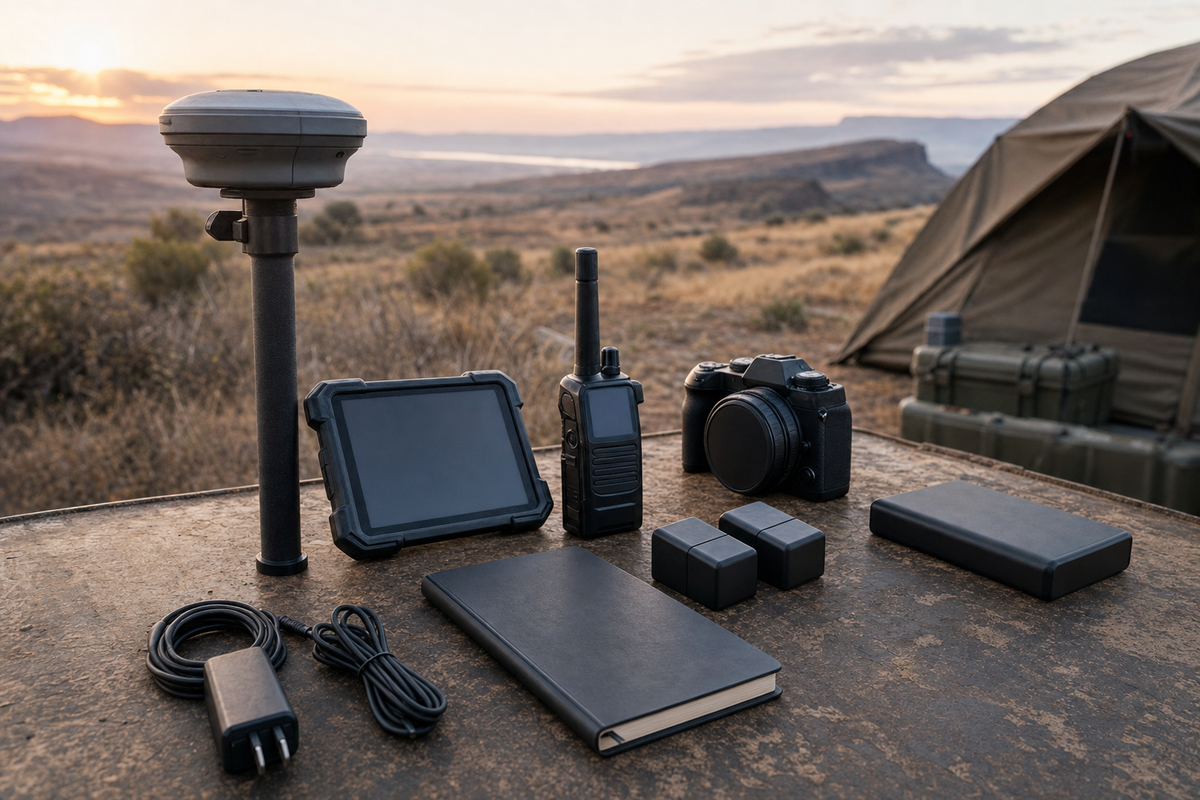

Battery planning for a scientific survey is not a matter of adding up the labels on a few power banks. It is an operations problem: what must run, for how long, when can it be recharged, and what happens if a day lasts longer than expected? A good plan produces a daily watt-hour budget, a recovery plan, and a fallback for mission-critical instruments.
Start with the field schedule, not the battery
Write the trip as a sequence of operating days and charging opportunities. Separate travel, base-camp, transit, and active survey periods. A GPS logger that records continuously, a radio used for short calls, and a laptop used for an hour at camp are different loads even if they all use “small” batteries.
For each device, record:
- device and battery type;
- quantity and whether its battery is removable;
- expected hours powered or number of readings per day;
- charging connector and input requirements;
- whether it is mission-critical, useful, or optional;
- the evidence behind the estimate: manual, label, measured draw, or a cautious assumption.
Mark the devices that protect safety, data integrity, navigation, or communication. Those loads get their own reserve and should not depend on the same single point of failure as entertainment or convenience charging.
Convert the inventory into watt-hours

Use one unit for comparison. Watts measure the rate of use; watt-hours measure energy used over time. For a device with a known power draw:
daily Wh = watts × hours of use
If you know battery voltage and amp-hours instead, use:
battery Wh = volts × amp-hours
That is nominal stored energy, not a promise of usable output. Real runtime varies with efficiency, temperature, battery age, load, and the device’s charging behavior. The watt-hour calculation explained here is useful when labels use amp-hours rather than Wh.
A practical worksheet might look like this:
| Load | Planning assumption | Daily energy |
|---|---|---|
| GNSS receiver | 6 W for 8 hours | 48 Wh |
| Tablet for data entry | 12 W for 3 hours | 36 Wh |
| Radio charging | 8 W for 1 hour | 8 Wh |
| Camera batteries | 15 W for 1 hour | 15 Wh |
| Daily total | 107 Wh |
These figures are an example of the method, not a runtime claim for any particular instrument. Replace them with measured or manufacturer data where possible. If a device only gives battery capacity, estimate how many batteries the schedule consumes and convert each battery to Wh; do not add a battery’s Wh and the device’s charger Wh as though they were separate loads.
Add the losses and reserve explicitly
The 107 Wh in the example is energy at the device level. A shared battery feeding chargers or an inverter will lose energy in conversion. Use the efficiency stated for your actual power path if available. If it is unknown, label your assumption rather than hiding it in a reassuringly precise total.
Then add reserve by scenario, not by habit:
- Routine plan: normal survey hours and the charging opportunities you genuinely expect.
- Delayed-return plan: at least one extra operating period for weather, access, or transport disruption.
- Failure plan: enough protected energy for the critical navigation, communication, and data-preservation loads while optional loads are shut down.
For example, if the daily load is 107 Wh, two routine days require 214 Wh before conversion losses and reserve. A three-day stay with no dependable charging needs a different capacity than a three-day stay with a verified charge window each evening. State the assumption beside the number; “three days” alone says very little.
Design around recovery, not just storage
A battery is only one part of the system. Decide how energy returns to it:
- Mains at a lodge or field station: confirm outlet access, charging hours, connector compatibility, and whether the team can charge several devices at once.
- Vehicle charging: check the vehicle socket, adapter limits, engine-running policy, and whether the vehicle will actually be nearby during survey days.
- Solar: treat it as a weather-dependent input. Estimate usable collection time, controller compatibility, shade, and a way to keep the panel oriented without compromising fieldwork.
- Generator or larger power system: account for fuel, noise, ventilation, weather protection, and who is responsible for operation.
Build a charging timetable. Give priority to batteries that will be needed first, and recharge during low-demand periods. Do not count a theoretical solar or vehicle input as recovery until you have tested it with the real cable, charger, and battery system.
For larger off-grid systems, a related off-grid battery planning guide can help with the broader storage-versus-recharge question, but the survey schedule and equipment loads still determine your actual requirement.
Plan for conditions that change the estimate

Cold
Cold can change both available capacity and charging behavior, but the effect depends on the battery, device, load, and manufacturer limits. Keep batteries insulated and dry, carry spares close to the team rather than exposed on a pack exterior, and check the battery manual for operating and charging temperatures. Never assume a generic “cold-weather percentage” applies to every chemistry or instrument.
If charging must happen in cold conditions, establish the allowed charging temperature before departure. A battery that can discharge in a cold environment may still have a different charging limit. Use the battery management system and charger instructions as the controlling information.
Wet, dust, and vibration
Protect connectors and charging gear in separate labeled pouches. Use covers where the equipment maker permits them, keep wet gear from entering a charging bag, and provide strain relief for cables. A capacity calculation cannot compensate for a corroded connector or a cable that fails after repeated movement.
Uneven workloads
Survey days rarely match the spreadsheet. A long transect may increase GNSS and radio use; a data-quality problem may extend tablet or laptop time. Give each day its own budget when the schedule is uneven. If the same battery serves several devices, define a shutdown order so the team knows what gets preserved first.
Choose redundancy by consequence
Do not duplicate every charger equally. Classify each failure:
- Stop-work failure: loss of a required instrument, navigation, emergency communication, or irreplaceable data path.
- Degraded-work failure: slower logging, fewer photos, or manual notes.
- Comfort failure: personal electronics and nonessential charging.
For stop-work loads, consider a separate spare battery, duplicate charging path, or independent instrument—whichever removes the most plausible single failure. Keep the critical reserve physically and operationally distinct. A “spare” that is stored in the same damaged case or requires the same failed cable is not real redundancy.
Transport batteries before departure
Battery transport is a separate planning task. Identify chemistry, watt-hour rating, whether the battery is installed in equipment, and the rules for every transport mode. For air travel in the United States, the FAA says spare or uninstalled lithium batteries and power banks must be in carry-on baggage, with terminals protected against short circuits. Its current guidance generally permits lithium-ion batteries up to 100 Wh; 101–160 Wh spares require airline approval and are limited to two per passenger. Airlines may impose stricter limits, so check the carrier before packing. See the FAA PackSafe lithium-battery guidance rather than relying on a general packing list.
For road, vessel, or international shipment, rules and documentation can differ. Use the battery manufacturer’s shipping information and the carrier’s current requirements. Do not place damaged, swollen, recalled, or otherwise suspect batteries into ordinary field luggage; isolate the issue and obtain qualified handling advice.
Test the whole plan before the trip
A bench test should imitate the mission, not merely confirm that each battery turns on. Run the actual instruments, cables, chargers, adapters, and logging workflow for a representative day. Record starting and ending state, charging time, weather or room conditions, and which loads were simultaneous.
Before departure, verify that:
- every device has a labeled charging route and backup route;
- cables and adapters are compatible and spares are included;
- batteries are dated or otherwise trackable;
- the reserve is protected from casual use;
- the team knows the shutdown priority;
- the charging timetable works with the real itinerary;
- transport limits and terminal protection are documented;
- data can be copied or preserved before power becomes critical.
A compact field calculation
Use this sequence:
- List every load and its daily operating pattern.
- Convert each load to Wh; use measured draw where uncertainty matters.
- Total each day separately.
- Add conversion and charging losses for the actual power path.
- Model a normal, delayed-return, and failure scenario.
- Subtract only charging inputs you have verified and scheduled.
- Divide the remaining need among primary storage, protected reserve, and recovery equipment.
- Test the complete arrangement under realistic conditions.
The result should be a plan the field team can operate, not just a capacity figure. If the number is uncomfortable, reduce consumption first—shorten duty cycles, turn off radios between checks, batch data transfers, or remove optional loads—then revisit storage and charging. Our related guide to off-grid power for surveillance towers illustrates the same principle at a fixed installation: the load profile and recovery plan matter as much as nominal battery capacity.