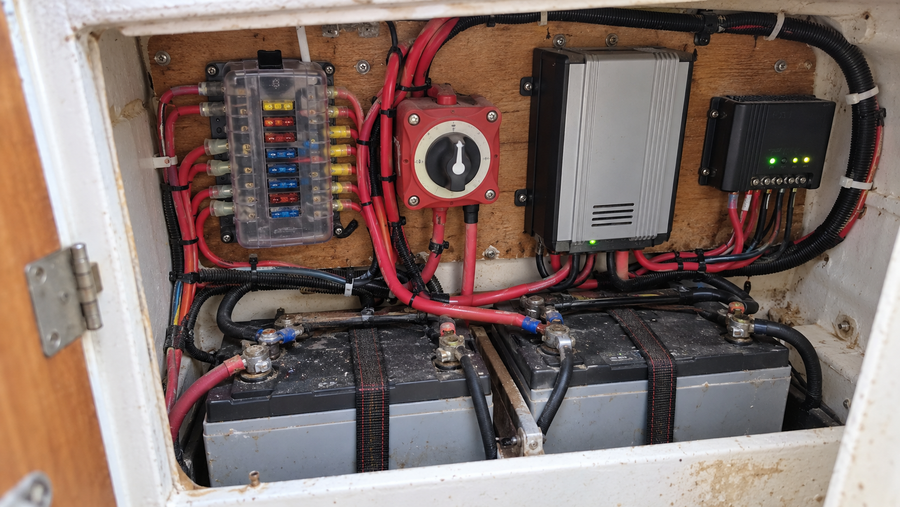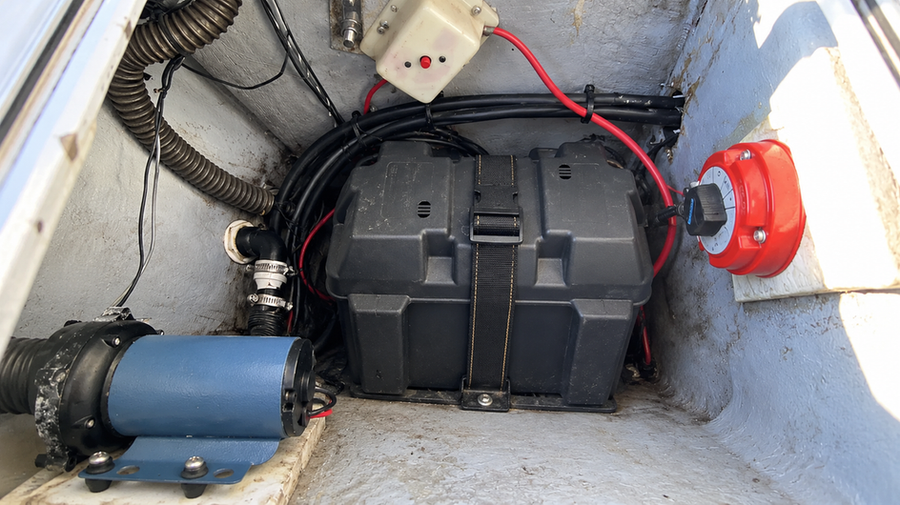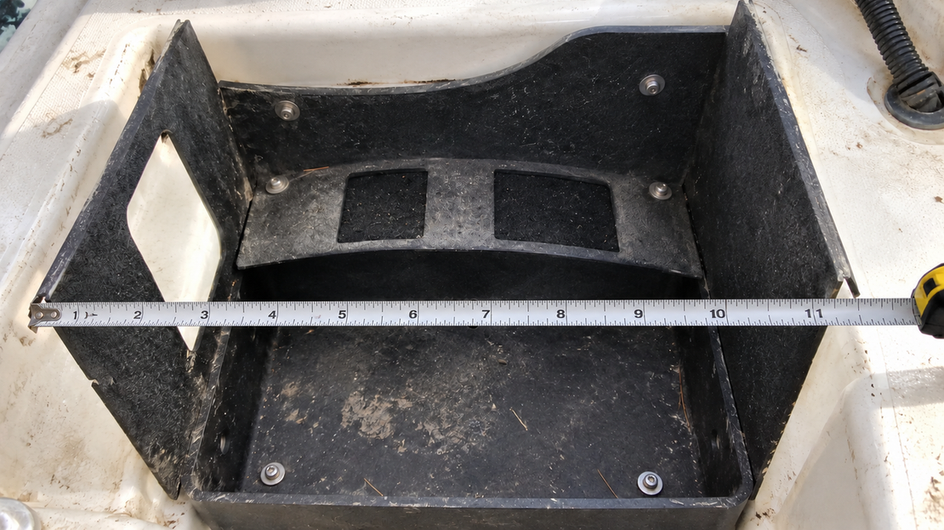

To choose between Group 24, 27, and 31 marine batteries, first measure the available tray space, then estimate the energy your onboard loads need for the time between charges. Compare those two requirements with the dimensions and capacity rating of each specific battery; a group label alone does not establish that a battery will fit or provide enough usable capacity.
What the group number actually tells you
Group sizes refer to standardized battery case dimensions and terminal layout, while amp-hours (Ah) describe electrical capacity. Batteries with the same group label can have different capacity ratings, so check both the dimensions and the label of the specific battery.
For engine-starting needs, check the battery's cranking rating against the engine requirements. For house loads such as lights, pumps, and electronics, compare the required energy with the battery's capacity rating.
Measure your tray before you shop

Measure the inside length, width, and height of the battery compartment or hold-down tray. Account for brackets, cables, and covers that reduce usable space, and note the terminal position on the current battery.
Use the dimensions listed for each specific battery to compare its case and terminal layout with the available space. Do not assume that one group size will fit a tray intended for another; choose only a battery whose dimensions and terminal arrangement work in your compartment.
Match capacity to what your boat actually draws
List the devices you plan to run and how long each will operate between charges. For each device, use its stated electrical consumption and operating voltage to estimate energy use over that period, then add the loads. If the device is rated in watts, multiply watts by operating hours to estimate watt-hours; converting that estimate to amp-hours requires the applicable system voltage. For devices with converters or other power-system losses, account for those as well rather than treating the estimate as an exact battery requirement.
Compare the resulting load estimate with the battery's rated capacity and the usable-capacity limits for that specific battery. Sizing also depends on factors such as the time the battery must supply the load, discharge rate, temperature, aging, and the maximum depth of discharge appropriate to the battery. A higher depth of discharge can affect lead-acid battery life, so do not apply one fixed usable-capacity fraction to every battery.
After measuring the compartment and estimating the load for the time between charges, compare the eligible batteries' dimensions and capacity ratings. A battery is a candidate only if it fits the available space and its capacity suits the load; if no battery in one group meets both conditions, compare another group using its specific battery specifications.
For a lithium option in the Group 31 size, the Vipboss 12V 105Ah Bluetooth battery provides 1,344Wh of stored energy while weighing about 24.2 pounds. It combines Bluetooth monitoring with a built-in 100A smart BMS for overcharge, over-discharge, overcurrent, short-circuit, and temperature protection. Its IP65 enclosure and low-temperature charge protection make it well suited to a properly installed marine house-power system, especially when space, usable energy, and weight all matter.
FAQs
What does a marine battery group number actually tell you?
Group numbers refer to standardized case dimensions and terminal layout, following BCI Group Size specifications, not to capacity. Batteries with the same group label can have different amp-hour ratings, so always check the specific battery's dimensions and capacity rating.
How do I calculate the battery capacity my boat needs?
List each device, use its stated electrical consumption and operating voltage, and multiply watts by operating hours to estimate watt-hours for the time between charges; convert watt-hours to amp-hours by dividing by the applicable system voltage. Add the loads and account for converter or other power-system losses, then compare the estimate with the specific battery's rated and usable capacity while considering discharge rate, temperature, aging, and the appropriate maximum depth of discharge.
How do I choose between Group 24, Group 27, and Group 31 for my boat?
Choose only a specific battery that fits the compartment's measured length, width, height, terminal position, brackets, cables, covers, and hold-down arrangement. Among the batteries that fit, select one whose capacity meets the house-load estimate and whose cranking rating meets the engine requirements when starting duty is needed.