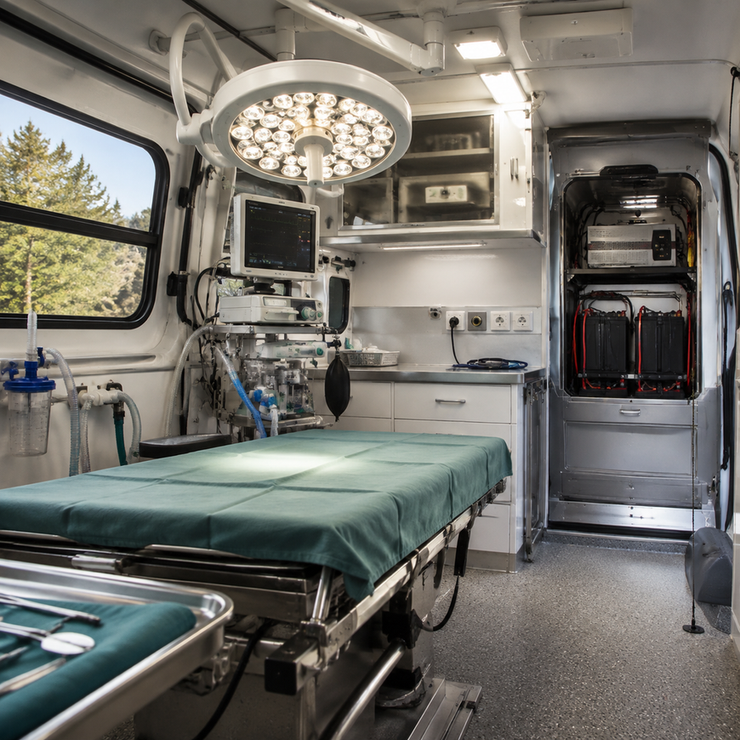

In a mobile veterinary surgery setting, a power interruption can remove surgical lighting, suction, electrosurgical capability, and video displays at the same time. What appears to be a vehicle-power problem can quickly become a procedure-continuity problem.
The practical goal is not simply to buy a larger battery or inverter. It is to identify the equipment that must remain available during a procedure, verify its actual electrical requirements, and build a tested backup path for when the primary source is unavailable.
Treat Power Loss as a Surgical-Continuity Risk

A mobile unit has less margin for improvisation than a fixed facility. It may be parked away from shore power, moving between appointments, or relying on onboard energy storage while clinical work is underway.
When electrical power is lost in a surgical environment, lighting, suction, electrosurgical units, and video displays can all be affected. That creates simultaneous disruptions rather than a single failed appliance. For a mobile practice, the right response is to decide in advance which loads are protected and which can be shed first.
Use a simple three-tier load hierarchy:
- Protected procedure-support loads List the equipment the veterinarian, equipment manuals, and practice protocols identify as necessary for the procedures being performed. Give these circuits priority for stored reserve and backup power.
- Clinically important but deferrable loads Include equipment that supports workflow or patient care but may be paused, rescheduled, or managed differently during an outage according to the practice's protocols.
- Convenience and comfort loads Put nonessential loads here: items that can be switched off first to preserve available energy for protected circuits.
This exercise should be completed for the actual vehicle and the actual service schedule. A load that is acceptable to shed during travel may not be acceptable to lose while a procedure is in progress.
Size the System From Equipment Labels, Not a Battery Headline

Battery capacity alone does not tell you whether a mobile surgery power system will perform as needed. The plan must account for two different demands:
- Running demand: the power equipment uses while operating.
- Startup demand: the short, higher demand some equipment requires when starting.
Motors, compressors, and pumps may require two to three times more power at startup than while running. That is a general planning reference, not a substitute for the manufacturer's stated inrush or startup requirement for a specific device.
For each piece of equipment, record the information from its label and manual rather than relying on estimates or generic online wattage charts.
| Record for Each Load | Why It Matters |
|---|---|
| Device name and model | Connects the worksheet to the correct manual and specifications |
| Rated running watts | Helps identify simultaneous operating demand |
| Manufacturer-listed startup or inrush requirement | Helps determine whether the inverter can handle equipment starting events |
| Expected operating duration | Shows how much stored energy is needed across the day |
| When it operates | Reveals which loads overlap during a procedure |
| Priority tier | Determines what remains powered if energy must be conserved |
| Primary and backup source | Makes single-source dependencies visible |
Start by identifying the equipment that may run at the same time, not every device installed in the vehicle. Simultaneous running loads and startup behavior shape the inverter requirement. The expected operating schedule, plus an emergency reserve, shapes the energy-storage requirement.
A LiFePO4 battery bank may be part of the stored-energy side of that plan, but it does not establish that a vehicle can support a particular medical or surgical device. Compatibility, installation, charging, and equipment requirements still need to be verified as a complete system.
Build Layers for Stored Energy, Recharging, and Backup
Reliable mobile power is usually a layered plan rather than a single source. Each component has a distinct role:
- Stored energy provides quiet, immediate reserve power between charging opportunities.
- Shore power can recharge the system when an appropriate connection is available.
- Alternator charging may replenish energy while the vehicle is operating, subject to the installed vehicle-specific charging design.
- Generator power can provide another energy source where its use is appropriate for the route and setup.
- Solar-hybrid charging may reduce fuel use, but weather conditions and available energy still need to be assessed.
Mobile-clinic designs may use diesel, gasoline, propane, or solar-hybrid generation approaches. The best choice is not universal; it depends on the vehicle's route, stop duration, fuel strategy, installed equipment, and the practice's reserve policy.
Solar should be treated as a contribution to the energy plan, not as an assumption that energy will always be available. A useful planning question is: if shore power is unavailable after several appointments, what restores the protected reserve, how long does that take under real operating conditions, and what happens if that source is unavailable too?
For broader perspective on how stored power can support vehicle-based field work, review this guide to lightweight lithium power for emergency communications vehicles. The operating mission differs, but the planning principle is the same: continuity depends on matching stored energy, charging access, and protected loads.
Treat Installation as Part of Reliability
A capable battery or inverter cannot compensate for poor integration. Grounding, wiring, ventilation, and secure mounting are all design considerations in a mobile-clinic power system.
Vehicle vibration, confined equipment spaces, heat, charging equipment, and generator arrangements make installation decisions inseparable from reliability planning. Final integration should be validated for the specific vehicle, power components, and veterinary equipment by qualified professionals, including the appropriate vehicle upfitter, electrician, and equipment supplier.
The same applies to any equipment with its own installation, operating, or power-quality requirements. Do not assume that an appliance or clinical device will operate correctly from a particular inverter or charging arrangement without confirming its documentation.
Test the Plan Before Surgery Day
A written load sheet becomes useful only when it is paired with routine checks. Before a surgical day, confirm:
- Available battery state of charge and the planned protected reserve
- Expected charging opportunities during the route
- Shore, alternator, generator, or solar-hybrid sources that are intended to be available
- Operation of protected circuits under planned simultaneous loads
- Equipment alarms and the practice's documented outage-response process
- Which nonessential loads will be turned off first if energy use must be reduced
Keep the procedure-specific response plan aligned with the veterinarian's protocols and the instructions for each device. The goal is not to invent an outage procedure while working in a vehicle; it is to know which loads are protected, what backup path is available, and when the practice should stop or defer work under its established clinical standards.
The key question is not, "How large a battery should we buy?" It is whether the practice can maintain its protected surgical loads through its real operating day and safely respond when one power source fails. Complete the equipment-level load sheet, establish a clinical reserve policy, test the system before surgery day, and then evaluate battery, inverter, charging, and monitoring components as parts of a verified mobile-power design.