
Build the backup-power plan around the products, equipment, and records your mobile unit actually carries. Start by identifying the loads that preserve required storage conditions and traceability, then have operations, quality, fleet, and qualified electrical stakeholders validate the design and outage procedures for that specific vehicle.
The objective is not to keep every outlet energized. It is to protect donors, preserve blood products and collection records, and give staff a documented path to reduce operations or stop safely when normal power is unavailable.
Start with the Protected Loads

Begin with an inventory of every product that may remain on the vehicle during setup, collection, recovery, post-collection handling, and return travel. Storage requirements determine which equipment belongs in the no-shed tier.
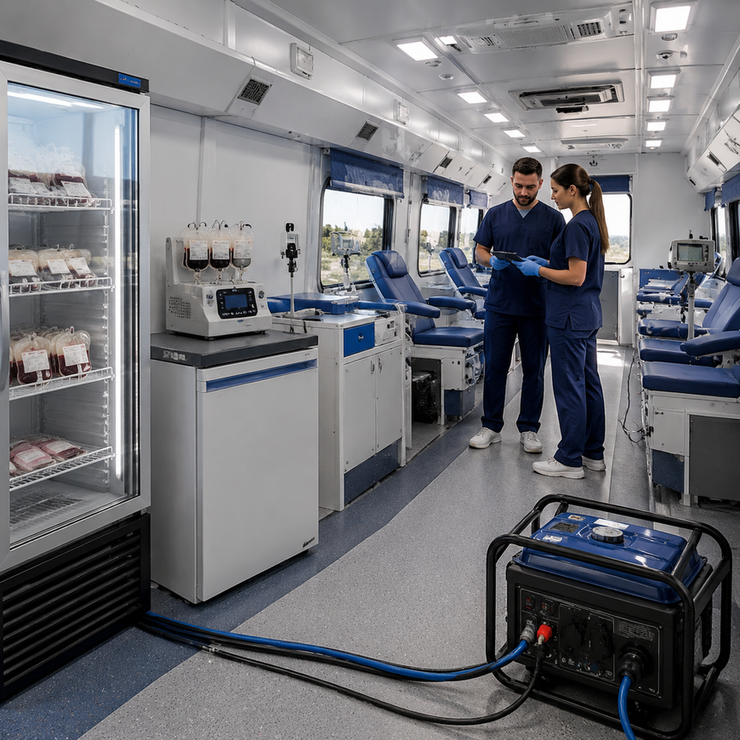
Under the applicable Title 21 blood-product standards, Whole Blood and Red Blood Cells are stored at 1–6°C. Platelets require storage at 20–24°C with continuous gentle agitation. Frozen plasma products must be stored at −18°C or colder. If the vehicle supports Cryoprecipitated AHF preparation, the source plasma must be frozen within 8 hours.
| Product or Workflow Present on the Unit | Protected Function to Identify | Planning Question |
|---|---|---|
| Whole Blood or Red Blood Cells | Refrigerated storage and its monitoring equipment | Which circuits keep the storage equipment and monitoring active? |
| Platelets | Temperature-controlled storage, continuous gentle agitation, and monitoring | Are both the storage and agitation loads protected? |
| Frozen plasma | Freezer and its monitoring equipment | Which power source supports the freezer through an outage or transfer? |
| Cryoprecipitate preparation workflow | The approved freezing workflow and its timing dependencies | What equipment and records must remain available to complete the approved process? |
| All collected products | Identification, labeling, and traceability records | Which devices need continuity power or a controlled shutdown? |
This table is not a universal equipment list. A unit that does not carry platelets, frozen plasma, or a cryoprecipitate workflow should not size its protected tier around those functions. Conversely, every product actually carried should be mapped to its specific storage equipment, monitoring method, and approved response procedure.
Create Three Load Tiers
A practical continuity plan separates circuits and devices into clear priorities:
- No-shed loads protect required storage conditions, monitoring, product identification, and any donor-care or safety functions identified by the blood center.
- Reduced-operation loads support an orderly, limited collection workflow when the normal source has failed.
- Deferrable loads can be switched off first without compromising the approved reduced-mode or shutdown process.
For each no-shed item, record the equipment name, circuit, normal power source, alternate source, alarm or monitoring dependency, and the staff member responsible for checking it after a transfer.
Map the Records and Communications Chain
A power interruption can affect more than cold storage. Collection, identification, labeling, local data storage, network access, and staff communications may all depend on separate devices or circuits.
Some blood-collection biomixers combine collection with data registration and may support barcode readers. That capability is not universal, so verify the configuration installed in each donor station rather than assuming every collection device has the same dependencies.
Use a simple dependency map for each station and process area:
| Area | Identify the Equipment and Dependency |
|---|---|
| Donor station | Collection device, any installed data-registration function, barcode reader, local power connection, and approved controlled-shutdown path |
| Product handling | Storage equipment, agitation equipment where applicable, temperature monitoring, and alarm indication |
| Records and labeling | Workstation, printer, scanner, local record storage, network equipment, and approved fallback process |
| Communications | Staff communications devices, connectivity equipment, and the approved escalation contact path |
| Vehicle operations | Shore-power connection, onboard power source, charging equipment, and the documented transfer responsibility |
The goal is to expose hidden single points of failure. A refrigerator may remain powered while the monitoring display, barcode scanner, labeling workstation, or communications device does not. Equally, a collection device may have power while its required data or identification workflow cannot continue.
Do not invent manual-record or alternate-labeling steps during an outage. Those workflows should already be approved by the blood center's quality system and matched to the installed equipment.
Define Runtime by Event Phase
Runtime should be based on the unit's real operating timeline, not on a generic battery or generator claim. List the expected period during which protected loads must remain available for each phase:
- Pre-departure checks and travel to the host site
- Setup and connection to site power, if used
- Active collection and donor recovery
- Post-collection handling and closeout
- Return travel or transfer to a receiving facility
- An outage, generator-failure, or severe-weather interruption at any point in that sequence
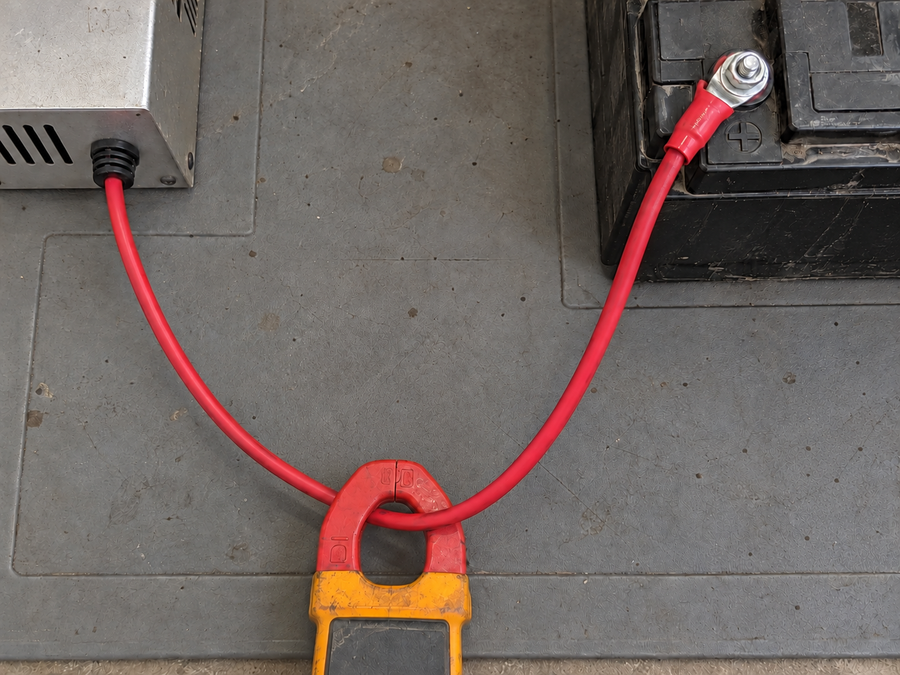
For each phase, document which loads must run continuously, which operate intermittently, and which can be shed. Then collect actual equipment nameplate information and operating data for the vehicle's installed storage, agitation, monitoring, collection, records, communications, charging, and other protected equipment.
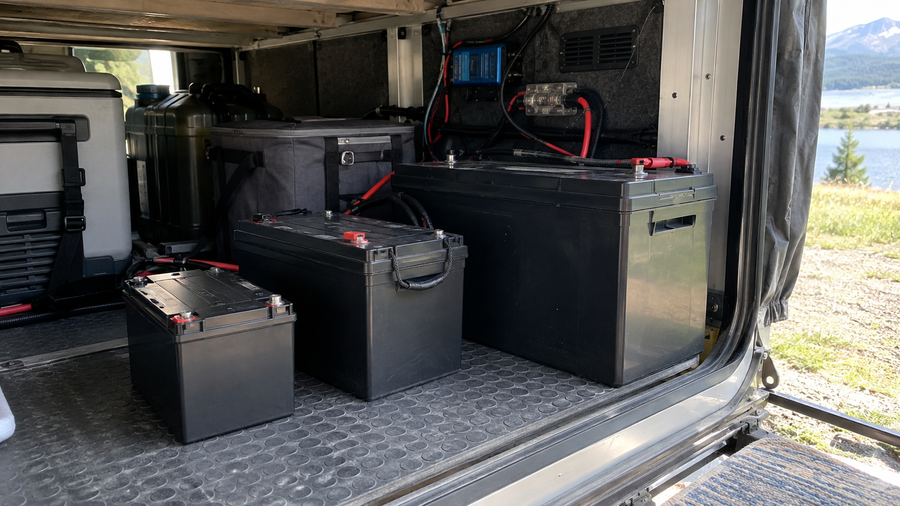
A qualified review should assess the complete arrangement: shore power, onboard generation if present, vehicle charging, battery and inverter equipment if used, circuit separation, transfer behavior, and the vehicle's approved electrical configuration. Do not treat alternator capacity, generator output, battery runtime, refrigeration holdover, or medical-equipment compatibility as assumptions.
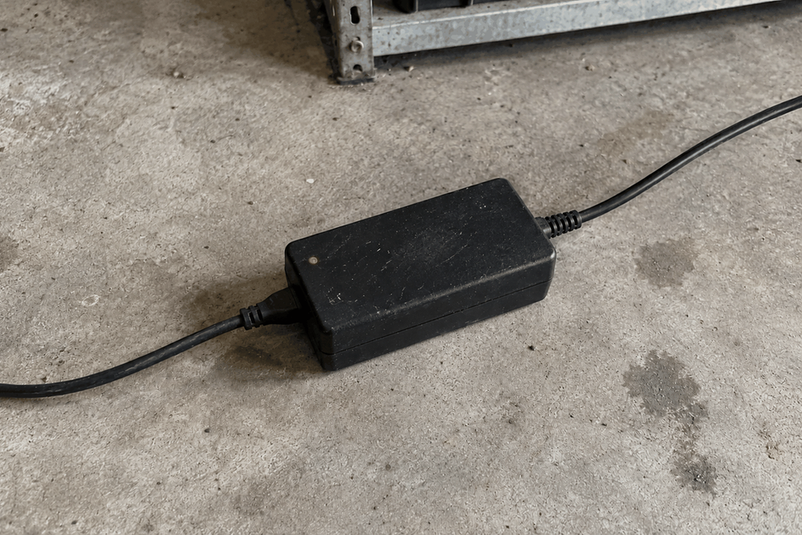
If the design includes a lithium upgrade to shore-powered charging, review the existing charging arrangement before changing components; this guide to shore-power charger replacement for a lithium upgrade can help frame that equipment conversation.
Write the Outage Procedure Before Deployment
The backup system and the operating procedure must match. A useful outage procedure identifies:
- Who confirms loss of normal power
- Who checks protected storage and monitoring equipment
- Who verifies the active power source and records the transfer
- Which nonessential loads are shed first
- Who confirms records, labeling, and communications availability
- Who has authority to pause or stop collection
- Which quality-system procedure governs product evaluation, quarantine, and disposition
Product excursions, donor-care decisions, collection continuation, and product disposition must follow the blood center's approved procedures for the exact product, equipment, and event. A power plan should support those decisions, not replace them.
Test the System as an Operating Workflow

A backup source that has not been exercised under the expected protected load is only a design assumption. Include functional testing, battery and fuel inspections where applicable, alarm checks, maintenance records, host-site power assessments, and staff drills in the operating plan.
During a drill, test the handoff between people as well as the handoff between power sources. Staff should be able to identify protected loads, confirm the status of storage and records equipment, communicate the event, and follow the approved reduced-operation or shutdown path without improvisation.
Controlled readiness means preserving the loads and records that protect donors and blood products—not simply keeping every outlet energized. Complete a load-and-runtime worksheet for the actual vehicle, validate it with quality, fleet, and electrical stakeholders, then assess verified Vipboss power-system options against that approved design.