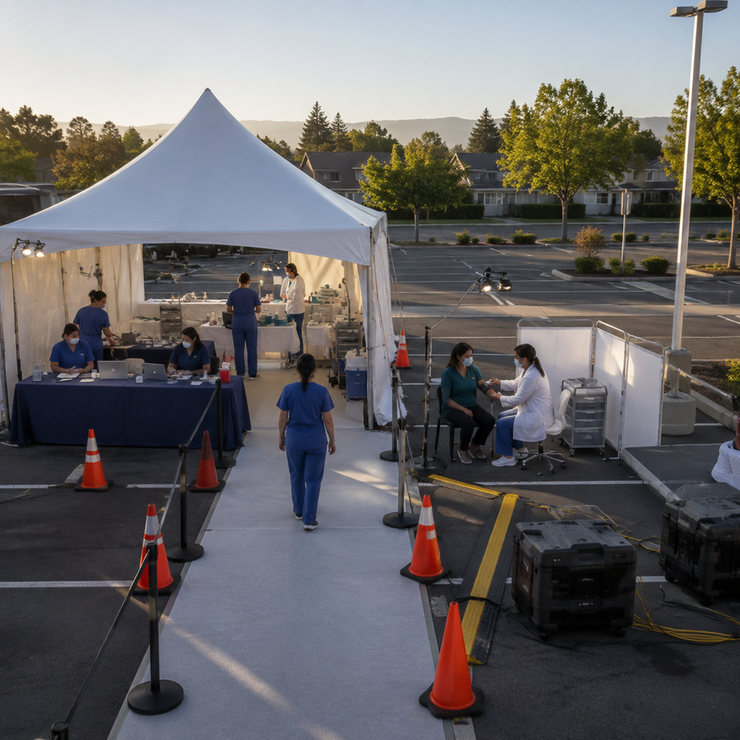

Build a mobile screening event around a measured, prioritized load list; a temporary-power arrangement with capacity for every connected load; and a written outage procedure with named staff roles. If vaccines or applicable RSV monoclonal antibody products are stored on site, add a documented storage contingency with a primary and alternate coordinator.
The goal is not simply to keep lights on. A loss of power can interrupt registration, connectivity, screening workflow, refrigerated storage, accessibility equipment, and patient flow. A resilient plan identifies what must continue, what can pause, and when services must stop safely.
Start with a Critical-Load List
Do not choose a generator, battery power station, UPS, or extension-cord layout before documenting the actual event loads. Temporary-power planning should calculate electrical demand so the supply has capacity for all connected loads, as outlined in temporary-power safety guidance.
Create a one-page worksheet for each event configuration—van, tent, community room, parking-lot site, or outdoor outreach station.
| Service Area | Device or Circuit | Verified Electrical Information | Priority During an Outage | Owner |
|---|---|---|---|---|
| Registration | Laptops, router, printer | Device label and manufacturer requirements | Continue or pause | Registration lead |
| Screening | Point-of-care or diagnostic equipment | Manufacturer instructions and measured demand | Continue only if verified | Clinical lead |
| Patient flow | Task lighting, accessibility equipment | Device documentation and actual use | Continue | Site lead |
| Records and communications | Network gear, charging, communications devices | Verified operating needs | Continue | Operations lead |
| Storage, if applicable | Refrigerated vaccine or product storage | Product and storage-unit procedures | Protect immediately | Vaccine coordinator |
For every connected item, record the electrical information on its label, any manufacturer requirements, and the event’s measured operating demand. Treat startup behavior, transfer tolerance, waveform requirements, and acceptable interruption time as device-specific questions—not assumptions.
Then assign each load one of three operating decisions:
- Must remain powered: Services or equipment needed to continue safe, approved operations.
- Can pause: Loads that may be shut down while the team stabilizes the event.
- Do not connect to backup: Convenience loads, nonessential charging, signage, or other items that would reduce available capacity for critical work.
This worksheet also makes the redundancy decision clearer. A portable battery may serve as a bridge or backup layer for a verified load, while another source may support the wider event. The correct architecture depends on the actual equipment, site conditions, manufacturer instructions, and qualified electrical review where needed.
Make the Physical Setup a Go/No-Go Decision

A power plan is incomplete until the physical layout is accepted before patient intake begins. Temporary-power equipment should be protected from vehicle traffic, accessible only to authorized people, and suitable for the expected environment. Equipment should also be rated for indoor or outdoor use as applicable.
Before opening, the site lead should confirm:
- Power equipment is positioned away from vehicle movement and patient traffic.
- Access to power equipment and distribution is controlled.
- Cords and wiring have been inspected for damage or alterations before use.
- The equipment selected matches the environment in which it will operate.
- Cables are routed to reduce trip hazards and protected from conditions that could damage them.
- The distribution plan keeps critical loads identifiable rather than mixing them with convenience loads.
- Venue rules and applicable local electrical, fire, and temporary-wiring requirements have been reviewed.
Do not treat a battery, generator, or power station as automatically suitable for sensitive screening equipment. Confirm compatibility with the device manufacturer’s instructions before connecting clinical equipment or refrigerated storage.
Assign Actions for an Outage

An outage card should be short enough to use under pressure. Give each role a specific decision, rather than asking everyone to troubleshoot.
Suggested Outage Roles
Power lead: Confirms the source status, monitors the connected critical-load plan, and decides whether backup capacity remains adequate.
Clinical lead: Determines whether screening can continue under the verified backup configuration or whether intake must pause.
Registration lead: Preserves records, communicates delays to patients, and stops new intake when directed.
Storage coordinator: Activates the applicable storage procedure if vaccines, RSV monoclonal antibody products, medications, or specimens are involved.
Site lead: Coordinates patient flow, partner notifications, and safe suspension or rescheduling if power resilience is no longer adequate.
The event’s stop-service threshold should be written in advance. For example, the team may stop intake when a required critical device cannot be supported under its verified operating conditions, when protected distribution is no longer available, or when the applicable storage contingency must take priority.
Maintain and Document Temporary-Power Controls
Temporary-power equipment, receptacles, flexible cords, and cables should be properly grounded. Keep a test and maintenance log for the equipment and cord sets in use; GFCIs should be tested monthly.
The log does not need to be complicated. Include the equipment identifier, date, person completing the check, GFCI test status, cord condition, and corrective action or removal from service.
When temporary power requires maintenance, repair, extension, or rerouting, disconnect the power and use lockout/tagout. Do not make live adjustments during event operations. Site-specific procedures, authorization, and electrical configuration should be established by the people responsible for the installation and applicable requirements.
Add a Cold-Chain Contingency When It Applies
For events that store or handle vaccines or RSV monoclonal antibody products, power planning becomes part of product-protection planning. Proper storage and handling practices are intended to protect product efficacy and quality, prevent unnecessary revaccination, minimize wastage, and maintain a viable supply, according to the CDC vaccine storage and handling toolkit.
Add a cold-chain section to the outage card with:
- The primary vaccine or storage coordinator.
- A backup alternate coordinator.
- The location of the applicable storage and handling standard operating procedure.
- The location of required monitoring records.
- The escalation contacts and product-specific instructions to follow during a disruption.
Do not use a generic battery-runtime estimate or a storage-unit marketing claim as a substitute for the applicable procedure. Follow manufacturer instructions and the organization’s clinical storage protocol. Providers administering publicly purchased vaccines should also consult their state or local immunization program for jurisdiction-specific storage and handling requirements.
Test the Plan Before Patients Arrive
A written plan becomes useful only after the team rehearses it with the actual event equipment. Before the event, conduct a controlled continuity check that verifies the documented critical-load configuration, identifies which devices can remain connected, and confirms that staff know their assigned actions.
Use the test to answer practical questions:
- Can the team identify and protect critical circuits quickly?
- Are nonessential loads clearly separated?
- Does each owner know when to pause intake or escalate?
- Are cords, distribution, and equipment placement still safe after the site is fully set up?
- Can the storage coordinator locate the applicable procedure without delay?
Record findings, correct gaps, and update the event worksheet before the next deployment.
Do not call the event power-ready until every critical device has verified compatibility, measured-load runtime, a tested transfer path, protected distribution, assigned staff actions, and a clear stop-service threshold. Once that checklist is complete, assess whether a Vipboss portable power option fits the documented bridge or backup role for the event.