
Morning dew rarely destroys a well-built battery bank, but in climates with big day–night temperature swings it can quietly drive corrosion, leakage currents, and nuisance faults unless live surfaces are properly protected.
You step out to your off‑grid shed at sunrise, only to find the inverter faulted, the battery management system (BMS) complaining, and beads of water glistening on cold busbars that were bone‑dry the afternoon before. A few hours later, once the sun is up and everything is warm, the errors mysteriously vanish and the system looks fine again. The goal here is to turn that fragile, temperamental setup into a hard‑running power system that shrugs off dew, heat, and cold with a few smart design and maintenance moves.
Why Big Day–Night Swings Are Tough On Battery Systems
When daytime highs and nighttime lows are far apart, your batteries never really see a steady environment. Temperature is a primary driver of how well lithium cells deliver and accept energy, and heat in particular accelerates chemical side reactions that permanently eat into capacity and raise resistance, which is exactly what long‑term degradation looks like in the field. Battery degradation and how to prevent it research highlights that higher temperatures and demanding usage patterns quickly amplify these losses, while deep cold temporarily suppresses performance.
Several energy‑storage studies point to a moderate operating window around roughly 60–80°F as the sweet spot where capacity, efficiency, and lifetime stay balanced; spending long periods above that range measurably shortens life even if the pack still “works” day to day. That aligns with practical recommendations for grid‑connected storage and with consumer guidance that lithium packs should typically operate between about 32–95°F ambient, underscoring how narrow the truly comfortable zone is for most cells.
The crucial nuance with large day–night swings is that lifetime does not track the simple average temperature. Long‑term storage tests where cells spend some time around 77°F and some near 122°F show that extra hours at the hotter temperature cause a disproportionate jump in calendar aging; a brief afternoon of heat can undo many cool nights of rest. In other words, a site that bounces from cool desert nights to scorching afternoons is much harsher on your battery bank than its average thermostat value suggests.

Those same swings drive humidity right up to saturation in the early morning. As metalwork and cable lugs cool below the dew point, moisture condenses on every exposed surface. External stressors like high humidity and dust are recognized as major contributors to corrosion, connection damage, and reduced efficiency in battery systems, and repeated wet–dry cycles on live metal amplify these effects at the very points where current density and heat are highest.
What Morning Dew Really Does To Exposed Connections
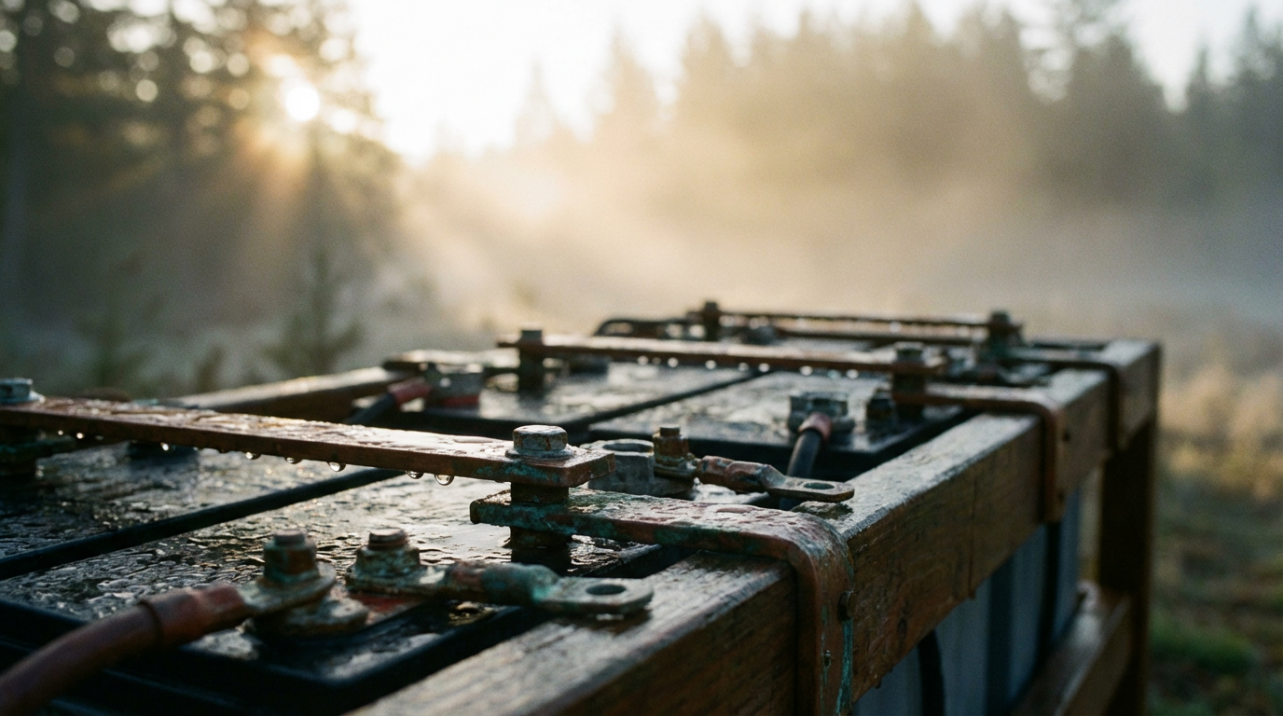
Morning dew forms when the air cools until it can no longer hold all its water vapor, and that vapor condenses on surfaces that have dropped below the dew point. Bare copper, tinned lugs, busbars, and steel rack parts sitting in still, cooling air make perfect collectors. You end up with a thin film or droplets of water exactly where you do not want them: around live conductors and along paths to ground.
Pure distilled water does not conduct much, but outdoor dew is never pure. Dust, pollen, sea salt, and even minute amounts of battery electrolyte residue dissolve into that water and turn it into a weak electrolyte. On a 24–48V DC system, a clean bead of water across a generous air gap usually cannot carry enough current to create a dramatic short, but a continuous damp film plus contamination can support leakage currents, especially across dirty surfaces and along cracks and crevices. Field‑scale degradation analyses show that high humidity and dust together can corrode connections and interfere with cooling, which is precisely what dew‑driven wetting does on a small but repeated scale around terminals.
The bigger long‑term problem is corrosion. Every wet morning invites oxygen and moisture into hairline gaps in crimps, threads, and plated surfaces. When the sun comes up, those same locations heat faster than their surroundings under load, accelerating electrochemical reactions and drying the moisture into concentrated salts. Over months and years, that cycle builds green and white crust on copper and aluminum, raises contact resistance, and creates hot spots under high current.

Hot spots then generate even more local heat under load, which accelerates both corrosion and insulation breakdown.
Electrically, dew shows up first as creeping currents and nuisance behavior rather than spectacular failures. Ground‑fault sensors may trip early in the day and clear by mid‑morning as surfaces dry. Sensitive electronics can see unexpected voltage offsets from leakage along PCB surfaces and terminal blocks. It is rare for morning dew alone to instantly weld tools, blow apart lugs, or destroy a lithium bank, but treating it as harmless is what allows slow damage to accumulate until the system fails under stress.
Inside The Cells: Temperature Swings Load The Pack Even When It Is Idle
Even if every lug is perfectly sealed, that big diurnal swing is still punishing the cells inside their cases. Battery degradation is the gradual loss of performance and capacity as internal side reactions chip away at active materials and increase internal resistance, and those reactions are strongly accelerated by high temperatures while cold temporarily suppresses performance. Research on battery degradation and its prevention shows that both cyclic stress and calendar time are amplified by heat and high state of charge, while deep cold raises resistance and lowers available energy during discharge.
Capacity testing across a wide temperature range typically finds that batteries deliver noticeably less current and energy around freezing compared with around 77°F, and that capacity can fall to roughly half the rated value in deep subzero conditions. At the other end, operation near 120°F may show a modest bump in short‑term capacity but at the cost of dramatically faster corrosion and side reactions, effectively halving service life compared with cooler conditions. These results match practical guidance that elevated temperature boosts short‑term power but sharply shortens lifespan, while cold imposes a performance tax that reverses when the pack warms.
A 2025 technical review of lithium‑ion performance under combined stress factors found that temperature swings, mechanical vibration, and aggressive charge and discharge rates interact in a non‑linear way, driving faster capacity fade and internal resistance growth than any single stressor alone. That work reports internal resistance increases of around 10–15% when vibration is layered onto already demanding thermal conditions, making clear that the real‑world mix of shocks, heat, and load ramps is harder on cells than tidy lab tests would suggest. Combined effects of environmental and operational factors are now recognized as the relevant lens for designing robust battery systems.
On top of that, advanced neutron imaging experiments on commercial electrolytes show that as these fluids cycle through low temperatures they can partially solidify or separate into compositionally different regions that do not fully remix when warmed. In pouch cells cycled between deep cold and warm conditions, electrolyte solidification was observed at low temperatures with capacity dropping to almost zero, and some capacity was permanently lost after repeated cold exposure. This work demonstrates that electrolyte and separator structures effectively remember their thermal history, not just the current temperature, which helps explain why cells subjected to repeated deep nighttime cold perform worse and age faster even if their daytime temperatures look reasonable.

Thermal history effects in battery electrolytes give a clear physical basis for this memory effect.
The net result is that in a high‑range climate, your pack is working harder internally at both ends of the day: struggling to deliver current when cold, aging faster every time the enclosure climbs into the hot zone, and never quite seeing the stable middle ground that lab data often assume.
When Does Morning Dew Become A Real Electrical Hazard?
For a typical off‑grid or backup system running a 24–48V lithium bank with modern equipment, morning dew on exposed connections is more likely to produce slow corrosion and nuisance trips than a catastrophic short. Terminals and busbars in certified gear are usually spaced and shaped so that a thin water film cannot bridge positive to negative at low voltage with enough current to do spectacular damage, especially once you factor in fusing and BMS protection.
The risk rises sharply when three things come together. First, bare live metal sits very close to other conductors or to grounded steelwork, with gaps on the order of a fraction of an inch where surface tension can stretch a water film. Second, contamination provides ions that lower resistance, such as fine dust, salt spray near the coast, or residue from previous electrolyte spills inside an enclosure. Third, the system runs at higher DC voltages, such as a 150–400V battery stack or PV strings feeding a charge controller, where even a damp creepage path can draw enough current to initiate an arc. In those conditions, morning dew is not just cosmetic: it is an active conductor.
External environment studies document that high humidity, dust, and mechanical vibration can damage components, corrode connections, and interfere with cooling, increasing losses and shortening life across energy storage installations. High humidity and dust as external stressors form the same trio you see in a remote battery shed with big temperature swings. Dew simply concentrates this ambient humidity on the very surfaces that matter most.
In practice, dew‑related shorts often show up as blown low‑amp fuses, tripped insulation‑monitoring devices, or intermittent communication faults long before they become pack‑destroying events. Treat them as early warnings: the system is telling you that moisture is reaching live metal and that the installation is living too close to the edge.
Practical Design Moves To Beat Dew In High-Range Sites
The most effective way to neutralize morning dew is to make sure that neither the pack nor its connections ever see the extremes that create it. For battery life, multiple studies converge on a simple target: keep the pack near a moderate temperature band and away from both deep cold and sustained heat. Grid‑oriented work recommends roughly 60–80°F for optimal life, while consumer and cell‑maker guidance puts safe operation in the 32–95°F bracket, with a clear message that cooler, stable conditions are better than hotter, variable ones. For retrofits, that means choosing an indoor location or an insulated, shaded enclosure rather than an uninsulated metal box baking in the sun and radiating heat to the night sky.
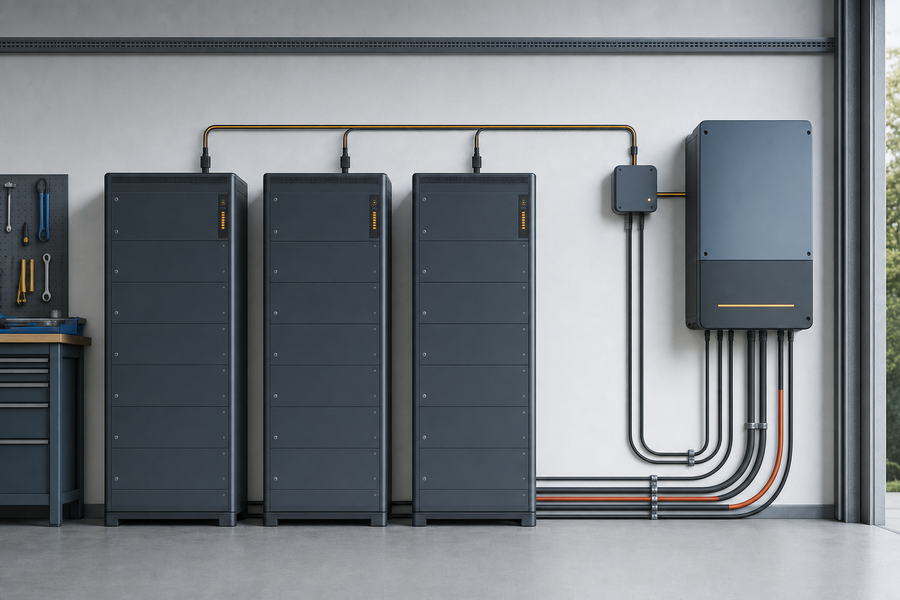
Next, keep dew away from live copper in the first place. Use proper terminal boots, heat‑shrink tubing over lugs, insulated busbar covers, and fully closed fuse holders or breakers for every exposed conductor. Orient busbars and cables so that any condensation that does form runs away from, not across, live metal; for example, loop cables downward before they enter an enclosure so water drips off the lowest point instead of following the conductor inside. For retrofit racks originally built around open top‑post lead‑acid batteries, take the opportunity to introduce insulated standoffs, plastic barriers, and clear covers when you switch to lithium modules.
Condensation control inside enclosures is just as important. A bare metal roof or wall that sees the full night sky cools quickly, becomes the coldest surface in the box, and invites droplets to form and then drip directly onto terminals or electronics. Adding thin insulation to roof and walls and using a light‑colored exterior reduces radiative cooling at night and heat gain during the day. Small passive vents or breather devices help equalize temperature and humidity so the interior does not swing quite as hard as the outdoor air. Large battery banks have considerable thermal mass, so with even modest insulation their internal temperature will lag and smooth the daily cycle, reducing both dew formation and chemical stress.
Monitoring is the last piece that turns these design choices into a durable system. Battery management systems (BMS) with built‑in temperature sensors and control logic can flag when pack temperature repeatedly drifts toward the hot or cold limits and can enforce current limits or shut down charging when the pack is outside its comfort band. Battery monitoring and temperature control are already recommended for keeping lithium cells within safe operating ranges. Adding a simple temperature and humidity data logger inside the battery enclosure gives you a low‑cost, high‑value view of how harsh the real environment is and whether your insulation and venting are doing their job.
On the operating side, do not make the cells’ job harder than it has to be. Avoid leaving lithium batteries parked at 0% or 100% state of charge in a hot, humid environment, because high temperature and high state of charge together accelerate calendar aging. Keeping everyday cycling mostly between about 20% and 80% state of charge, limiting very high charge and discharge currents, and scheduling heavy charging for cooler parts of the day all reduce internal heat and extend life. State‑of‑charge and temperature management are among the most effective levers for slowing degradation, and they also limit how much dew‑driven corrosion can hurt you because your system will spend less time at the ragged edge of its capability.
A few common scenarios illustrate how this all comes together:
Situation |
Likely issue |
High‑value fix |
Outdoor cabinet with exposed copper busbars and big day–night swings |
Morning dew builds corrosion and leakage paths along busbars, raising resistance and tripping protection over time |
Add insulated busbar covers and terminal boots, apply suitable protective coatings, and insulate and shade the cabinet to narrow temperature swings |
Metal‑roof battery shed in a desert climate |
Roof radiates heat out at night, interior metal cools below dew point, droplets form and drip onto terminals and electronics |
Add roof insulation, paint the exterior a light color, introduce gentle ventilation, and fit drip shields over critical components |
Lithium retrofit into an old steel rack with lugs close to bare frame |
Dew plus dust creates creepage paths from positive lugs to grounded frame, causing nuisance ground‑fault trips |
Install insulating standoffs and barriers, reroute or extend conductors to increase clearance, and fully insulate lugs and terminations |
FAQ
Is it enough to just wipe off dew in the morning?
Wiping terminals dry is better than letting dew sit all day, but it does not address the underlying problem that moisture keeps reaching live metal. Each cycle of wetting and drying still drives corrosion inside threads and crimps where you cannot reach with a cloth. A more reliable fix is to insulate and cover those connections so dew never touches them, and to tame the temperature swings that create dew in the first place.
Can I leave battery terminals bare if the bank is under a roof?
A simple roof keeps direct rain off the system, but it does not stop condensation and dew from forming on cold metal surfaces overnight. In high‑range climates, a roofed but otherwise open shed can still see heavy dew on terminals and enclosures. Bare lugs in that environment invite corrosion, leakage, and avoidable faults, especially once dust and salt accumulate. Fully insulating and covering live connections is a modest cost compared with the downtime and replacement expense of a preventable failure.
A high diurnal temperature range is not a reason to fear lithium retrofits or off‑grid systems, but it is a reason to build like you expect dew every single morning. Control temperature, seal live metal, and give your monitoring tools a clear view of what is happening, and your battery bank will deliver clean, reliable power long after the morning mist has burned off.