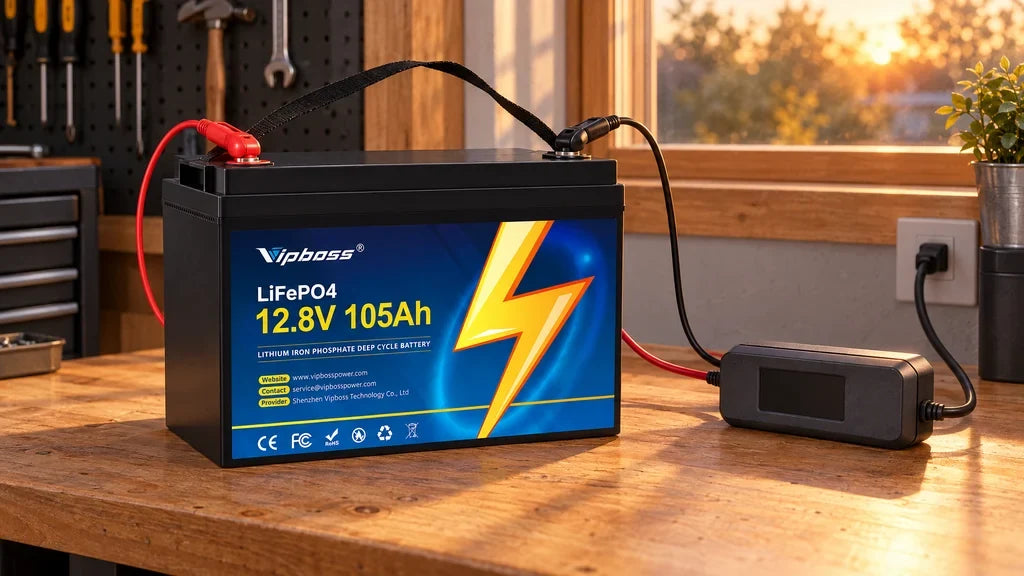

A 100Ah lithium battery takes about 10 hours with a 10A charger, 5 hours with a 20A charger, 3.3 hours with a 30A charger, or 2 hours with a 50A charger from empty in an ideal bulk-charge estimate. Real charging time is longer because current tapers near full charge and charging conditions matter.
Charging Times With 10A, 20A, 30A, and 50A Chargers
Divide amp-hours needed by charger amps for a useful first estimate. For a fully discharged 12v 100Ah lithium battery, 100Ah ÷ 20A equals five bulk-charge hours.
Do not use the estimate as a promise: a smart charger may reduce output as it reaches target voltage, and some batteries retain a small reserve before their battery management system disconnects.
| Charger output | Bulk-charge estimate from empty | Practical planning range* |
|---|---|---|
| 10A | 10 hours | About 10–12 hours |
| 20A | 5 hours | About 5–6 hours |
| 30A | 3.3 hours | About 3.5–4.5 hours |
| 50A | 2 hours | About 2.5–3.5 hours |
*Assumes a compatible charger, moderate battery temperature, no meaningful loads running, and a battery permitted to accept the listed current.
Charge-current limits vary widely across 12V lithium batteries. A 105Ah battery may charge best at around 20A, even if it can handle more. Check your battery manual for the right limit.
Why Is Actual Charging Time Longer Than a Simple Ah Calculation?
Actual charging time is longer because a lithium charger normally transitions from constant-current charging to a constant-voltage absorption stage. During bulk charging, a 20A charger can deliver near 20A if the battery accepts it. Near the target voltage, current tapers; the remaining charge may need extra time for cell balancing and charge completion. LiFePO4 charge stages show constant current followed by an absorption stage.
Other reasons include charger efficiency, AC input limits, warm or cold cells, voltage drop in long wires, and DC loads running at the same time. If a refrigerator pulls 5A while a 20A charger runs, the battery sees about 15A net charge current before other losses. The charger display can still read 20A.
Use amp-hours for an estimate, then give the charger time to complete its specified profile. A battery monitor with a shunt provides a better state-of-charge reading than voltage alone during active charging. Check charger settings and battery wiring before you plug in.

How Does Starting State of Charge Affect Charging Time?
Starting state of charge affects charging time. You only need to replace the amp-hours that are missing. At 50% state of charge, a 100Ah LiFePO4 battery needs roughly 50Ah. A 20A charger therefore needs about 2.5 bulk-charge hours, plus taper time. At 80%, the same charger needs about one bulk-charge hour, plus taper time.
| Starting state of charge | Amp-hours to replace | 20A bulk estimate | 50A bulk estimate |
|---|---|---|---|
| 20% | 80Ah | 4 hours | 1.6 hours |
| 50% | 50Ah | 2.5 hours | 1 hour |
| 80% | 20Ah | 1 hour | 0.4 hour |
Battery monitors estimate state of charge from current flow and need correct setup. A resting voltage reading can help with a basic check, yet LiFePO4 voltage stays relatively flat across much of its capacity. Treat voltage as one clue, not a precise fuel gauge.
Can a Higher Amp Charger Safely Charge a 100Ah Lithium Battery Faster?
Yes, as long as the charger stays within the battery’s allowed charge current and uses the right LiFePO4 voltage settings. For a 100Ah battery, 50A equals 0.5C. Under normal conditions, a 0.5C charge rate can bring an empty battery through the bulk stage in about two hours. Check your battery manual before choosing a faster charger, since charge-current and temperature limits vary from one model to another.
Higher amps are not automatically better. Check:
- Battery maximum and recommended charge-current ratings.
- Charger lithium profile, voltage settings, and equalization setting.
- Shore-power circuit rating and generator capacity.
- Wire gauge, connector rating, fuse rating, and voltage drop.
- Alternator and DC-to-DC charger limits in a vehicle charging circuit.
A 12 volt lithium battery 100ah unit may accept 50A, 100A, or less depending on its design. Never use a charger simply because its amp rating looks convenient.

What Can Make a 100Ah Lithium Battery Charge More Slowly?
Cold cells, hot cells, an undersized charger, low AC supply voltage, solar shade, voltage drop, and concurrent loads can slow charging. Battery protection may stop or limit charge outside the approved temperature range. Many 12V LiFePO4 batteries stop accepting charge near 32°F. Check the restart temperature in the manual before charging in cold weather.
Solar charging also varies through the day. A 200W panel array cannot deliver a steady 200W under every sky condition, and a controller may limit output. Vehicle alternator charging can be limited by wiring, alternator temperature, engine speed, or a DC-to-DC charger's current cap.
Investigate a slow session in order:
- Confirm battery temperature and any BMS alert.
- Measure charger voltage at the battery terminals while charging.
- Check actual charge current with the battery app or monitor.
- Turn off nonessential DC and inverter loads for the test.
- Inspect connectors, fuses, and cables for heat, looseness, or corrosion.

Match Charger Output to Your 100Ah Battery for Practical Charging Times
Match the charger to your battery's specified voltage and safe charge-current limit, then plan from the amp-hours missing. A 20A charger suits relaxed overnight charging; 30A to 50A suits faster recovery when wiring and battery limits allow it. Verify temperature, net battery current, and charger settings before relying on any estimated charge time.
100Ah Lithium Battery Charging FAQs
Can I Leave a 100Ah Lithium Battery Charging Overnight?
Yes, with a quality lithium-compatible charger and a battery operating within its approved temperature range. Follow the battery manual's charge-voltage, current, and ventilation guidance for the charger. Do not leave a damaged battery, hot connector, improvised wiring, or an unsuitable lead-acid charger unattended. Check charge status and wiring condition before routine overnight charging.
Do I Need a Lithium-Specific Charger for a 100Ah Battery?
Yes. Use a charger with a LiFePO4 mode or adjustable settings that match your battery manual. Lead-acid chargers may use equalization or desulfation modes that are unsuitable for LiFePO4 batteries. Check charge voltage, charge current, and low-temperature limits before connecting the charger.
Can I Charge a 100Ah Lithium Battery With a Car Alternator?
Yes, though a DC-to-DC charger is often the safer approach for an RV or vehicle house battery. It limits current, sets a lithium charge profile, and protects long cables and the alternator from excessive demand. Match its output to the battery's permitted charge current and the vehicle wiring system.
Why Does a Battery Reach 100% Before the Charger Stops?
A battery monitor can show 100% before charging is fully complete. Near full charge, the charger holds voltage while current drops. That extra time can support cell balancing, depending on the battery and charger settings. Let the charger finish its normal cycle unless the battery manual gives different instructions.
How Often Should a 100Ah Lithium Battery Be Fully Charged?
It depends on the battery manual and use pattern. Normal LiFePO4 service does not require a full charge after every shallow cycle. Periodic full charging can support state-of-charge calibration or cell balancing when the maker recommends it. For storage, follow the stated storage state of charge and recharge interval.