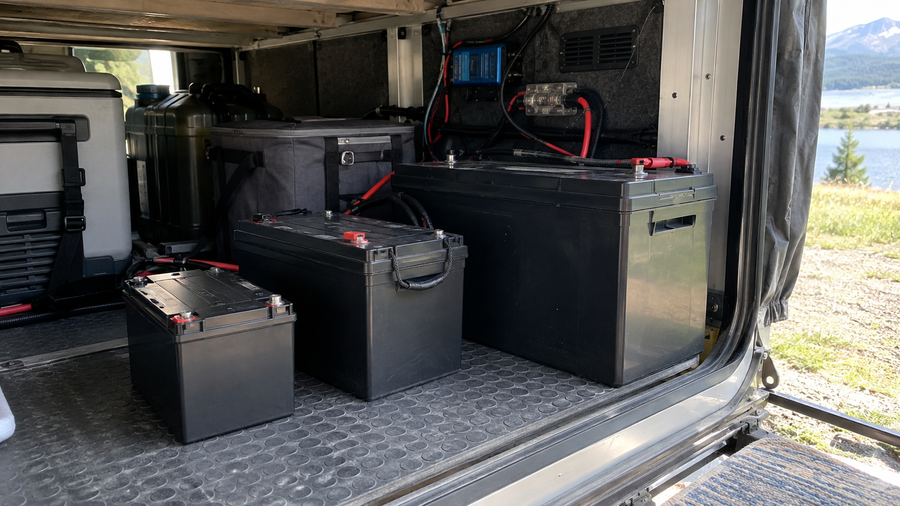

A Group 31 lithium battery will fit only when its case, terminals, cables, hold down, and battery box match the available space. Measure the empty tray and surrounding area before ordering. Batteries with similar case dimensions can still use different terminal layouts and mounting details.
Does the Battery Footprint Match the Existing Tray?
Yes, the footprint matches when the full battery base sits flat and the hold down reaches solid mounting points.
The Group 31 dimensional reference lists Group 31A and Group 31T batteries at a maximum of 13 inches long, 6 13/16 inches wide, and 9 7/16 inches high. Compare those limits with the exact dimensions of the battery you plan to buy.
| Fit Check | What to Measure | Pass Condition |
|---|---|---|
| Tray length | Flat space between end stops | The full battery base stays supported |
| Tray width | Narrowest usable point | The case clears lips and brackets |
| Tray surface | Ribs bolts and curved corners | The case rests level |
| Anchor points | Hole spacing and mounting strength | The restraint reaches solid structure |
Remove the old battery before measuring. Rust, liners, bolt heads, molded ribs, and bent edges can reduce usable space.
A 12V 105Ah Group 31 lithium battery measures 12.95 × 6.77 × 8.42 inches. Those dimensions provide a useful reference when comparing a 100Ah 12V battery for a boat, RV, or backup power setup.
The tray also needs to support the entire base. A case that hangs over an edge can place uneven pressure on the bottom panel during travel.

Is There Enough Clearance Above and Around the Battery?
You have enough clearance when the terminals, cables, lid, hold down, and service tools fit without pressing against the case.
Check each area before choosing a 12V boat battery or 12V RV battery:
- Above the terminals: Include bolt heads, washers, and cable lugs.
- Under the lid: Check for contact after adding the full height of the terminal hardware.
- Beside the case: Leave room for power cables, monitor leads, sensors, and hold down parts.
- At cable bends: Give each cable a smooth curve so the lug rests flat on the terminal.
- Along the service path: Keep the fuse, disconnect, and terminal bolts within reach.
- Near heat sources: Follow the battery temperature limits and keep the case away from engine or exhaust heat.
Overhead clearance matters most inside low battery boxes and shallow RV compartments. Cable lugs and washers can add noticeable height above the case.
For a tight space, build a cardboard model using the listed case dimensions. Add small blocks for terminal height, then place the model in the tray. Check the lid, cable route, brackets, and tool access before ordering.
Do the Terminal Position and Hardware Match the Existing Cables?
The existing cables will fit when polarity, terminal location, thread size, lug hole, and cable reach all match the new battery.
Follow these checks before removing the old setup:
- Label the positive and negative cables.
- Record the position of each terminal.
- Confirm the terminal style and thread size on the new battery.
- Match each cable lug hole with the supplied bolt.
- Check cable reach with a relaxed curve.
- Plan a suitable bus bar when several approved accessory cables share one connection point.
Group 31A and Group 31T use the same listed outside dimensions, although their terminal types differ. The linked 105Ah model uses M8 terminal bolts, so each cable lug needs the correct hole size and full flat contact.
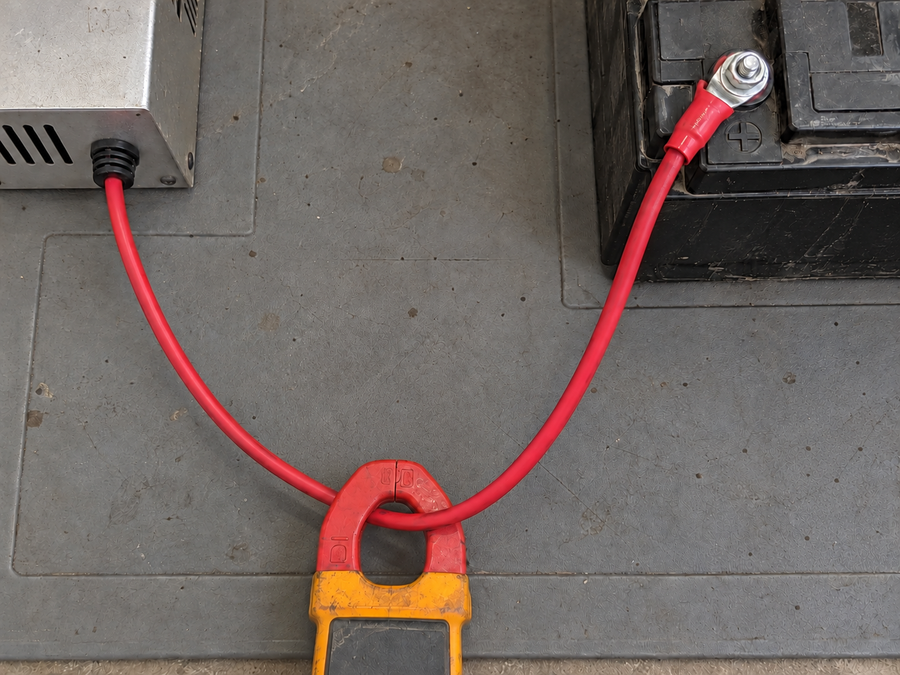
Cable length also matters. A cable that barely reaches can pull sideways on the terminal, loosen the connection, or prevent the lug from sitting flat. Longer replacement cables should match the required current rating and installation environment.
For marine installations, battery terminal connection rules require a secure mechanical connection. Tighten terminal hardware to the torque value listed in the battery manual.
Which Hold Down Method Will Secure the Battery Without Damaging the Case?
A rigid crossbar, base clamp, wide strap, or custom frame can secure the battery when pressure stays on reinforced case areas.
The restraint must prevent the battery from sliding, lifting, or tipping. It also needs a solid connection to the tray or another structural part of the boat, RV, or vehicle.
- Factory crossbar: Use one that clears the terminals and rests on a reinforced case edge.
- Base clamp: Use one with a matching lower case ledge and tray.
- Wide webbing strap: Attach it to strong anchor points inside the battery box.
- Custom frame: Use one for larger RV or energy storage layouts with several batteries.
Foam pads can fill small gaps and reduce vibration. The bracket, clamp, strap, or frame still needs to carry the securing force.
Tighten the hold down until the battery stays in place under firm hand pressure. Stop tightening if the case wall bends, the lid bows, or the strap cuts into a corner. A narrow metal bar may need a wider contact pad to spread pressure.
For covered recreational boats, battery securement requirements limit battery movement to one inch under the listed force and test directions.

Does the Battery Box Provide Enough Space and Weather Protection?
Yes, the battery box is suitable when it has room for the case, terminals, cables, hold down, fuse, disconnect, and lid.
| Box Feature | What to Check |
|---|---|
| Inside dimensions | Narrow points near ribs corners and molded supports |
| Lid height | Clearance above bolts lugs and cable hardware |
| Cable openings | Smooth routing with edge protection |
| Anchor access | Solid mounting points for the box and battery |
| Service space | Access to terminals fuse disconnect and monitor leads |
| Drainage | A clear path for collected water |
| Exposure | Spray rain road debris heat and loose gear |
Use the inside dimensions of the box for every fit check. Outside measurements include wall thickness, handles, hinges, and molded features that provide no usable room around the battery.
The linked 105Ah battery lists IP65 enclosure protection for RV, marine, solar, and backup use. Keep the battery box away from standing water and direct heat. Protect cable openings with smooth grommets or edge guards, and keep loose metal items outside the box.
A box that barely accepts the battery may leave too little room for cable bends or the hold down. It may also block access to the main fuse or disconnect. Check the complete installed height and width after all hardware is added.
Complete Every Fit Check Before Ordering a Group 31 Lithium Battery
Use the exact product drawing as the final fit reference. Confirm the tray size, overhead clearance, terminal layout, cable reach, hold down points, and battery box dimensions before placing an order.
FAQ about Lithium Battery Fit
Q1: Is Group 31 a Battery Size or a Capacity Rating?
Group 31 is a case size classification, while capacity is measured separately in amp hours or watt hours. Two Group 31 batteries may offer very different runtime and current output. Compare capacity, continuous current, peak current, charging limits, and BMS ratings after confirming the physical fit.
Q2: Can a Group 31 Lithium Battery Be Mounted on Its Side?
Yes, when the manual for the exact battery approves side mounting. Internal cell layout, pressure relief parts, case seals, and terminal orientation can affect the allowed position. Use the listed mounting direction for a boat, RV, vehicle, or stationary setup, and keep the battery firmly restrained in every direction.
Q3: Can Different Group 31 Lithium Batteries Share One Energy Storage Bank?
Yes, when voltage, chemistry, capacity, BMS limits, age, state of charge, and wiring layout match closely. Large differences can lead to uneven current sharing during charging and discharge. Matched batteries with similar service history usually work together more evenly. Confirm series or parallel approval for every battery in the energy storage bank.
Q4: Do Group 31 Lithium Batteries Need the Same Venting as Flooded Batteries?
No. LiFePO4 batteries produce no routine hydrogen gas during normal charging, so their venting needs differ from flooded lead acid batteries. The compartment still needs suitable temperature control and a way for heat to escape. Follow the enclosure and mounting limits listed for the exact battery.
Q5: Should Terminal Boots Be Used Inside a Closed Battery Box?
Yes. Terminal boots or fitted covers reduce the chance of a dropped tool, loose fastener, or metal lid touching an energized positive terminal. Closed boxes still contain tight service areas and may hold items that shift during travel. Marine electrical rules may also require caps, boots, covers, or shields on energized terminals.