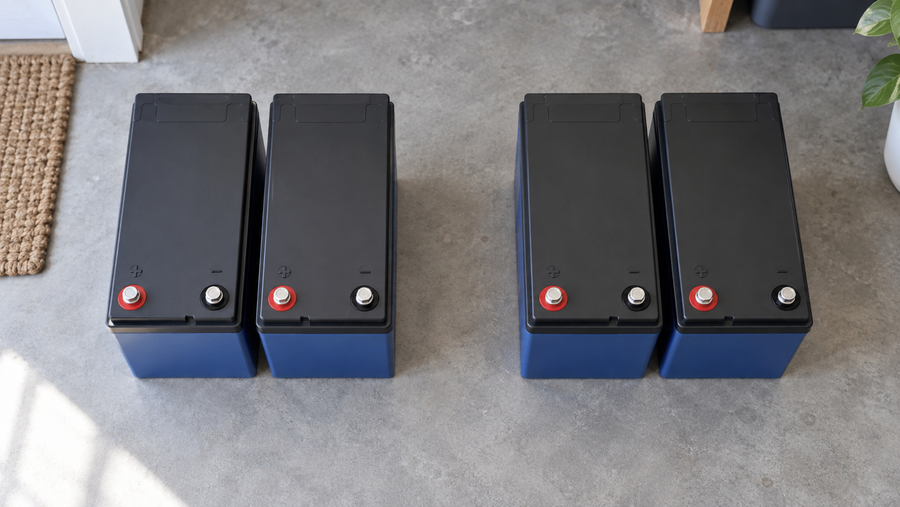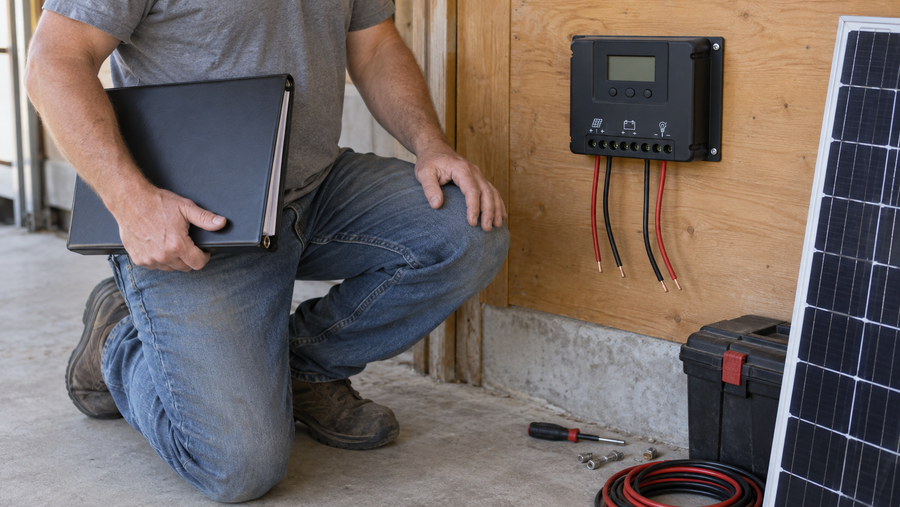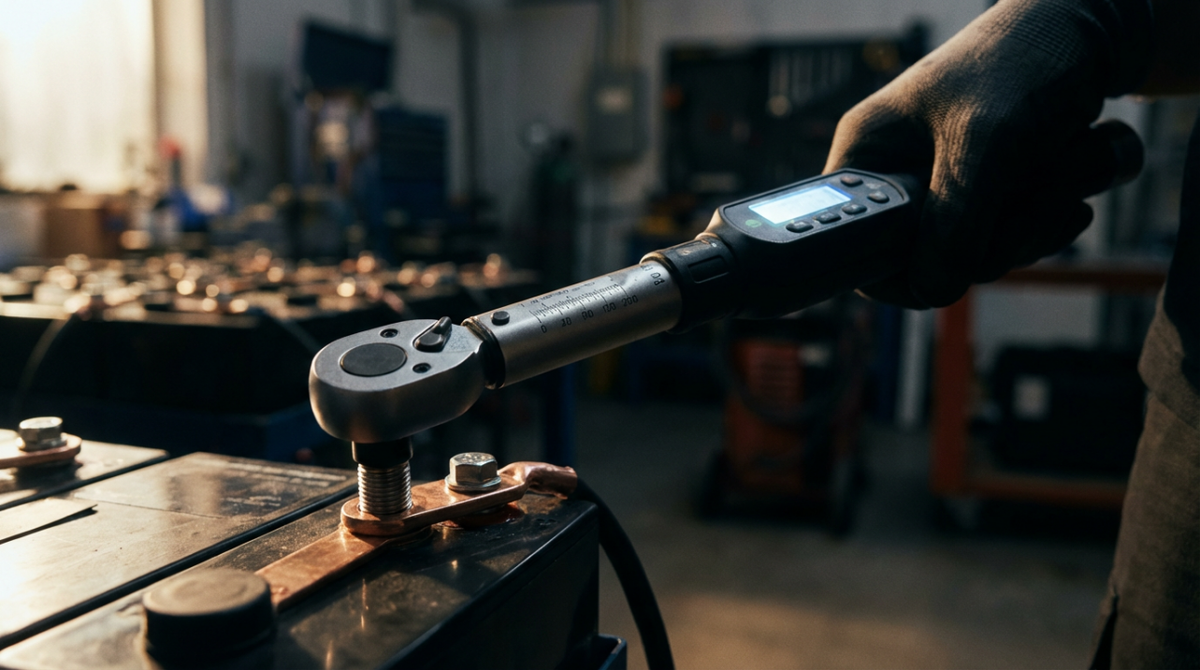

If you care about safe, efficient lithium power, whether it is a retrofit battery bank or a hard-working off-grid system, "tight enough" by feel is gambling. A torque wrench gives you repeatable clamp force, cooler connections, and far fewer surprise failures.
Why "Tighten by Feel" Is a Problem
On a lithium bank or inverter busbar, you are not just turning screws; you are setting clamp force on current-carrying joints. That clamp force sets heat, resistance, and how long the joint survives.
A torque wrench applies controlled torque so bolted connections actually hit the specification instead of whatever your wrist guessed. That is the difference between a snug battery lug and a stud snapped off inside a $1,500.00 inverter.
Data shows that small torque errors matter, shrinking joint integrity and pushing failure risk way up. In the field, this shows up as hot spots on IR scans, melted ring terminals, and "mystery" shutdowns whenever the inverter hits surge.
On low-voltage DC in particular, under-torqued lugs loosen with vibration and thermal cycling, while over-torqued hardware cracks threads or deforms copper lugs so they never seat correctly again.

What a Torque Wrench Does for Your Power System
A good torque wrench turns the manufacturer specification sheet into reality: 45 in-lb on a BMS terminal, 95 ft-lb on a combiner box mount, 120 ft-lb on a battery rack anchor—every fastener, every time.
Calibrated torque tools hold you within a few percent of target, and that accuracy has been linked to dramatically fewer tightening-related failures and recalls in critical industries, as shown in torque accuracy studies. In an off-grid system, that translates to cooler lugs, less voltage drop, and fewer nuisance trips when you hit big loads like air conditioners or welders.
Think of torque as a protection layer for everything downstream: correctly torqued terminals protect cells from imbalance, busbars from hot spots, and structures from fatigue when wind loads rock your solar array.

Once you set the torque, a repeatable click or digital beep means anyone on your crew—not just the most experienced tech—can build to the same standard.
Choosing the Right Torque Wrench for Off-Grid Work
You do not need one giant wrench; you need the right ranges.
Start by matching the wrench to the fasteners you actually use. For small screws on BMS boards, electronics, and control wiring, a 1/4-inch drive inch-pound wrench covers the low torque those tiny fasteners need. For battery terminals, inverter and MPPT lugs, and most chassis connections, a 3/8-inch or 1/2-inch drive foot-pound wrench in the roughly 20 to 150 ft-lb range is the workhorse. For structural hardware such as array rails, ground mounts, and wall brackets, step up to a higher-range 1/2-inch or even larger drive when specifications call for more than about 150 ft-lb.
Guides on how to choose torque wrench size consistently stress matching the wrench's range and drive to the fastener size and specification. In practice, most serious off-grid projects run at least two wrenches: one inch-pound and one foot-pound.

If your system includes large ground-mount arrays or containerized power rooms with big structural fasteners, adding a higher-range 1/2-inch or 3/4-inch wrench keeps you from abusing smaller tools near their limits.
Calibration and Habits: Keeping Readings Honest
A torque wrench is a measuring instrument, and like any meter, it drifts. Drops, over-torquing, and temperature swings slowly knock it out of specification.
Professional labs use traceable equipment and controlled environments to calibrate torque wrenches so what you dial in is what the joint actually sees. For tools you rely on to protect expensive lithium hardware, that traceability is cheap insurance.
Heavy users should calibrate about every few months; lighter, DIY-level use can often go about a year, with immediate checks after any hard drop or overload. In high-stakes battery rooms, many teams move to intervals of about 3 to 6 months.
Different standards and manufacturers suggest slightly different calibration intervals, so for critical battery banks and off-grid systems, follow the strictest guidance that applies to you.
Day-to-day habits matter just as much as the lab sticker. Always return click-type wrenches to their lowest setting after use, store them clean and dry in a case, and never use them as breaker bars. Treat the torque wrench like the life-support instrument it is for your power system, and it will pay you back in stable connections, longer hardware life, and fewer midnight trips to the battery shed.