
A 12V deep cycle marine battery label shows how much energy the battery can supply over time and how much current it can deliver for engine starting. Read Ah for house-load capacity, CCA or MCA for cranking ability, and reserve capacity for a standardized 25A runtime test.
What Does Ah Tell You About a Marine Battery?
Ah tells you how much charge a battery can deliver under a stated test rate. A 100Ah rating often refers to a 20-hour discharge test, so the battery delivers about 5A for 20 hours under that test condition before reaching the manufacturer’s cutoff voltage.
Use Ah to compare capacity for common house loads:
- Navigation electronics
- Cabin and deck lights
- Livewell or bilge pumps
- Fish finders
- Trolling motors
A higher Ah rating does not promise exact on-water runtime. Actual runtime also depends on:
- Load current
- Temperature
- Battery age
- Wiring loss
- Inverter use
- Stated usable depth of discharge
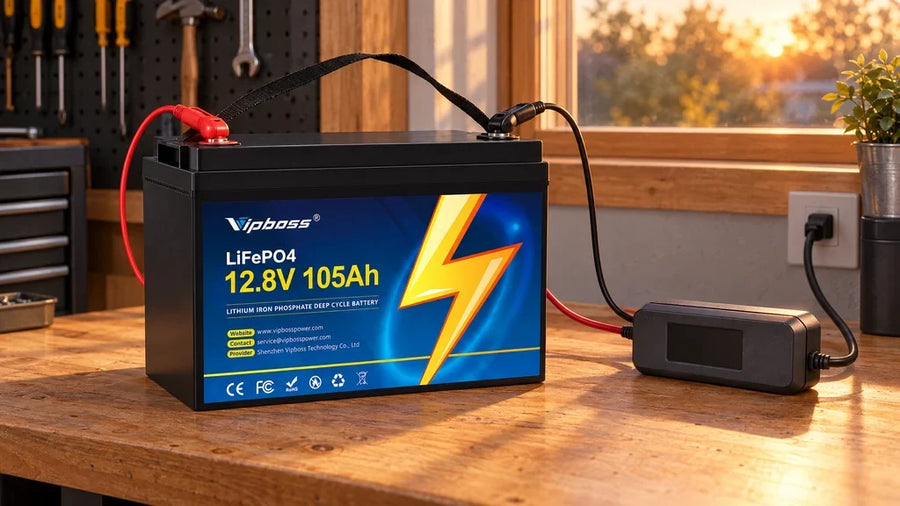
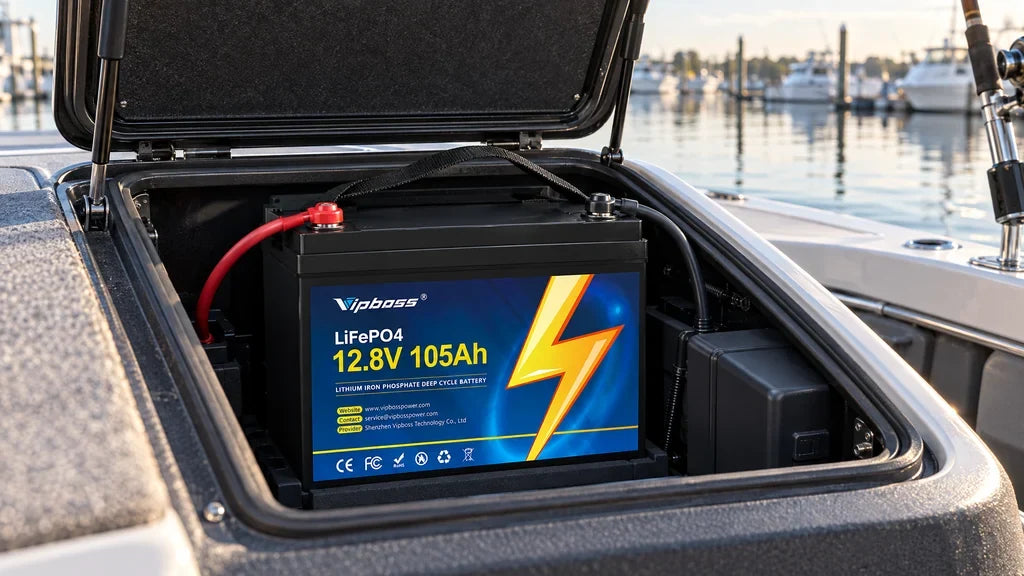
For a lithium house bank, nominal energy provides another helpful number. A 12.8V 100Ah battery has about 1,280Wh of nominal stored energy. The 12V 105Ah LiFePO4 battery is listed at 1,344Wh, which matches 12.8V × 105Ah.

What Is the Difference Between CCA and MCA?
CCA means Cold Cranking Amps, and MCA means Marine Cranking Amps. Both ratings measure short-duration cranking output under different temperatures.
- CCA: Current delivered for 30 seconds at 0°F while maintaining at least 7.2V.
- MCA: Current delivered for 30 seconds at 32°F while maintaining at least 7.2V.
MCA is commonly higher because batteries perform better at the warmer test temperature. Use the engine manufacturer’s required starting rating as your baseline. Do not treat a 700 MCA battery and a 700 CCA battery as equal, since their tests use different temperatures.
How Does Reserve Capacity Relate to Battery Runtime?
Reserve capacity measures how many minutes a fully charged 12V lead-acid battery can supply 25A at 80°F before voltage falls to 10.5V.
For example:
- A 120-minute RC rating represents a controlled 25A load for two hours.
- It does not represent universal battery runtime.
- It is useful for comparing similar lead-acid batteries.
Your boat may draw 4A for navigation electronics, 25A for several loads together, or much more for an inverter. The RC test uses a 25A discharge load, so use a battery monitor and your own load estimate for trip planning.
Lithium labels may feature Ah, watt-hours, continuous discharge current, and BMS limits. Do not project a lead-acid RC result onto lithium without a discharge curve or manufacturer guidance.
Which Battery Ratings Matter for Starting and Deep Cycle Use?
The ratings that matter depend on the battery’s job aboard your boat.
| Boat job | Ratings to prioritize |
|---|---|
| Engine starting | Required CCA or MCA, group size, terminal layout |
| Electronics and lighting | Ah or Wh, continuous current, usable capacity |
| Trolling motor | Voltage, Ah or Wh, continuous current, BMS rating |
| Inverter loads | Wh, continuous and surge current, cable and fuse limits |
Starting batteries need the specified CCA or MCA plus suitable terminal layout, group size, and reserve margin. Deep-cycle house batteries need usable energy, charge acceptance, continuous discharge capability, and cycle-use suitability.
A 12 volt deep cycle marine battery may list a cranking rating when it is dual-purpose. That label does not mean its deep-cycle capacity matches a dedicated house battery of the same case size.

Why Can Two 12V Marine Batteries Have Very Different Ratings?
Two marine battery 12 volt products can have very different ratings because their internal designs and intended jobs differ.
Compare the following items before choosing between batteries:
- Battery type: Starting, deep cycle, or dual purpose
- Chemistry: Flooded lead-acid, AGM, or LiFePO4
- Capacity test: Ah rating and discharge rate
- Starting output: CCA or MCA, plus test temperature
- Runtime metric: RC at 25A for lead-acid batteries
- Current limits: Continuous and peak output, especially for lithium batteries
- Physical fit: Group size, terminal position, weight, and mounting needs
- Charging requirements: Charger profile, alternator compatibility, and temperature limits
A starting battery favors high short-term current. A deep-cycle battery favors repeated energy delivery. A 12v lithium marine battery may offer a different usable-energy profile from an AGM battery with the same printed Ah, while its BMS can impose a separate current limit.

Match the Battery Label to How You Use Your Boat
Match the label to each job on your boat. Engine starting needs the required CCA or MCA, while house loads need adequate usable energy and discharge capability. Verify group size, terminals, charger compatibility, cable and fuse ratings, and battery mounting before installation. Record your normal on-water load, then choose the battery after comparing its complete label and manual with your boat’s electrical plan.
Marine Battery Label FAQs
Do Marine Batteries Need CCA if They Are Only Used for Electronics?
No. A dedicated electronics or house battery does not need a CCA target unless it also starts an engine. Prioritize Ah or Wh, continuous output, charge compatibility, physical fit, and the protection requirements of connected circuits. Keep the engine-start battery sized to the engine manufacturer’s specified cranking rating.
Is a Higher Ah Rating Always Better for a Boat Battery?
No. More Ah can add useful runtime, but the battery must still fit the tray, meet weight limits, accept your charger, and support the required current. Capacity cannot fix an undersized fuse, cable, BMS, or alternator charging plan.
What Does 100Ah Mean on a Marine Battery?
It means the battery has 100 amp-hours of rated capacity at its stated test rate. At a 20-hour rate, that commonly corresponds to 5A for 20 hours. Real runtime changes with current, temperature, age, cutoff voltage, and chemistry, so treat the label as a comparison value.
Can Two Marine Batteries With the Same Voltage Have Different Performance?
Yes. Two 12V batteries can differ in Ah, CCA, MCA, RC, chemistry, usable capacity, weight, continuous current, and charging limits. Voltage identifies system compatibility at a basic level; it does not describe energy storage or cranking performance.
Are Battery Labels Different for Lithium and Lead Acid Marine Batteries?
Yes. Lead-acid labels commonly show CCA, MCA, RC, and Ah. A LiFePO4 marine battery label may emphasize Ah, Wh, BMS continuous and peak current, charge limits, and low-temperature charging limits. Read the manual with the label, especially before connecting an alternator or charger.