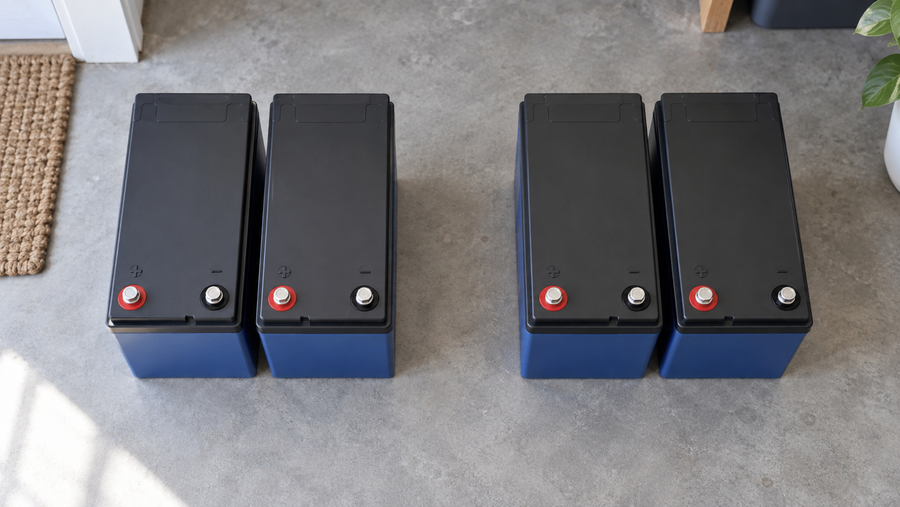

LiFePO4 batteries themselves are usually RF‑quiet; most interference comes from chargers, controllers, and wiring around them, not from the cells, and with good layout, grounding, and a few ferrites, LiFePO4 power can actually lower your noise floor compared with many AC supplies.
You key up your radio during a storm, the grid goes dark, and within seconds the noise on your favorite band turns into a wall of buzzing. It is a frustrating way to learn that the way your station is powered can matter as much as your antenna, yet many operators have run modern lithium packs for nearly a decade with clean audio, as long as the power gear is set up correctly. By the end of this guide you will know whether your battery is really to blame, how to test your setup, and the practical tweaks that keep your station strong and quiet on battery power.
Short Answer: Chemistry vs. Noise Sources
The LiFePO4 chemistry inside a battery cell does not generate RF energy in the way a transmitter, inverter, or switching supply does. A bare pack is essentially a DC source. What creates RFI is the electronics wrapped around that pack: charge controllers, inverters, protection circuits, and noisy cabling.
That is why experienced operators report running all of their radios from LiFePO4 for nearly a decade without the battery ever causing cut‑outs or band hash. In the occasional case where a radio seems to make a lithium bank shut down, the evidence almost always points to installation details, not to LiFePO4 as an inherently noisy technology. When radios are powered directly from the battery instead of through a noisy controller or cheap switching supply, operators consistently see quieter receivers and fewer birdies, a pattern echoed in independent ham power guides and manufacturer application notes.
So when you ask whether LiFePO4 “generates RFI,” the technically correct answer is that the cells are quiet, but the total system you build around them can be either very clean or very dirty, depending on your design choices.
Where the RF Noise Actually Comes From
Chargers, MPPT Controllers, and Inverters
Off‑grid and backup ham stations lean heavily on solar and DC power electronics, and those devices are prime RFI suspects.
Real‑world reports from off‑grid solar installations show a clear pattern: an inverter‑charger such as a high‑power hybrid unit can paint faint lines across 80, 40, and 20 meters, disappear around 17 meters, and then reappear on 15 through 10 meters. As charging current rises from just a few amps up toward full output, the hash on 20 meters becomes obvious; kill the PV input and the noise vanishes instantly. That behavior pins the interference on the solar charging side, not on the radio or the battery.
The same story shows up in detailed testing of popular MPPT controllers. When a radio is powered from the controller’s load output during active charging, the receiver fills with switching noise on the lower HF bands. Move the radio over to the battery terminals instead and the interference largely disappears. The noise is being conducted along the DC cabling from the controller, not primarily radiated directly from the antenna.

In other words, the “RFI personality” of your station depends more on the specific charger or controller you pick and how you connect it than on whether the storage is lead‑acid or LiFePO4.
Battery Management Systems and Pack Layout
LiFePO4 packs almost always include a battery management system that switches and measures current at relatively high speed. In well‑designed packs, the BMS is quiet, but it is still electronics sitting inches from your DC rails.
RF design work on lithium packs for portable devices shows that battery protection circuits can demodulate RF, inject low‑frequency noise into power lines, shift protection thresholds, and even reset a host system if they are not laid out with RF in mind. Poor copper distribution and large loops on the pack board can form little antennas that pull transmitter frequency and create hot spots on exposed metal.
Translated to a ham context, you occasionally see reports where keying the transmitter causes a lithium pack to shut down. It is rarely the cells; it is usually a sensitive BMS or marginal wiring reacting to RF, sometimes right at the trip threshold for over‑current protection.
Station Wiring and Proximity to the Antenna
Even the cleanest battery and charger can cause trouble if the wiring is sloppy.
Operators seeing power‑related cut‑outs and RFI often discover that their battery sits right beside the coax feedline, with long DC leads and loose loops under the operating table. The closer you bring that wiring to the RF field around your antenna, the more energy you couple into the power system. The effect follows the inverse square law: just moving cables a few feet farther from the antenna can make a surprising difference.
Experienced RFI troubleshooters such as K9YC emphasize bonding and grounding for exactly this reason.

A good single‑point ground that ties the radio chassis, battery negative, and any metal enclosures together gives RF currents a clear return path and keeps them off your DC wiring, where they can upset electronics.
How to Tell If Your LiFePO4 Power Is Causing RFI
Before you start wrapping ferrite on everything in sight, you want a simple way to prove whether your LiFePO4 system is actually to blame.
A straightforward method is to run the radio on the battery alone with everything else disconnected. Unplug the AC charger, turn off or disconnect the solar charge controller, and make sure any inverter is shut down. If you can transmit and tune across the bands with a clean noise floor in that state, the LiFePO4 pack itself and your basic wiring are likely fine.
Next, reintroduce components one at a time. First, power the radio directly from the battery and bring the solar controller online during a sunny period so it pushes at least several amps. Listen across 80, 40, 30, 20, 17, and 15 meters. If you see evenly spaced lines or a distinct tone that rises with charge current and disappears as soon as you shade or disconnect the panels, the controller is the culprit.
Then repeat with your AC charger connected and the radio still on the battery. If turning the charger on and off makes FM broadcast or HF bands suddenly pick up a buzz or hum, you have confirmed a noisy charger. Listening carefully to the character of the noise helps: a high‑pitched tone that moves with the tuning dial points one way; a broad hum or hash that blankets a region points another.
Finally, pay attention to behavior during transmit. If the battery seems to cut out only when you key up on certain bands or power levels, the BMS or wiring may be reacting to RF rather than simple current draw. That pattern mirrors cases where hams saw lithium power drop out only when transmitting until better ferrites and bonding were added.
Mitigating Noise While Keeping the Lithium Advantages
Start With a Clean DC Source
The quietest baseline for most stations is a direct battery feed.
Field setups built around a 100 amp‑hour LiFePO4 deep‑cycle battery, a simple DC distribution panel, and no inverter routinely run 25 to 50 watt HF rigs for hours without noticeable added noise. The same philosophy shows up in shack designs where radios that normally run on AC are instead fed from a lithium battery kept topped up by a dedicated charger. If mains fails, the battery keeps the rig on the air, and during normal use the radio sees a stable 13‑plus volt DC bus with no switching noise from a low‑grade power brick.
For a 100 watt HF radio, heavy 10 or 12 AWG leads from the battery to the radio or distribution block, fused within a few inches of the positive terminal, keep voltage drop low and minimize the chance that high current peaks will stress the BMS. That setup also tends to be cleaner because the DC path is short, direct, and free from auxiliary electronics.
Use Ferrites and Filters Where They Matter
When RFI does sneak in, ferrite is often the first and most effective tool.
Common‑mode chokes built with #31 material are well suited to the 1 to 600 megahertz range where many HF and VHF problems live. Snap‑on clamps in that mix can ride over DC cables, with both positive and negative run through the same core and, when space allows, several turns through the opening. For lower‑frequency switching noise in the hundreds of kilohertz up to a few megahertz, #77 material on a toroid such as an FT240‑77 lets you wind in multiple turns and present a much higher impedance to the unwanted currents.
Practical ham power guides recommend treating the main battery leads, the lines between the solar panels and charge controller, and the cable between any inverter or charger and the battery as prime candidates. When powerful controllers still leak noise into the rig, an LC filter on the radio’s DC input, built from a modest series inductor and an electrolytic capacitor with a small ceramic in parallel, can help clean up the last bit of hash without noticeably affecting voltage to the rig.
Cable Routing, Bonding, and Shielding
Good cabling costs nothing and often fixes more than any accessory.
Panel leads that run as a tight pair, tied together, radiate far less than separated runs forming a big loop. Keeping DC wiring parallel and close dramatically reduces the loop area and the magnetic field the conductors can radiate or pick up. At the same time, routing those DC bundles away from the coax and antenna base keeps the strongest RF fields away from your power system.
A single common ground bus near the operating position that ties together radio chassis grounds, battery negative, and charge controller negative gives RF currents a clear reference. Corrosion‑free crimped ring terminals, a little dielectric grease, and short, direct connections make the difference between a ground that actually sinks RF and one that simply looks good on paper.
When a charger or inverter is inherently noisy, shielding can be the last resort. Operators worried about FM interference from chargers have had success building simple Faraday cages from aluminum foil or metal screen around the unit, making sure the metal is insulated from live parts and bonded solidly to ground. Even then, keeping the AC and DC cords as short as possible prevents them from acting as antennas that bypass the shield.
When You Actually Need a Different Component
Sometimes the cleanest solution is to stop fighting a particularly noisy device.
If careful tests show that one specific MPPT controller or inverter sprays noise everywhere during high current operation, and ferrites plus filters only reduce the problem rather than eliminating it, you have a choice. One option is to power the radio only from the battery and schedule heavy charging for times when you are not on the air. Another is to replace the offending device with a quieter model documented by other hams as station‑friendly.
In one well‑known Victron MPPT example, simply bypassing the noisy load output and feeding the radio directly from the battery made the RFI largely disappear, at the cost of losing some built‑in monitoring features. In the long run, picking components that play nicely with RF is every bit as important as choosing the right antenna for your band plan.
Why LiFePO4 Still Wins for Ham Power
From a power‑upgrade perspective, LiFePO4 is still the strongest overall choice for both base and field stations, even after you factor in RFI concerns.
Compared with lead‑acid, LiFePO4 packs provide much deeper usable capacity without damage. Lead‑acid batteries resent being taken below about half of their rated capacity on a regular basis, while lithium packs are comfortable at 70 to 80 percent depth of discharge. That effectively doubles usable runtime for the same amp‑hour rating. On top of that, LiFePO4 self‑discharges only a few percent per month and can sit for months or even a couple of years and still be ready when you need emergency power.
Weight is just as important in the field. Because there are no heavy lead plates, a lithium pack of a given capacity typically weighs less than half of a comparable lead‑acid battery. Operators building micro‑RV power systems or backpack‑portable stations appreciate being able to strap a 100 amp‑hour pack to a simple wooden mount and still move the entire power module from a vehicle to a picnic table without straining their back.
Perhaps most important for RFI, running a radio directly from a well‑designed LiFePO4 pack eliminates the wideband noise that often comes with cheap AC switching supplies. Off‑grid specialists who swapped linear or low‑grade switching supplies for LiFePO4 packs consistently report cleaner reception, especially on the lower HF bands where switching hash tends to be most obvious.
A concise way to see the tradeoffs is to compare how different power options behave around RF:

Aspect |
LiFePO4 battery power |
Lead‑acid battery power |
AC switching supply |
RFI risk |
Low by itself; depends on chargers |
Low by itself; similar once wired well |
Highly dependent on design; often noisy |
Usable capacity |
High; about twice the usable capacity per rated amp‑hour |
Moderate; prefers shallow discharge |
Not a storage source |
Weight for runtime |
Light for given hours on the air |
Heavy for same operating time |
Not directly comparable |
Self‑discharge |
Very low, good for standby and backup |
Higher; needs more frequent topping |
Not applicable when unplugged |
Field portability |
Excellent, especially 20–50 Ah packs |
Poor for higher capacities |
Poor without extra battery or generator |
RFI mitigation |
Focus on BMS, charger, wiring |
Focus on wiring and charger |
Often requires filters and distance |
The main downsides of LiFePO4 are that it demands a proper charger tuned for its voltage profile, should not be charged below about 32°F unless the protection system explicitly allows it, and costs more upfront. Those are power‑engineering problems you can solve once. In return you get years of cycle life, lower station noise, and a power source that actually encourages you to operate portable instead of leaving the rig on the bench.
FAQ
Can a LiFePO4 battery by itself ruin my HF receive noise floor?
A healthy LiFePO4 pack without anything else attached is extremely unlikely to raise your noise floor. Reports of band hash traced to “the battery” have, on closer inspection, turned out to be caused by a connected charge controller, inverter, or poorly routed cabling. A clean test with the radio on the battery alone is the best way to prove this in your own shack.
Is it safe to run a ham radio directly from a LiFePO4 pack?
Yes. Most modern ham radios are designed for a nominal 13.8 volt DC supply and run very happily directly from a 12 volt LiFePO4 pack, as long as you size the wiring and fuse correctly. Guides from LiFePO4 vendors and ham‑focused battery manufacturers recommend a main fuse close to the positive terminal, heavy gauge cable to keep voltage drop low, and a distribution block or standard connectors such as Anderson Powerpole for multiple loads.
Why does my lithium system only get noisy when the sun is out?
That symptom is a classic sign that the solar charge controller is the source of RFI. When panel current is low or zero, the controller switches gently and radiates little. As current climbs, its high‑frequency switching becomes more aggressive and the noise gets stronger, sometimes drawing comb‑like lines across your bandscope. Ferrites on the PV and DC leads, better cable routing, and in some cases moving the radio off the controller’s load output and straight to the battery are effective fixes.
A well‑built LiFePO4 power system should feel like a performance upgrade, not a compromise: more runtime per pound, better standby reliability, and a quieter receiver when the rest of the neighborhood’s lights go out. Tune up your wiring and power electronics now, and the next time the grid blinks you will stay loud and clear while everyone else is still rebooting.
References
- https://smeng.ucsd.edu/wp-content/uploads/overcoming-the-interfacial-challenges-of-li-fe-po4-in-inorganic-all-solid-state-batteries.pdf
- https://stacks.cdc.gov/view/cdc/227981/cdc_227981_DS1.pdf
- https://oh8stn.org/blog/2022/08/21/victron-75-15-mppt-rfi-problem-on-hf-receiver/
- https://rsgb.org/main/files/2012/11/EMC10-final.pdf
- https://resources.altium.com/p/rf-interference-prevention-and-rf-pcb-design-in-the-internet-of-things
- https://battlebornbatteries.com/lithium-ham-radio-battery/?srsltid=AfmBOoruEzO7NwLcDR02OhBzZVhoepqLDEcRbX_M4yKeQWCzlRP69n_t
- https://www.device-solutions.com/news/optimizing-rf-performance-for-battery-powered-devices
- https://www.e2companies.com/hubfs/LiFePO4-Battery-Whitepaper_Final_11.21.23.pdf?hsLang=en
- https://www.edn.com/rf-interference-design-considerations-for-portable-device-batteries/
- https://ferrite-shop.com/prevent-solar-panel-interference/