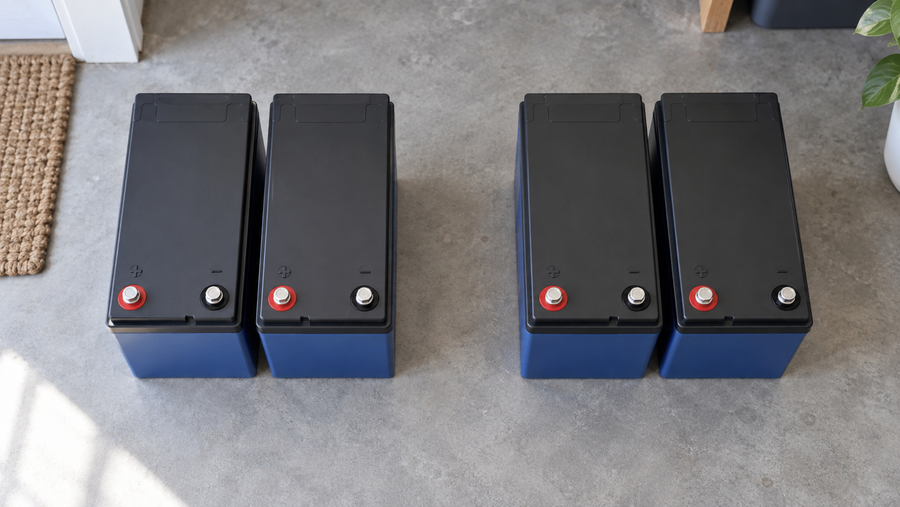

Choose 12V when your off-grid system has modest loads, short battery-to-inverter wiring, or existing 12V equipment. Choose 48V when the inverter and solar array are larger, cable runs are longer, or you expect to expand. Start by dividing the inverter's watt rating by the battery voltage to estimate DC current, then confirm that the inverter, cables, fuses, charge controller, and battery management system support the result.
Why 48V carries the same power with less current
Battery voltage changes the current needed to deliver the same power. The basic relationship is:
current = power / voltage
For an illustrative 2,400-watt load, a 12V bank would supply about 200 amps, while a 48V bank would supply about 50 amps. These are simplified values before conversion losses, and they are not a sizing approval. They show why higher-voltage systems usually need less extreme cable, fuse, and connection choices for the same power.
The trade-off is that a 48V system requires equipment designed for that voltage. A 12V system can be easier to match with small DC loads, vehicle equipment, and existing RV or marine components. The right choice is the voltage supported by the complete system, not just the battery.
Choose 12V for smaller or equipment-led systems

A 12V bank is a practical fit when most of your loads already use 12V DC, the inverter is modest, the battery and inverter sit close together, and you do not expect substantial expansion. It can also make sense when replacing an existing 12V battery bank would otherwise require changing several connected devices.
Check the current before choosing it. For example, an illustrative 1,200-watt inverter load would be about 100 amps at 12V before losses. That may be workable only when the inverter, battery, protection, terminals, and cables are all rated for the actual continuous and surge demand. If the calculated current pushes those parts beyond their documented limits, move to a higher-voltage design instead of compensating with improvised wiring.
The supplied Vipboss 12V 105Ah Bluetooth LiFePO4 Lithium Battery is suited to a 12V design when its 1,344Wh stated storage, 100A BMS rating, charging-temperature limits, and expansion instructions match the rest of the system. Its product description identifies RV, marine, solar, off-grid, and backup-power use, but it does not by itself prove compatibility with a particular inverter or charge controller. View the Vipboss 12V 105Ah battery only after checking those connected-device requirements.
Choose 48V for higher power or planned expansion
A 48V rack system is usually the stronger starting point when the system must run larger AC loads, deliver power over longer battery-to-inverter wiring, or grow over time. The lower current can make cable routing and overcurrent protection more manageable, but it does not remove the need for correct design.
Use the actual continuous and surge ratings of the inverter. An illustrative 5,000-watt load is about 417 amps at 12V and about 104 amps at 48V before losses. That difference can affect cable size, fuse selection, connection layout, heat, and voltage drop. Treat the calculation as a comparison tool, then use the equipment manuals and applicable electrical requirements for final sizing.
For a 48V bank, use only a series configuration that the exact battery documentation supports, and check that the inverter, charger, and protection equipment are rated for the planned configuration. Do not assume that four 12V batteries can be connected in series without confirming those requirements in the applicable manual