
Choose series when your inverter, motor, or other equipment requires a higher voltage; choose parallel when the equipment already uses your battery's voltage and you need more runtime. Check the equipment voltage first, then confirm in the applicable battery and equipment manuals whether the planned arrangement and charging limits are allowed before making any connection.
Choose series when your equipment needs higher voltage
A series connection links the positive terminal of one battery to the negative terminal of the next. The battery voltages add together, while the amp-hour capacity remains that of one battery.
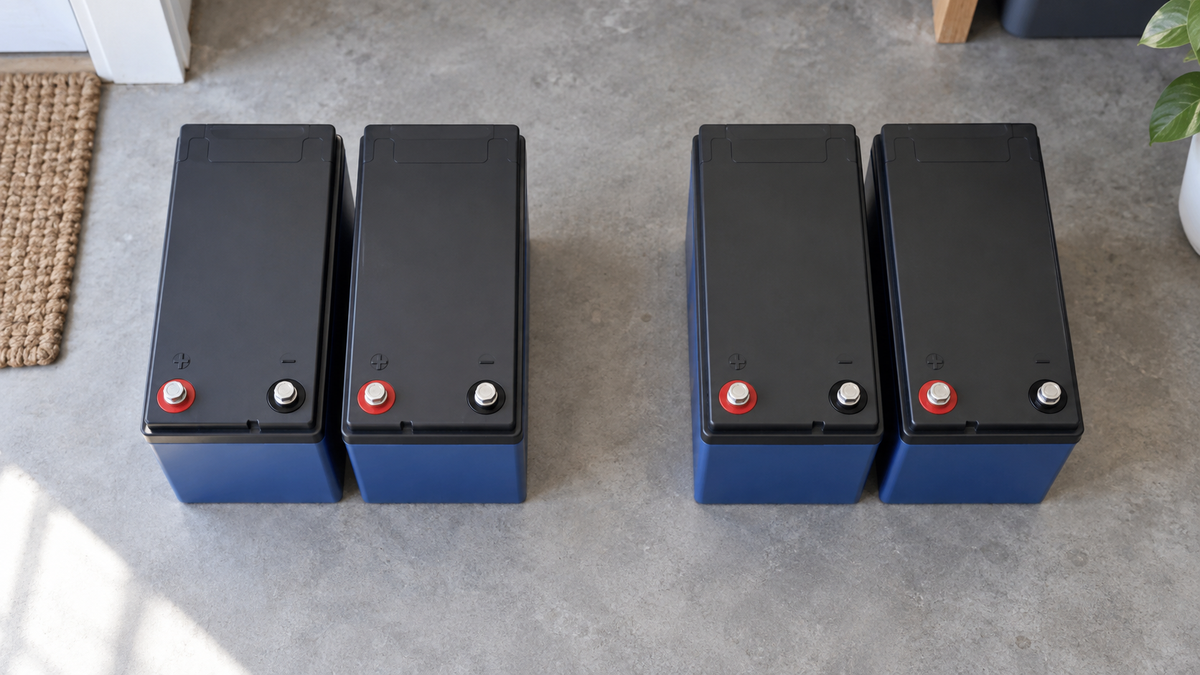
For example, two compatible 12V, 105Ah batteries in series form a nominal 24V, 105Ah bank. Four form a nominal 48V, 105Ah bank. This is the right direction when your inverter or other equipment is designed for 24V or 48V rather than 12V.
Series wiring does not turn a 12V device into a 24V device. The charger, inverter, fuse arrangement, and other connected equipment must be rated for the new voltage. Confirm the planned series arrangement and charging limits in the exact battery and equipment manuals. Battery systems should be handled according to the manufacturer’s technical documents, and damaged, hot, swollen, or abnormal batteries should not be connected or charged; follow this lithium-ion battery safety guidance for additional handling boundaries.
Choose parallel when you need more capacity at the same voltage
A parallel connection joins positive terminals together and negative terminals together. The voltage stays the same, while the amp-hour capacity increases.
Two compatible 12V, 105Ah batteries in parallel make a nominal 12V, 210Ah bank. That can provide more stored energy and longer operation for a 12V RV, marine, backup, or solar system, but it does not provide the higher voltage that a 24V or 48V inverter requires.
Before connecting batteries in parallel, use the exact battery and equipment manuals to confirm that the arrangement, charging parameters, and connection limits are allowed.
Match the connection to the equipment before buying more batteries

Start with the voltage printed on the equipment or required by its manual:
- 12V equipment: Stay at 12V. Use parallel batteries only if the applicable manuals allow that arrangement and you need more capacity.
- 24V equipment: Use a compatible 24V battery bank, often made by connecting two matching 12V batteries in series.
- 48V equipment: Use a compatible 48V bank, often made by connecting four matching 12V batteries in series.
- Unclear equipment requirement: Do not guess from the battery label. Confirm the required nominal voltage, charging profile, maximum current, and connection limits first.
The Vipboss 12V 105Ah Bluetooth LiFePO4 battery is a 12V battery for planning a compatible 12V system. You can review the Vipboss 12V 105Ah battery when checking the product information, then confirm any expanded configuration in the exact battery and equipment manuals.
The short answer is simple: series raises voltage; parallel raises capacity. Let the equipment’s required voltage make the first decision, then use parallel capacity only within the exact battery and system limits.