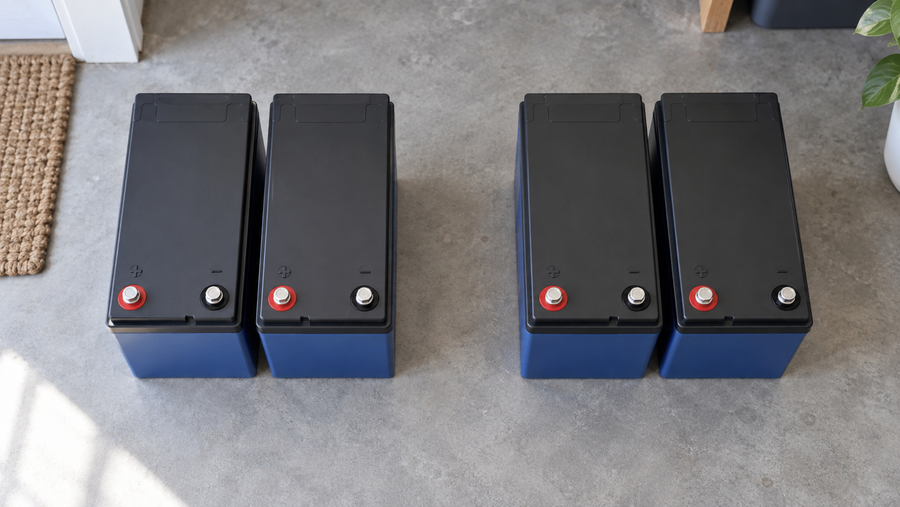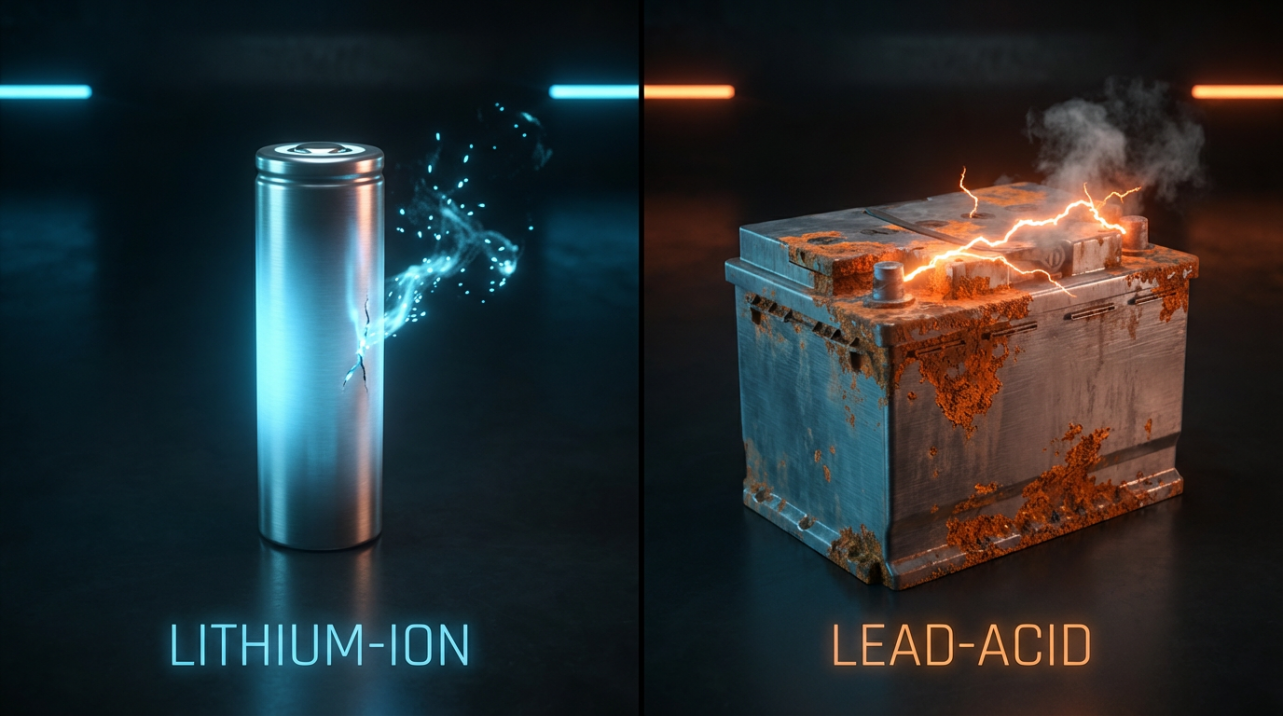

This article explains how battery self-discharge works, why lithium batteries retain charge far better than lead-acid during long storage, and how to store each chemistry so your off-grid system wakes up ready to run.
Self-discharge rate is how fast a battery loses charge while it simply sits unused. Lithium chemistries leak far less energy than lead-acid, so they often still have usable power after months of storage, while lead-acid banks are frequently flat or damaged.
Picture this: you park the RV or shut down the cabin for half a year, confident the batteries are ready for spring. When you come back, the lithium bank wakes up and runs your fridge, but the old lead-acid bank barely clicks a relay. Across off-grid systems, this pattern repeats again and again: lithium banks that were sized and stored correctly come back online, while lead-acid banks self‑drain, sulfate, and never fully recover. This guide shows what that “slow leak” inside each battery is, how fast different chemistries lose charge, and the storage habits that keep your upgraded system ready after months of downtime.
The Slow Leak Inside Every Battery: Self-Discharge Rate
Every battery has a quiet internal current that never reaches your loads. Even when the terminals are open, side reactions between electrodes and electrolyte slowly consume active material. That natural loss of charge over time is self-discharge, and the self-discharge rate tells you how fast it happens, usually in percent of remaining capacity per month or per year.
ChinaGode, Battery Power Tips, RHY Battery, and Large Battery all describe self-discharge the same way: it is inherent, it cannot be completely eliminated, and it strongly depends on chemistry, temperature, and build quality. In practice, you can measure it by charging a battery, letting it rest without any external load, and then re‑measuring its capacity. A common engineering formula is:
Rate (%) = (C₀ − Cₜ) / C₀ × 100
Here C₀ is the starting capacity and Cₜ is the capacity after a rest time t. For example, ChinaGode shows a 100 Ah lithium-ion cell that is fully charged, rested at about 77°F for a month, and then measured at 96 Ah. Plugging those values in gives a monthly self-discharge of 4%.
That one number is powerful because it lets you predict how much usable energy is left after storage. If you know your battery tends to lose 2% per month at 68–77°F, then over six months you can expect around 12% of its charge to vanish even with no external loads attached. Raise the temperature, and the leak gets much worse: multiple sources, including ChinaGode and RHY Battery, note that reaction rates roughly double for about every 18°F increase.
Lithium vs Lead-Acid: How The Numbers Stack Up Over Six Months
To understand why a lithium bank still “has power” after a long layup while a lead-acid bank feels dead, you have to compare typical self-discharge rates, not just rated amp-hours.
Drawing on data from Large Battery, RHY Battery, Delongtop, Neexgent, and Battery Power Tips, the patterns are consistent. Lithium-ion chemistries used in off-grid storage (including LiFePO₄) usually sit in the low single digits per month under normal conditions, while lead-acid chemistries lose several times more.
Here is a simplified view using typical values reported by those sources for healthy batteries stored in cool, dry conditions around 59–77°F.
Battery type |
Typical self-discharge in storage |
Example loss in 6 months (no external load) |
Lithium-ion / LiFePO₄ (no heavy BMS draw) |
About 0.5–3% per month |
Roughly 3–18% of charge lost |
Lithium-ion pack with BMS always on |
Around 10–20% per year |
Roughly 5–10% of charge lost |
About 4–6% per month |
Roughly 24–36% of charge lost |
|
Flooded lead-acid (cheaper types) |
About 6–8% per month or more |
Roughly 36–48% of charge lost |
Large Battery quotes lithium-ion self-discharge at roughly 1–2% per month, while RHY Battery gives a realistic range of about 0.5–3% per month, with an initial drop of 5–10% in the first month after a full charge. Delongtop and Neexgent both place lithium around 1–2% per month versus roughly 3–4% or more for lead-acid. Large Battery and RHY Battery’s broader self-discharge surveys show AGM and gel lead-acid at about 4% per month and cheaper flooded designs up to about 8% per month, rising even higher in heat.
Now translate those rates into real stored energy.
Example: 100 Ah Lithium vs 100 Ah Lead-Acid in Storage
Imagine you have two fresh 100 Ah batteries on the bench, one LiFePO₄ and one AGM lead-acid. You fully charge both to 100 Ah, disconnect all loads, and store them for six months around 70°F.
For the LiFePO₄ bank, use a mid‑range self-discharge of 2% per month, well within the 0.5–3% band reported by RHY Battery and the 1–2% band from Large Battery and Delongtop. Over six months, that adds up to roughly 12% charge loss. Your 100 Ah lithium battery might come back with about 88 Ah still on tap.
For the AGM lead-acid bank, use a mid‑range 6% per month, consistent with the 4–8% figures from Large Battery and RHY Battery’s general guidance on lead-acid. Over six months, that is about 36% loss. Your 100 Ah AGM battery could easily be down near 64 Ah before you attach a single load.
Lead-acid also cannot be used as deeply without damage. Grener and other sources note that to avoid severe sulfation, you typically limit lead-acid to roughly 50% depth of discharge, which means only about 50 Ah of that 100 Ah is truly “safe” to use cycle after cycle. After six months of self-discharge and no charging, the AGM battery in this example may already be hovering in the zone where any meaningful load drags it into unhealthy, deeply discharged territory.
In contrast, LiFePO₄ comfortably supports 80–90% depth of discharge with far less wear, as shown in off-grid comparisons from Solar Technology and Delongtop.

So that same 88 Ah remaining after six months is almost entirely usable.
This is why, in seasonal cabins or RVs that are parked for months, lithium banks still feel “full” while neglected lead-acid banks behave like they are dead: lithium not only loses less energy to self-discharge, it also lets you safely access a much larger slice of whatever remains.
What Really Kills Lead-Acid Banks In Storage
Self-discharge alone does not always push a battery to zero. The real story is how that slow leak interacts with chemistry, temperature, and time. For lead-acid, the combination is brutal.
Chemistry And Side Reactions
Lead-acid batteries use lead and lead dioxide plates submerged in sulfuric acid. Neexgent and Delongtop describe how, over time, the plates corrode and the electrolyte breaks down. Even when idle, side reactions slowly convert active material into lead sulfate crystals that do not easily revert during charging. That process is sulfation, and high self-discharge accelerates it.
Lithium-ion chemistries, including LiFePO₄, rely on lithium compounds and graphite in organic electrolytes. Large Battery and Battery Power Tips point out that lithium cells also have parasitic reactions, but their materials and design generally support much lower self-discharge. A thin protective film, often called a passivation or solid-electrolyte layer, forms on electrode surfaces and helps suppress further reactions.
Even at the cutting edge, self-discharge is a front-line design target. Research summarized by Technology Networks reports that scientists from Argonne National Laboratory, SLAC, and others identified “cathode hydrogenation” as a key self-discharge mechanism in high-energy electric-vehicle cathodes, linking internal electrolyte breakdown directly to self-discharge and long-term capacity loss. That work, published in Science, underlines a central point for system designers: self-discharge is not a vague nuisance; it is driven by specific chemical pathways that can be engineered down in lithium systems far more effectively than in classic lead-acid.
Heat And State Of Charge
Temperature is where self-discharge really punishes lead-acid in storage.
RHY Battery’s general self-discharge guidance for lead-acid shows that an AGM battery stored around 32°F can retain about 90% of its charge over roughly six months, but at about 104°F it can lose up to half its charge in roughly four months. That aligns with ChinaGode’s broader observation that reaction rates roughly double for about every 18°F increase.
Lithium-ion is not immune, but the starting point is much lower. ChinaGode notes that a lithium battery that self-discharges at about 2% per month around 77°F can jump to roughly 8% per month around 131°F. RHY Battery likewise warns that lithium self-discharge speeds up significantly at high state of charge and high temperature.
State of charge itself matters. Multiple sources, including ChinaGode, RHY Battery, and TEFOO Energy, recommend storing lithium-ion and LiFePO₄ packs around 40–60% state of charge in cool, dry conditions between roughly 50 and 77°F. High state of charge combined with heat accelerates the reactions that cause self-discharge and long-term aging. TEFOO Energy goes further for long storage, advising 50–70% state of charge and recharging about every three months to counter self-discharge and the extra draw from any built‑in electronics.
Lead-acid likes a different regime. To avoid sulfation, it wants to sit close to full, but that full state combined with elevated temperature pushes self-discharge and corrosion even faster. RHY Battery’s example at 104°F is a good illustration: a battery stored full in a hot engine bay or sun‑baked compartment can lose half its charge in roughly a third of a year without anyone touching it.
Self-Discharge, Deep Discharge, And Permanent Damage
A lead-acid battery does not just wake up at low state of charge after six months; it often wakes up damaged.
Neexgent and Grener both stress that lead-acid is highly vulnerable to deep discharge. When voltage is allowed to sit low for weeks or months, lead sulfate crystals harden, internal resistance rises, and usable capacity shrinks. The higher self-discharge of lead-acid simply makes it much easier for an unused battery to slip into that dangerous low state of charge.
Lithium-ion has its own red lines. Grener points out that repeatedly discharging below roughly 2.5 V per cell or truly to 0% state of charge raises internal resistance, increases self-discharge, and causes permanent capacity loss. That is why serious lithium packs include a battery management system that enforces low-voltage cutoffs and avoids leaving cells in a deeply discharged state. When you follow best practice and store lithium at a moderate state of charge in a cool space, its low intrinsic self-discharge means it almost never creeps into the deep-discharge zone on its own.
In real off-grid installations, that difference is obvious.

Lithium banks that were parked at 40–60% state of charge in a cool utility room often restart months later with only modest top‑up needed. Lead-acid banks left full in a hot shed, with no float charge and maybe a few parasitic loads, frequently come back below safe voltage with noticeable sulfation, even if the math suggests there “should” be charge left.
Storage Strategies That Make Your Upgrade Pay Off
Understanding self-discharge is only useful if it changes how you store and design your system. The goal is simple: you want the batteries to wake up ready to work after long gaps, not to run a delicate lab experiment.
When You Store Lithium Banks For Months
Lithium’s low self-discharge gives you a huge advantage, but it is not a license to forget about the bank indefinitely. TEFOO Energy, RHY Battery, ChinaGode, and Delongtop all converge on the same practical habits.
Before a storage period of a few months, bring the bank to roughly half charge, not full. For most LiFePO₄ packs, this means somewhere in the 40–60% state-of-charge window. Store the batteries in a cool, dry area, ideally between about 50 and 77°F and away from direct sun or heaters. If the pack has a switchable battery management system, turn it off or place it in storage mode to reduce electronic self-consumption.
TEFOO Energy notes that bare lithium-ion packs typically lose about 10–20% of their capacity per year in storage, and that a permanently powered BMS can raise the effective loss to roughly 20% per year. Over six months, that is still only about 5–10% of capacity for a healthy pack, but only if you stay out of hot environments. Plan to check state of charge every three to six months. If voltage or state of charge has drifted low, recharge gently back toward 50–60%, not to a hard, sustained 100%.
For larger off-grid racks, research summarized by Technology Networks suggests that matching modules by self-discharge behavior matters. Studies on electric-vehicle packs show that variations in self-discharge rate between cells are strong predictors of long-term capacity retention. In practical terms, buying quality lithium modules from a reputable manufacturer, with tightly controlled self-discharge and a proven battery management system, reduces the risk that one “leaky” module silently drags down the rest of your parallel bank over years.
If You Still Have Lead-Acid In The System
If lead-acid is still part of your system, you must treat storage as an active process, not a passive one.
RHY Battery and Neexgent emphasize that you should never leave a lead-acid battery sitting partially discharged for long periods. For seasonal storage, that means fully charging the bank, disconnecting unnecessary parasitic loads, and either providing a proper float charge from solar or a charger, or scheduling periodic top‑ups. In cooler climates where the storage area stays near 32–50°F, self-discharge is slower, but you still want to test voltage and recharge before state of charge drops much below about 80%. In hotter climates or engine compartments that can reach 104°F or more, the combination of 4–8% monthly self-discharge and heat-driven corrosion means a lead-acid bank can lose half its charge within a few months and start sulfating aggressively.
Where lithium may only need a quick health check and a light charge every few months, lead-acid often needs continuous float maintenance if you expect it to wake up strong after six months. That maintenance cost, along with the shorter cycle life and higher self-discharge, is one of the reasons Delongtop, Neexgent, and Solar Technology all conclude that lithium usually wins on total cost of ownership for frequently used, deep-cycling, or long-storage off-grid systems.
Design Choices That Reduce Self-Discharge Risk
You cannot change the laws of chemistry, but you can design around them.
First, choose chemistries and products with inherently low self-discharge for the roles that truly require long standby life. For long‑life sensors and ultra‑low‑power devices, Plant Engineering highlights bobbin‑type lithium thionyl chloride cells, which can have self-discharge under about 1% per year and operate over extreme temperatures from roughly −112 to 257°F. For high‑power off-grid storage that still needs to sit idle for months, modern LiFePO₄ packs, with around 0.5–3% self-discharge per month and robust battery management, are a better fit than lead-acid.
Second, keep everything cool and dry. Large Battery, Battery Power Tips, and RHY Battery are unanimous that a storage range around 59–77°F and low humidity dramatically slows self-discharge and other aging processes for both lithium and lead-acid. Avoid hot sheds, enclosed engine bays, and sealed compartments without ventilation.
Third, manage state of charge intentionally. Lithium banks prefer the middle band during storage; lead-acid prefers to sit full but cannot be left to drift down. Treat self-discharge rate as a planning parameter, just like amp-hour capacity or depth of discharge, and you will start to see why lithium so often justifies its higher upfront price in real off-grid use.
FAQ: Self-Discharge And Long Breaks Off-Grid
If lithium self-discharge is so low, can I ignore my battery for a year?
The chemistry can tolerate long idle periods better than lead-acid, but the supporting electronics still need respect. TEFOO Energy estimates that lithium packs typically lose about 10–20% of their charge per year in storage, and notes that a battery management system can raise effective loss to about 20% per year. Over a year, a pack stored hot, near full, and with a hungry BMS can drift into low state of charge. The safe habit is to store at roughly half charge in a cool space and schedule at least one check and gentle recharge every three to six months, especially if the bank is critical to your off-grid system.
Why does my lithium battery lose several percent in the first day, then almost stop dropping?
Large Battery explains that lithium-ion cells often show an initial drop of about 5% in the first 24 hours after a full charge and rest. That early fall is largely surface processes and relaxation, not the long-term linear self-discharge you see over months. After that first day, typical lithium self-discharge settles into a much slower pattern of roughly 1–2% per month under moderate temperatures, or around 0.5–3% when you include broader chemistries and conditions as RHY Battery does. Seeing a small, fast early drop followed by a very slow decline is normal for a healthy pack.
Does disconnecting the battery stop self-discharge?
Disconnecting the battery only removes external loads. It does nothing to stop the internal side reactions that drive self-discharge. TEFOO Energy’s distinction between bare cell self-discharge and the higher effective loss when a BMS is attached makes this clear: once you remove loads and shut down as much electronics as possible, you are still left with the chemistry’s own self-discharge rate. That is why storage temperature and state of charge matter even when everything is “disconnected.”
A well‑planned lithium upgrade takes advantage of this reality instead of fighting it: you choose a chemistry with a naturally low self-discharge, pair it with a smart battery management system, design your storage routine around cool temperatures and mid‑range state of charge, and let the bank quietly wait until you need it. Do that, and six months from now the lights come on when you flip the switch, instead of sending you hunting for a booster pack and a replacement quote.

References
- https://pmc.ncbi.nlm.nih.gov/articles/PMC9085530/
- https://iopscience.iop.org/article/10.1149/1945-7111/acb669/meta
- https://rspsupply.com/c-4034-high-rate-batteries.aspx
- https://www.batterypowertips.com/why-self-discharge-is-important-in-batteries/
- https://www.delongtop.com/lithium-ion-vs-lead-acid-batteries/
- https://www.neexgent.com/article/why-do-lead-acid-batteries-have-a-shorter-lifespan-than-lithium-ion-batteries.html
- https://www.plantengineering.com/low-battery-self-discharge-the-hidden-secret-to-long-operating-life/
- https://www.power-sonic.com/lithium-vs-lead-acid-batteries/
- https://www.rhybattery.com/news/understanding-lithium-ion-battery-self-discharge.html
- http://www.batteryuniversity.com/article/bu-802b-what-does-elevated-self-discharge-do/