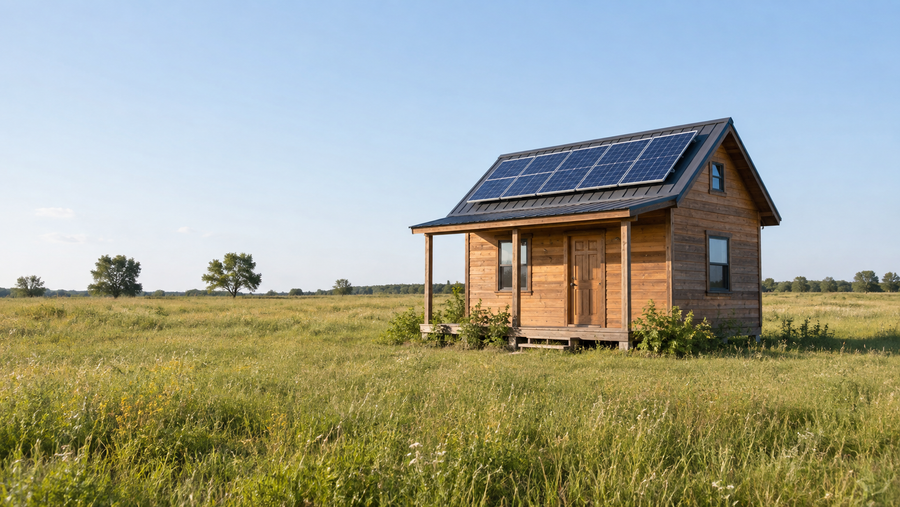

This guide explains how to size off-grid batteries and solar so a small but continuous Starlink-style internet load stays online 24/7, even through several cloudy days.
For a continuous internet load of about 40 watts, you typically need roughly 2.5-3.5 kWh of lithium battery storage to keep Starlink-style internet online 24/7 with two to three days of reserve. The exact number depends on your actual power draw, system losses, and how many "no-sun" days you design for.
Picture this: you roll into your cabin or off-grid site, fire up Starlink, and everything is perfect until the third gray day, when your internet drops in the middle of a video call because the batteries finally sag. That pattern shows up over and over in off-grid forums, where even a modest 40 W continuous load is described as a "significant engineering undertaking" once you try to support it all day, every day. With the right sizing math borrowed from proven off-grid battery guides, you can turn that fragile setup into a rock-solid 24/7 link by knowing exactly how much storage you need and how to build it.
Why a 24/7 Internet Load Is Trickier Than It Looks
Satellite internet and Wi-Fi gear look harmless on paper. Forty watts sounds tiny next to an air conditioner or microwave, yet off-grid designers point out that feeding a continuous 40 W load is not trivial once you are hundreds of ft from the grid or relying entirely on solar and batteries. That 40 W turns into about 960 Wh per day because it never shuts off. In off-grid design terms, you have added a small but relentless "appliance" that behaves more like a refrigerator than a light bulb.
Experienced off-grid advisors repeatedly stress that the challenge is not the peak power, it is the energy over time. A community example uses that same 40 W continuous figure to show how quickly infrastructure costs climb if you try to power it over a 1,500 ft cable run instead of local solar and batteries, and the conclusion is clear: once a load is always on, you must treat it as a major design driver, even if the wattage sounds modest.
For Starlink, that means you cannot just bolt the dish onto an existing undersized battery bank and hope for the best.

The internet load has to be measured, converted into daily energy, and built into your storage and solar sizing from the start.
Step 1: Turn Your Starlink Into a Daily Energy Number
Every reputable off-grid sizing guide starts in the same place: convert your loads into watt-hours per day. Whether it is a camper, RV, or full-time home, the method is identical. You take the device's power in watts and multiply by the number of hours it runs per day. Engineering articles and battery calculators for campers and cabins use this exact formula to size everything from laptops to water pumps.
Your satellite internet kit behaves like a textbook continuous load. If your dish, router, and modem together average about 40 W when you measure them with a plug-in meter, the daily energy is:
40 W x 24 hours = 960 Wh per day, or about 1.0 kWh.
Off-grid camping examples show that a 100 Ah, 12 V lithium battery holds about 1,200 Wh of energy, and a modest daily load of lights, a 12 V fridge, and a laptop can already consume around 663 Wh per day. When you add roughly 960 Wh for 24/7 internet on top of that, you are suddenly in the neighborhood of 1,600 Wh per day for "just" communications and a basic work setup. That is why internet power must be accounted for like any other core appliance.

If you are already off-grid, the best move is to log your actual Starlink system with a watt-meter for a few days. Once you know your real average wattage, the daily energy math is straightforward, and every serious battery sizing method from major off-grid battery vendors is built on that same step.
Step 2: Decide How Many "No-Sun" Days You Want to Survive
Next comes the design choice that separates fragile systems from resilient ones: days of autonomy. Off-grid battery specialists routinely recommend aiming for two to three days of autonomy, with four to five days for very cloudy climates, when they size systems for cabins, tiny homes, and farms. That "days without sun" number simply means how long you want to run with little or no charging.
Here is how common off-grid home sizing formulas translate for a 24/7 internet load of 960 Wh per day:
For 2 days of autonomy, you need 960 Wh x 2 = 1,920 Wh of usable energy.
For 3 days of autonomy, you need 960 Wh x 3 = 2,880 Wh of usable energy.
Battery designers then divide by allowable depth of discharge and system efficiency. Proven LiFePO4 guides often assume about 80-90% depth of discharge and 85-90% overall efficiency once you include the inverter and wiring losses. Using 90% for both as a realistic but optimistic target gives a combined factor of 0.81.
So a two-day internet reserve becomes about 1,920 Wh / 0.81, or roughly 2,370 Wh of nominal battery capacity. Three days becomes roughly 2,880 Wh / 0.81, or about 3,560 Wh. Rounded, that is about 2.5-3.5 kWh of lithium storage purely to support the internet link.
Off-grid home examples that include lights, fridges, pumps, and routers routinely end up in the 5-15 kWh battery range for similar two- to three-day autonomy.

The pattern is the same: decide on your "no-sun" tolerance up front, and the math tells you how much storage you need to buy.
Step 3: Choose Battery Chemistry, Voltage, and Bank Size
Why Lithium Is the Go-To for 24/7 Internet
Battery comparison articles for off-grid homes and remote sites consistently show lithium iron phosphate (LiFePO4) leading for long-term, daily-cycle use. Typical guidance is that traditional lead-acid batteries should only use about 50% of their rated capacity to preserve life, while LiFePO4 units safely deliver 80-90% of their capacity every day for thousands of cycles. Off-grid advisors who have run both point out that lithium banks are simpler to live with, charge faster, tolerate partial state of charge, and avoid the watering and equalization rituals of large flooded lead-acid banks.
Because your internet load runs 24/7, you are essentially asking the battery to cycle constantly. In that use case, lithium's higher usable depth of discharge and long cycle life usually deliver a lower lifetime cost even if the upfront price per kWh is higher, a conclusion echoed by cost breakdowns from off-grid battery companies.
Sizing the Bank for Starlink-Style Loads
Once you choose lithium, you can lean directly on the formulas used in off-grid home examples. One widely used approach is:
Total Battery Capacity (Wh) = (Daily Energy Use (Wh) x Days of Autonomy) / (Depth of Discharge x System Efficiency).
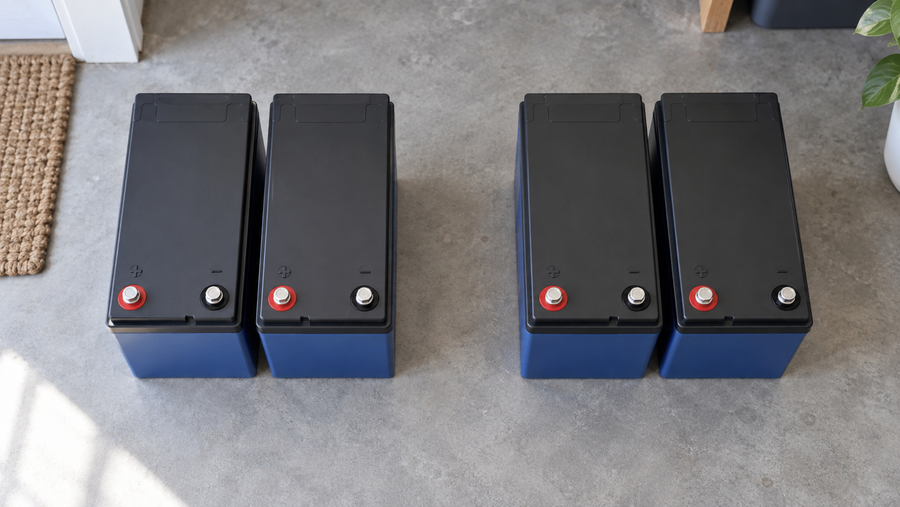
We already ran this for the 960 Wh/day internet load and got roughly 2.5-3.5 kWh for two to three days of autonomy at 90% depth of discharge and 90% efficiency. To convert that into amp-hours, you divide by the system voltage. Many off-grid designers favor 24 V for small setups and 48 V for full-time cabins and homes because higher voltage means lower current and thinner cables.
At 24 V, about 2.4 kWh of storage is roughly 100 Ah, and 3.6 kWh is about 150 Ah. So for a dedicated "internet only" bank at 24 V, a 24 V, 100-150 Ah LiFePO4 battery would cover two to three days of 24/7 service for a 40 W-class Starlink-style load, assuming the rest of your system is efficient.
If you fold the internet into a broader off-grid lifestyle, the math scales the same way. One detailed example from an off-grid battery calculator shows a small home using 2,250 Wh per day and needing about 8,824 Wh of lithium storage for three days of autonomy at 90% depth of discharge and 85% efficiency, which works out to roughly a 48 V, 200 Ah bank. Adding a 960 Wh/day internet link to that profile nudges the daily total near 3,200 Wh and pushes the required bank above 12 kWh. In other words, a 24/7 satellite link is a major contributor in a minimalist system and still a noticeable slice of a small off-grid home.
What If You Use Lead-Acid?
Lead-acid can work, but it roughly doubles the required nameplate capacity. Several off-grid sizing tutorials use a simple rule of thumb: multiply your required usable energy by two to stay within a 50% depth of discharge limit. A system needing 2,880 Wh of usable storage for three days of internet, for example, would want on the order of 5.5-6 kWh of lead-acid capacity, plus extra headroom for temperature and aging. Off-grid experts who compared real installations often found such banks were heavy, slow to recharge, and unforgiving if they were not brought to full charge regularly, especially in winter, which is why many now recommend shifting to lithium for mission-critical loads like communications.
Example Off-Grid Starlink Setups
To see how the pieces fit together, it helps to compare a few real-world scenarios, all built around that same 40 W continuous internet load and the sizing methods used by off-grid calculators and RV designers.
Scenario |
Loads Included |
Daily Energy Use (approx.) |
Days of Autonomy |
Lithium Battery Size (nominal) |
Internet-only site |
Starlink-style internet (~40 W, 24/7) |
960 Wh |
2-3 |
2.5-3.5 kWh at 24 or 48 V |
Remote work cabin |
Internet plus basic lights, 12 V fridge, laptop (about 663 Wh/day extra) |
About 1,600 Wh |
2-3 |
4-6 kWh, often at 24 V |
Small off-grid home |
Internet plus roughly 5 kWh/day of household loads from a typical case study |
About 6,000 Wh |
3 |
Around 20 kWh at 48 V |
The "remote work cabin" line combines a published 663 Wh/day camping load profile (LED lights, a 12 V fridge, and a laptop) with the 960 Wh/day satellite internet number. The small home line folds the 1 kWh/day internet into an off-grid house that already uses about 5 kWh/day and targets three days of autonomy, similar to the design example where a 5 kWh/day load led to roughly 17 kWh of lithium storage.
No matter which row looks most like your life, the next step is to confirm that your solar array can refill the bank.

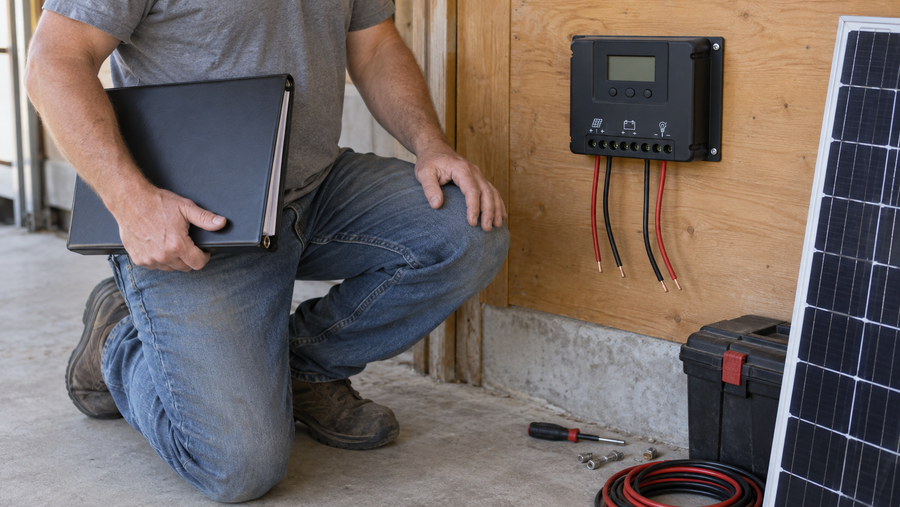
Solar engineers often size panels for the worst season by dividing daily energy by winter "full sun hours." One worked example uses a 1,000 Wh/day load and 2.5 winter sun hours to justify about a 400 W array. If your internet system also uses about 1,000 Wh/day, you should expect a similar panel size just to replace the internet energy in winter, plus extra solar to cover your other loads and overhead.
Common Mistakes and How to Avoid Them
One of the biggest mistakes people make when they add Starlink to an off-grid system is ignoring system losses. Multiple sizing guides warn that real systems only deliver 50-90% of theoretical panel energy once you account for inverter inefficiency, charge controller limits, wiring, and temperature. If you size your battery purely from the internet wattage multiplied by hours, without dividing by depth of discharge and efficiency, you will almost certainly end up with a bank that looks good on paper but dies early in the morning of the second cloudy day.
Another common pitfall is undersizing the solar array relative to the battery. Advisors working with off-grid homes describe large lead-acid banks that, on paper, had plenty of kilowatt-hours, yet never really got full because the array was too small, shortening battery life and requiring frequent generator use. Modern lithium systems flip that around: they oversize the solar array so the battery is full by midday on most days, even if some solar energy is "wasted" in the afternoon. For a 24/7 Starlink link, that oversizing strategy is your friend because it keeps your communication battery topped up whenever the sun is available.
Temperature and environment are easily overlooked. Off-grid resources note that batteries deliver less usable capacity in the cold and age faster in heat. They recommend keeping banks in sheltered, moderate spaces rather than baking in the sun or freezing on a shed floor. If your Starlink gear sits on a roof or pole, that is fine, but the battery feeding it should live in a temperature-friendly location if you want your carefully calculated capacity to actually be there in January.
Finally, do not forget the infrastructure trade-offs. The 40 W at 1,500 ft example shows how quickly voltage drop and cable size become a problem if you try to "just run a wire" from the nearest utility source. For most off-grid Starlink installations, a compact local lithium bank and properly sized solar, located near the dish and router, will be more efficient and more flexible than extreme long-distance wiring.
FAQ: Do You Need a Separate Battery Just for Starlink?
In many off-grid cabins and homes, the most robust approach is a single, well-designed lithium bank that supports both Starlink and other critical loads like refrigeration, lights, and pumps. The same sizing formulas used by off-grid calculators simply add the internet watt-hours to the rest of your loads and deliver one integrated capacity number.
A dedicated "internet only" battery can make sense for critical communications at a remote site where other loads can be shed aggressively. In that case you would size the Starlink bank using the methods above, then design your main house bank for everything else, knowing that a storm or unexpected usage will not take down your connection. Either way, the math does not change: you start from watts and hours, pick days of autonomy, choose a chemistry, and build a bank that can be recharged reliably by your solar array.
When you approach Starlink as a 24/7 design load instead of a gadget, you end up with a quiet, always-on connection that just works, even after a string of cloudy days. Do the sizing once using proven off-grid formulas, invest in a right-sized lithium bank and an adequately large solar array, and your off-grid internet becomes as dependable as your ambition.
References
- https://efom.crs.org/wp-content/uploads/sites/1/2012/09/EFOM-Facilities-How-to-size-off-grid-baterries.pdf
- https://forum.outbackpower.com/viewtopic.php?t=17854
- https://brightsparkgroup.com.au/solar-battery-sizing-calculator-guide/
- https://www.felicityess.com/how-to-calculate-battery-capacity-of-solar-energy-system/
- https://www.franklinwh.com/blog/choosing-the-right-size-and-capacity-for-a-solar-battery-system
- https://www.greentechrenewables.com/article/what-panelboard-sizing-120-rule
- https://www.instructables.com/How-to-Size-Your-Off-Grid-Solar-Batteries-1/
- https://magsolar.ca/what-size-solar-system-does-your-commercial-building-need/
- https://suninone.com/how-much-battery-do-you-need-for-an-off-grid-system/
- https://community.ui.com/questions/f9bd14ff-2846-4fb4-b4ac-93f651977ea5