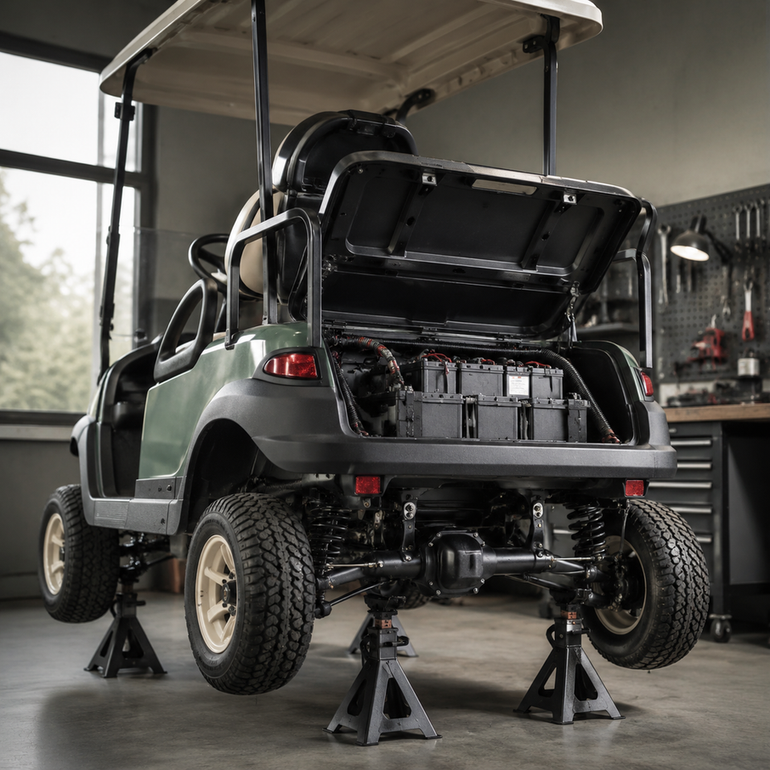

A suspension lift does not automatically mean your golf cart needs a new battery tray. It does mean the existing mounting arrangement deserves a fresh inspection before the cart returns to service.
The lift can change how the chassis, rear structure, steering, and suspension move relative to battery cables and nearby components. Keep the factory battery location only when the tray, restraints, cable paths, and clearances remain suitable for the specific cart, lift kit, and battery installation instructions.
Start with Electrical Isolation
Disconnect the battery or batteries before beginning lift-kit work. Documented Yamaha G2/G9 lift instructions begin with that step, and it is the right starting point before working around high-current battery connections and vehicle structure.
Then make the cart safe to support and service according to the applicable cart and lift-kit procedures. The goal is not simply to create space for the lift components. It is to make the battery compartment, cables, and attachment points visible enough to inspect as the cart is disassembled and reassembled.
Do not assume that a lift affects every cart the same way. Battery trays may remain untouched on one model but sit close to a structural area, cable run, or component that moves during installation on another.
Watch Wiring as the Rear Structure Moves

The rear portion of a lift installation can be the point where an otherwise acceptable cable path becomes a problem.
In a documented Yamaha G22 procedure, the center section is lowered after removal of the upper rear-shock bolts. The instructions specifically tell the installer to watch electrical wiring and other lines that may be affected during that movement. If an item is adversely affected, the procedure calls for replacing it as needed.
Use that example as an inspection principle, not as a universal description of every lift:
- Identify every battery cable and accessory lead that passes near the area being lowered, raised, or repositioned.
- Observe those routes while the relevant structure moves through the procedure.
- Stop if a cable becomes stretched, pinched, dragged, trapped, or exposed to a sharp edge.
- Correct an adversely affected wire or line before completing the installation.
A cable that looked fine with the cart at rest may not remain fine while the rear assembly is being moved. This is why battery mounting and cable routing should be checked during the lift installation, rather than only after the larger tires are on.
Inspect the Existing Battery Mount Before Reusing It

A lift does not by itself prove that the factory tray is inadequate. It does create a reason to inspect it again.
Check the battery location against the instructions for your exact cart, lift kit, and battery. Focus on whether the installation has altered access, introduced interference, or changed the path of the main battery cables.
Your inspection should confirm that:
- The battery tray is in sound condition and remains properly attached.
- The battery is restrained as required by its manufacturer.
- The hold-down system has not been removed, loosened, or made inaccessible by the lift installation.
- Battery cases, terminals, and cables are not positioned where steering, suspension, tires, drivetrain parts, or other moving parts can contact them.
- Cables are protected from sharp edges and do not become strained as the chassis and suspension move.
- The battery maker's mounting, orientation, fusing, charger, and connection requirements are being followed.
Rough-terrain use makes this inspection more important. Vibration and shock can expose weaknesses in a tray, restraint, or cable route that may not be apparent during a quick driveway check.
Check More Than Ride-Height Clearance
A lifted cart should not be evaluated only at parked ride height. The relevant question is whether the battery and its wiring remain protected through the movements the cart can make in use.
With the cart safely supported and following applicable service procedures, inspect the intended battery location and cable routing during:
- Suspension compression
- Articulation, where applicable
- Steering at full lock
- Movement of any rear structure involved in the lift installation
Do not rely on a universal clearance figure. The appropriate space depends on the cart, lift design, tire size, battery package, and documented installation requirements.
If a component can touch, pull on, pinch, or rub a cable, treat the route as unresolved. Likewise, if the battery itself can interfere with vehicle movement or cannot be securely retained in its intended position, the original arrangement should not be reused unchanged.
Treat a Lithium Conversion as a New Fitment Decision

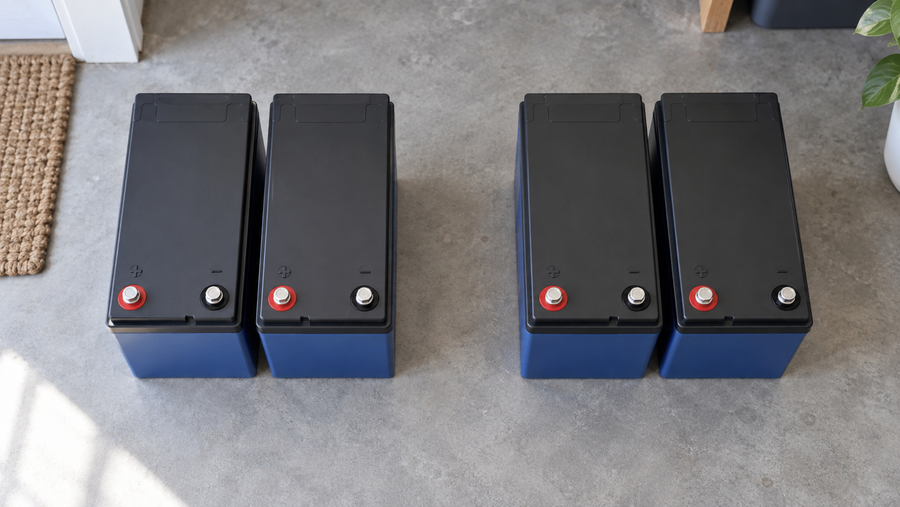
Replacing several lead-acid batteries with a lithium battery can change the physical layout of the battery compartment, even if the cart voltage remains appropriate for the system. Complete LiFePO4 golf-cart battery kits are available in multiple configurations, including 36 V, 48 V, and 70.4 V (72 V) 105 Ah options, so a nameplate voltage alone does not establish tray fit or mounting compatibility.
Before installing a lithium battery in a lifted cart, compare the specific battery's current installation documentation with:
- Available tray or compartment space
- The battery's required mounting method and orientation
- Restraint points and access for service
- Main-cable and charger-connection routing
- The lift kit's altered chassis and suspension geometry
Do not fill tray gaps with improvised restraints or assume a smaller battery can simply be left loose in the original lead-acid footprint. The battery must be retained according to its documented requirements, and its cables must remain protected as the cart moves.
For a broader look at how battery-system weight changes can affect planning, see this guide to golf cart range and weight reduction. Weight reduction does not automatically resolve stability concerns on a lifted cart; placement and the complete vehicle configuration still matter.
When Relocation Needs a Pause
Relocating a battery under the seat, into a rear compartment, or onto a custom tray is not a simple extension of a lift install. It can change cable paths, attachment methods, service access, and how the battery load is carried.
Pause for qualified golf-cart technician review when the plan involves:
- A damaged or questionable factory tray
- Frame drilling, welding, or a custom fabricated mount
- Changes to high-current cable length or routing
- Unclear battery-management-system or charger wiring
- A battery location near moving, hot, or sharp-edged components
- Questions about axle loading, handling, or stability after relocation
The same caution applies when a lift kit requires structural movement near existing electrical lines. A battery mount is part of the cart's power system, not merely a storage location.
Use a Clear Go/No-Go Decision
Go: Retain the factory battery location when the tray is sound, the battery is securely restrained as documented, cable routes remain protected, and all relevant suspension and steering movements pass inspection.
No-go: Do not reuse the arrangement unchanged if the lift installation adversely affects a cable, line, restraint, tray, or battery clearance. Correct or replace the affected item before the cart is used.
Pause: Seek technical review when the solution requires relocation, frame modification, custom mounting, or changes to high-current wiring. For a lithium conversion, verify the specific Vipboss battery model's installation documentation against the exact cart and lift configuration before finalizing the mount.