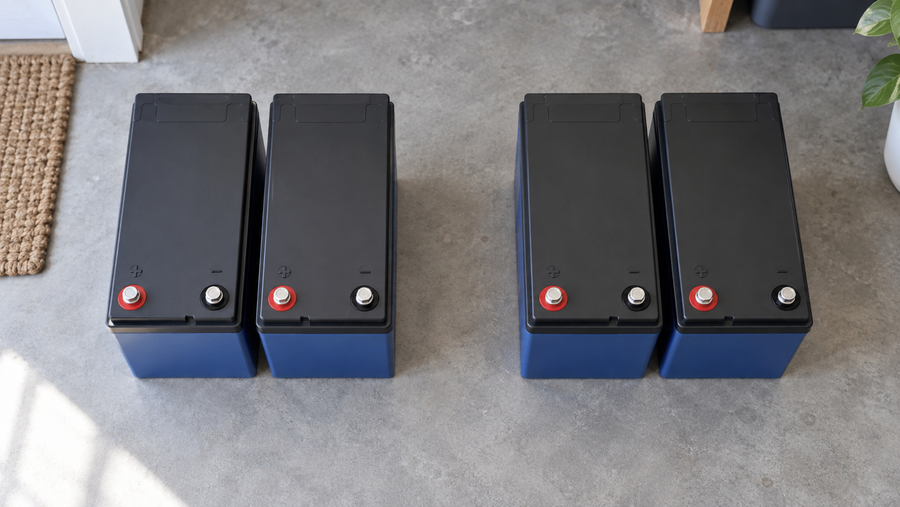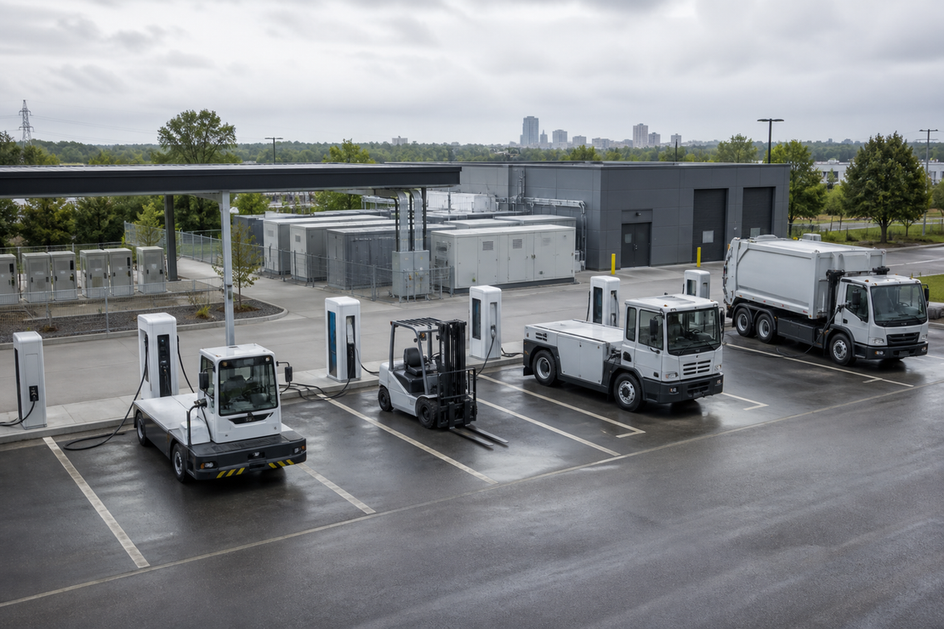

Charging infrastructure belongs in fleet total cost of ownership as a site-level operating system, not as a charger purchase alone. Build three linked views for every project:
- Project cash flow --- when money is required for equipment, installation, upgrades, and ongoing service.
- Financial-reporting and tax treatment --- how each cost is treated under the accounting, tax, and lease rules that apply to the operator.
- Economic fleet TCO --- the lifetime cost assigned to a site, vehicle group, department, or migration scenario.
A defensible model tests charger utilization, simultaneous charging, tariff structure, shared-asset allocation, equipment replacement timing, and the effect of operational changes during a lead-acid-to-lithium migration.
Start with a Complete Cost Register

The charger invoice is only one line in the infrastructure budget. Create a register before comparing battery or migration options, with each line tagged by site, project phase, asset owner, and intended cost treatment.
| Cost Group | Inputs to Capture | TCO Decision It Supports |
|---|---|---|
| Charging equipment | Charger hardware, mounting equipment, communications components | Purchase, lease, or service-model comparison |
| Electrical scope | Panels, switchgear, transformers, conduit, wiring, service upgrades, and connection work | Whether the existing site can support the planned charging pattern |
| Site and facility work | Civil work, equipment pads, access changes, permits, and installation labor | Full upfront cash requirement by location |
| Software and communications | Network, monitoring, data, and software-service charges | Recurring operating-cost estimate and allocation plan |
| Utility costs | Energy charges, demand charges, fixed charges, interconnection charges, and time-based rates | Electricity-cost scenarios and charging-schedule decisions |
| Maintenance and repair | Preventive service, inspections, parts, and repair allowances | Operating-cost and availability assumptions |
| Replacement and end-of-life | Planned refreshes, residual-value assumptions, removal, and disposal scope | Lifecycle cash flow and economic TCO |
| Financing or service arrangement | Lease payments, charging-service fees, ownership terms, and contract commitments | Cash-flow timing versus ownership economics |
This register should preserve original invoices and scope descriptions. It also needs a clear flag for whether an item is directly tied to one charging point, shared among several charging points, or shared with non-charging facility operations.
That distinction matters for both management reporting and incentive analysis. It also prevents a common modeling error: assigning all facility work to a battery conversion without documenting what portion serves the fleet.
Keep Cash Flow, Accounting, and TCO Separate
The same project can look different depending on the view being used.
Cash flow answers when the operator must fund the work. It should show deposits, construction phases, equipment delivery, commissioning, recurring utility bills, maintenance, and replacement events.
Financial reporting and tax treatment answer how costs are recognized under the operator's applicable rules. Do not assume that every installation expense receives the same treatment as charger hardware, or that tax treatment determines book accounting. Record the proposed classification for each cost line, then validate it with the organization's accountant or tax adviser.
Economic TCO answers whether one operating model is economically preferable over another. It should include the complete site cost and the recurring costs of operating it, regardless of when an item is recognized in financial statements.
A practical register can include these fields:
- Site and department
- Asset or service description
- One-time or recurring cost
- Direct or shared cost
- Cash-payment timing
- Proposed accounting and tax treatment for local validation
- Allocation driver
- Replacement assumption
- Scenario affected
This approach creates an audit trail for assumptions without turning a fleet TCO workbook into a tax return.
Allocate Shared Infrastructure Consistently
Many fleet assets are shared: a panel may support multiple chargers, a communications platform may serve several sites, and one utility account may cover multiple departments. Allocate these costs with a driver that reflects the management question being answered.
Possible allocation drivers include:
- Charging sessions
- Electricity delivered
- Charging hours
- Vehicle count
- Shift usage
- Departmental usage
- Reserved charging capacity
No single driver is universally correct. A fleet that wants to understand vehicle-level economics may use one driver, while a facilities team budgeting a site expansion may use another. The important discipline is to document the driver, apply it consistently, and rerun the model when utilization assumptions change.
Use a separate line for costs shared with non-fleet operations. Otherwise, a fleet migration may appear more expensive---or less expensive---than it truly is.
Model Electricity as More Than an Energy Rate

Electricity should be a distinct operating-cost module, not a single blended price. Capture the tariff elements that apply to the site, including energy charges, demand charges, fixed charges, service or interconnection costs, and time-of-use pricing where relevant.
The operational input is equally important: when vehicles charge, how many charge at once, how long charging windows last, and which shifts depend on the same infrastructure.
Run at least three cases:
- Base case: expected fleet duty cycle and charging behavior.
- Constrained-site case: limited electrical capacity, heavier overlap in charging windows, or delayed infrastructure work.
- Managed-charging case: a defined operating approach intended to control charging concurrency.
Do not assume that managed charging produces a specific utility saving or eliminates an upgrade. Treat it as a scenario with its own operational assumptions, equipment requirements, and utility-cost outcome.
Treat a Lead-Acid-to-Lithium Conversion as a System Change

A battery migration should not be modeled as a battery-price substitution. The charging plan may change along with charging windows, charger usage, fleet availability, facility layout, maintenance routines, and electrical load patterns.
Before assigning savings or upgrade costs to a lithium scenario, validate:
- Battery and charger compatibility
- Charger quantity and utilization assumptions
- Charging-window requirements by shift
- Existing electrical capacity and proposed scope
- Shared infrastructure used by other fleet or facility loads
- Downtime and staging assumptions during conversion
- Replacement timing for charging equipment and batteries
Battery-side economics can be considered alongside infrastructure costs, but they should remain separate inputs. A comparison of lithium and lead-acid charging costs can help frame that battery-side review; it does not replace a site-specific electrical and TCO assessment.
For multi-site fleets, create the model at both the site and portfolio levels. A favorable result at one facility does not automatically transfer to another location with a different tariff, electrical scope, shift structure, or charger utilization pattern.
Apply U.S. Federal Charging-Credit Assumptions Separately From TCO
For U.S. projects, a potential federal credit should be modeled as a separate, conditional cash-flow branch---not as an automatic reduction to charger cost or a general accounting rule.
Under the stated §30C business-credit rules, qualifying refueling or recharging property must be placed in service from January 1, 2023 through June 30, 2026. The stated base rate is 6% of eligible cost, including labor, subject to a $100,000 limit per item. The stated rate can be 30% when prevailing-wage and apprenticeship requirements are met, also subject to the per-item limit. Directly attributable associated property may include items such as pedestals, conduit, and wiring. IRS guidance on the stated §30C credit conditions also describes location, original-use, depreciability, and placed-in-service requirements.
For TCO purposes, maintain three cases:
- No credit assumed
- Credit assumed but pending eligibility confirmation
- Credit confirmed under the applicable project facts
Shared electrical assets need particular care. A ratable share may be relevant when infrastructure supports multiple qualifying charging items, while shared infrastructure serving non-credit purposes may be partly or wholly excluded from the credit calculation. That tax-credit treatment is not a universal internal allocation method for fleet TCO.
Build a Decision-Ready Migration Model
A useful model does not need artificial precision. It needs transparent assumptions that management can challenge and update.
For each scenario, show:
- Upfront cash requirement by project phase
- Recurring electricity, software, maintenance, and service costs
- Planned replacement events
- Allocation of shared assets
- Tax-credit or incentive assumptions shown separately
- Operational assumptions for charging windows and vehicle availability
- Risks or dependencies requiring validation
Then test the assumptions that most affect the decision: charger utilization, charging concurrency, tariff changes, demand charges, equipment life, downtime, financing cost, and replacement timing.
Create the asset and recurring-cost register; obtain utility tariff and interval-load data; validate electrical scope and charger compatibility; confirm accounting and tax treatment locally; run base, constrained-site, and managed-charging scenarios; then use the completed inputs to evaluate a staged lead-acid-to-lithium fleet migration with Vipboss and qualified technical and financial advisers.