
This guide shows how to swap a tired Power Wheels lead-acid battery for a well-matched lithium pack that delivers longer runtimes, faster charging, and a safer, more exciting ride. Set it up before Christmas and your kid's old car can feel like a brand-new present on Christmas morning.
Swap the tired stock battery for a properly chosen lithium pack and you can turn a sluggish Power Wheels into a longer-running, faster-charging Christmas "new car" without buying a whole new toy.
Does your kid's Power Wheels crawl to a stop just as the Christmas lights come on and the fun should be peaking? Moving from the original 12-volt lead-acid brick to a well-matched lithium setup can cut charge time from most of a day to just a few hours and add a serious kick every time they hit the pedal. This guide walks you through choosing the right lithium battery, installing it safely, and dialing in charging habits so the upgrade feels magical on Christmas morning and stays reliable all year.
Why a Lithium Battery Feels Like a Whole New Power Wheels
Stock Power Wheels batteries are usually sealed lead-acid units that are heavy, slow to charge, and fade as your kid drives, which is why the car feels strong at first and then bogs down. Lithium-ion batteries store more energy in a smaller, lighter case than lead-acid, so the car sheds weight and holds speed more consistently during a ride. That translates into more fun per charge at the same voltage level. Lithium‑ion packs built for Power Wheels also recharge faster and tolerate more charge cycles before they noticeably wear out.
The difference is especially obvious in charge time and lifespan. One 12-volt guide shows typical lead-acid Power Wheels batteries needing roughly 8-12 hours to recharge, while comparable 12-volt lithium packs are designed to come back in about 2-4 hours and can reach around 1,000-2,000 cycles instead of a few hundred for lead-acid. Modern 12-volt lithium systems aimed at ride-on toys pair higher energy density with smart protection electronics and clearly defined charge limits to keep things safe and efficient in kids' vehicles. Analyses of 12‑volt Power Wheels batteries underline how this longer life and faster charging make the higher upfront cost pay off over time.
Real-world tinkering backs this up. In one popular Power Wheels Jeep conversion, a worn-out OEM pack that took more than 12 hours to charge and delivered only 20-30 minutes of run time was replaced with Milwaukee M18 lithium tool batteries. With proper fusing and a speed controller, the owner reported about 65% more power and full recharges in roughly 60-90 minutes using the existing tool charger instead of waiting overnight. That kind of hands-on result shows how much performance is being left on the table by an aging lead-acid brick when a well-managed lithium pack is ready to drop in. This specific Jeep project is documented in a detailed discussion of Milwaukee M18 lithium batteries in a Power Wheels Jeep.

To make the choice concrete, it helps to compare the main options side by side.
Feature |
Sealed lead-acid (stock) |
General lithium-ion pack |
LiFePO4 pack tuned for toys |
Weight |
Heavy, adds drag to small cars |
Much lighter, better acceleration |
Slightly heavier than other lithium, still lighter overall |
Charge time |
About 8-12 hours for a full charge |
Often about 2-4 hours with the right charger |
Similar to other lithium with good chargers |
Cycle life |
Roughly 150-500 cycles before big performance drop |
Commonly around 500-1,000 cycles |
Frequently around 1,000-2,000 cycles |
Behavior in use |
Voltage sags; car slows noticeably as battery drains |
Holds voltage better; speed feels more consistent |
Very flat discharge curve; runtime stays predictable |
Upfront cost |
Lowest purchase price |
Higher purchase price |
Often highest, but best cost per cycle |
Maintenance |
Sensitive to deep discharge and long storage at low charge |
Needs charger matched to pack and proper management |
Designed for high safety with robust thermal stability |
These ranges and trade-offs match what manufacturers and retailers report about ride-on toy batteries, where lithium is consistently framed as faster-charging, longer-lasting, and lighter than comparable lead-acid in Power Wheels-style toys. Battery care guides for electric ride-on toys explain that lithium packs typically deliver several times more charge cycles than lead-acid while requiring less hands-on maintenance, as long as owners respect voltage limits and use the correct charger. Amped ride-on toy battery care resources echo these points.
Choose the Right Lithium Pack for Your Kid's Car
The best lithium upgrade does not start with "maximum volts." It starts with staying inside what the toy can safely handle while giving your kid a clear, noticeable improvement.
Start With Voltage and Speed, Not Hype
Most Power Wheels platforms use either 6-volt or 12-volt batteries, and some larger or sportier models are built for 24 volts. Speed is essentially tied to system voltage: 6-volt cars are slow and gentle, 12-volt is the usual sweet spot, and 24-volt is reserved for bigger vehicles and older kids who can handle higher speed plus stronger acceleration. Retailers that specialize in replacement Power Wheels batteries emphasize matching the factory voltage unless the model is explicitly designed to accept a higher-voltage upgrade. Their recommendations for common Jeep and Dune Racer models highlight 12-volt replacements and modest 12-volt capacity upgrades rather than aggressive voltage jumps. These practices are laid out in selection and upgrade advice Power Wheels battery specialists.
Charging guidance for kids' electric cars points in the same direction. Typical 12-volt ride-on batteries are expected to provide around 1-2 hours of driving per full charge and need roughly 6 hours to recharge after the initial conditioning charge, as long as the charger voltage matches the battery. Using a 24-volt charger on a 12-volt battery is explicitly flagged as unsafe because it can overheat and permanently damage the pack. A charging guide for kids' electric cars stresses that replacements must match the car's original voltage and that choosing a higher-voltage battery or charger purely for speed is a safety risk that can burn out electronics or worse. These points are made clearly in advice on charging kids’ electric cars.
For a Christmas surprise that feels like a new car but keeps risk low, the safest play is to keep the same voltage and focus on better chemistry and smarter capacity. If you decide to move to a higher voltage later (for example, from 12 to 18 or 24 volts), treat that as a separate performance build with upgraded motors, wiring, and safety hardware rather than a quick holiday swap.
Size the "Gas Tank" Without Overloading the Car
Battery capacity, measured in amp-hours, is your runtime lever. A simple rule of thumb from toy car battery guides is that, all else equal, doubling capacity roughly doubles runtime. That is why lithium upgrade packs marketed for Power Wheels often jump from stock capacities of around 9.5 amp-hours to 12-15 amp-hours. One retailer highlights a 12-volt 15 amp-hour upgrade for common models like the Power Wheels Jeep and Dune Racer, noting that this swap yields longer playtime while still fitting the stock compartment and wiring. These runtime-oriented upgrades are part of the product lineup presented by Power Wheels battery suppliers.
On the lithium side, guides to toy car batteries explain that a 2,000 milliamp-hour pack will typically deliver about twice the runtime of a 1,000 milliamp-hour pack, assuming similar driving conditions. They also stress that very high-capacity packs are larger and heavier, so you must check both physical fit and weight to avoid upsetting the toy's balance or overloading its plastic chassis. Manufacturers of LiFePO4 toy car batteries, a lithium chemistry valued for its stability, call out the need to match voltage, capacity, dimensions, weight, and connector type to the specific ride-on car rather than chasing the biggest number on the spec sheet. These compatibility and sizing cautions are spelled out in guidance for selecting LiFePO4 toy car batteries.
There is also a hidden trap in "monster" batteries. Power hobbyists discussing Power Wheels mods sometimes consider dropping in an 80 amp-hour 12-volt deep-cycle lead-acid battery to get all-day runtime. Experienced builders point out that these huge batteries are extremely heavy and should not be discharged below about 50% if you want them to last, so your effective capacity is closer to 40 amp-hours while the extra weight makes the car sluggish and hard on plastic gears. In contrast, using two power-tool lithium packs in parallel, each around 100 watt-hours, can deliver similar usable energy with far less weight and better performance, as reported by enthusiasts comparing options on Power Wheels battery modification forums.
For a Christmas upgrade, a good target is a lithium pack in the same voltage and general size as stock, with a moderate capacity bump—roughly 25-50% more amp-hours—rather than a giant "forever battery" that the toy was never designed to carry.
Pick Chemistry and Form Factor That Fit Your Skills
Not all lithium packs behave the same way. Standard lithium-ion packs built for consumer electronics or tool batteries prioritize energy density and power, while LiFePO4 packs trade a bit of energy density for very high thermal stability and long cycle life. Battery makers who specialize in LiFePO4 underline that this chemistry is particularly forgiving in toys and light vehicles because it resists overheating and provides a very flat discharge curve, which keeps performance predictable for kids' ride-on cars over many seasons. These benefits and trade-offs are described in resources on LiFePO4 toy car batteries.
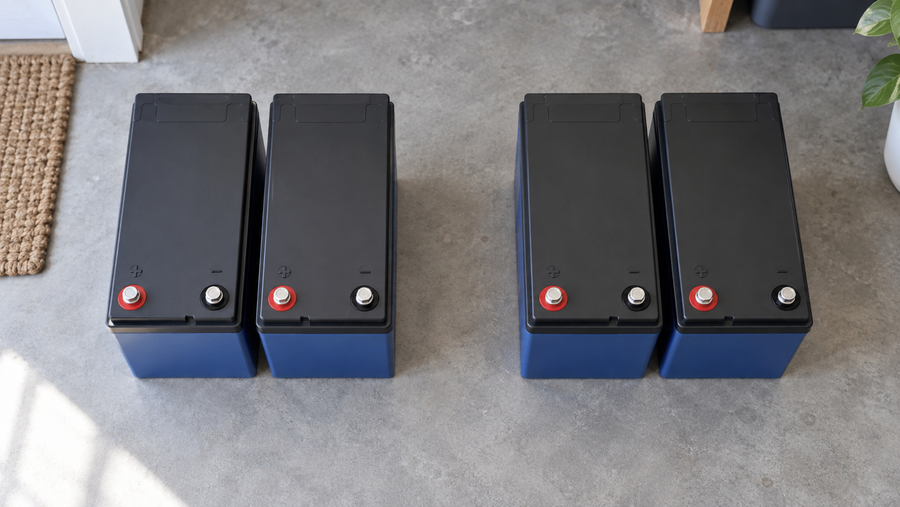
Form factor is your next decision. One path is to use a "drop-in" LiFePO4 pack that is built as a direct replacement for a specific Power Wheels battery, usually with matching connectors and an internal battery management system that handles overcharge, over-discharge, and short-circuit protection. Replacement packs marketed for 12-volt ride-on vehicles, including Power Wheels models, are sold with around 20 amp-hours of LiFePO4 capacity and are labeled as compatible with those toys. A representative example is a 12-volt 20 amp-hour LiFePO4 replacement battery sold for Fisher Price Power Wheels vehicles on Amazon, which is designed to slot into the original compartment and wiring harness without custom electronics. This style of ready-made pack is illustrated by the SEFEPODER 12-volt LiFePO4 replacement battery for Power Wheels.
Another path, better suited to technically confident parents, is to repurpose cordless tool batteries. Enthusiasts have shown that paralleling two similar power-tool packs at the right voltage can provide more runtime and stronger acceleration than the stock lead-acid battery while remaining surprisingly affordable if you already own the tool ecosystem. In the M18 Jeep build mentioned earlier, the combination of internal tool-pack protection, a properly sized fuse, and a pulse-width-modulated speed controller made the higher-power system controllable and reasonably safe. This approach and its considerations are laid out in the same M18 Power Wheels conversion discussion.
If you prefer a plug-and-play Christmas surprise with minimal wiring, a drop-in LiFePO4 pack with built-in protection and the correct connector is usually the most family-friendly choice. Tool-battery conversions can be fantastic, but they belong in the "garage project" category with time set aside for testing, fusing, and tuning before a child drives the car.
Real-World Upgrade Examples and Lessons
A straightforward, parent-friendly build starts with a direct-replacement lithium pack. Suppose your kid's Power Wheels Jeep currently uses a 12-volt sealed lead-acid battery rated around 9.5 amp-hours that takes 8-12 hours to charge and gives about an hour of continuous driveway play. Replacing it with a 12-volt LiFePO4 pack around 15-20 amp-hours, designed as a Power Wheels replacement, keeps voltage the same but increases runtime and slashes charge times when paired with the correct lithium charger. Lithium battery vendors and ride-on specialists report that these packs typically recharge in roughly 2-4 hours and are designed for hundreds more cycles than the original, so the kid notices longer drives while you notice a lot less downtime. This pattern is supported by 12-volt lithium product overviews showing fast charging and extended cycle life relative to lead-acid, as well as the direct-replacement LiFePO4 packs marketed for Power Wheels-style toys on battery manufacturers' and retailers' sites.

An advanced build, inspired by the Milwaukee M18 conversion, might target more punch rather than just more runtime. Imagine that your original 12-volt battery is at the end of its life, taking all night to charge and barely moving the car for 20 minutes. If you already own compatible 18-volt tool batteries and chargers, constructing a harness that feeds the Power Wheels through a fuse and a speed controller lets you step up voltage and power in a controlled way. Builders who followed this route measured about a 65% increase in power and dramatically reduced charge times with the tool charger. However, they also invested in protective electronics and careful wiring to keep motors and gears alive, as described by the hobbyist who shared the Milwaukee M18 Power Wheels Jeep project. For a Christmas deadline, that kind of mod is best started weeks in advance so you can test, tune speed down for younger drivers, and ensure all wiring runs cool under load.
Safety First: Make Lithium Boringly Reliable
Any time you move from factory lead-acid to lithium, you are trading simplicity for performance. The goal is to make lithium's extra power feel boringly safe.
One conservative school of thought in ride-on car circles recommends sticking with sealed lead-acid batteries entirely, arguing that motors and wiring are designed around their specific behavior. A widely cited discussion comparing lithium and SLA in a children's ride-on car warns that using other lead-acid types or lithium packs without fully understanding the design can overheat motors or create unexpected risks, and suggests that many families are better served by high-quality SLA replacements. This cautious perspective is presented in a thread on lithium versus SLA in ride‑on cars. That concern is worth respecting, and it is exactly why your lithium upgrade should mimic the original battery's voltage and be built from reputable components with proper protection.
On the battery side, lithium manufacturers and ride-on toy brands emphasize several common safety practices. They insist on using the charger specified for the battery chemistry and voltage, rather than reusing a lead-acid charger or a random charger from another toy. Overcharging—especially leaving a pack on charge far beyond the recommended time—shortens life and increases risk, so smart chargers that shut off automatically or parents who unplug promptly are both critical. Guides for ride-on battery care recommend charging new or replacement 12-volt batteries for roughly 6-8 hours before first use, then recharging after each ride and avoiding leaving the charger connected indefinitely, repeating these points across multiple kids' car battery care resources and toy battery upgrade guides.
On the usage side, lithium packs do best when you avoid extremes. A smart charging strategy for lithium, sometimes called the 80/20 rule, is to operate mostly between about 20% and 80% state of charge in regular use. Charging to full occasionally is fine, especially after long storage, but keeping a pack parked at 100% or repeatedly running it nearly empty accelerates aging. Detailed lithium care instructions for RV and marine batteries explain that staying in this mid-range reduces internal heat, increases cycle life, and still provides more than enough usable energy for daily use. These habits are outlined in guidance on the 80/20 rule for lithium batteries.
Environment matters too. Safety guides for ride-on toys with lithium batteries urge parents not to charge or store these cars near flammable materials such as curtains or couches, and to avoid direct sunlight, extreme heat, or freezing conditions. If a battery casing looks swollen, cracked, or smells like burnt plastic, the advice is to stop using the toy immediately, move it away from the house, and treat it as a potential fire risk rather than "one more ride." Battery maintenance articles advise regular visual inspections, keeping terminals clean, and recycling old or damaged packs instead of tossing them in household trash, with similar themes echoed by ride-on toy battery care resources like those from Amped ride-on toys.
Finally, protect the rest of the electrical system. Experienced Power Wheels modders treat an inline automotive fuse as non-negotiable, sized appropriately for the motors and wiring. They also warn that higher voltages and huge capacity bumps can shred stock plastic gears and switches, which were never designed for that stress. Performance-oriented suppliers of Power Wheels upgrade batteries caution against exceeding roughly 18 amp-hours of capacity in many builds, and recommend pairing higher-voltage systems with heavier-duty motors and soft-start modules to avoid gear-destroying surges. That level of caution keeps your Christmas upgrade from turning into a string of broken gearboxes.

Christmas Game Plan: From Idea to First Test Drive
A clean, drama-free Christmas upgrade starts weeks before wrapping paper hits the floor. Begin by confirming the toy's model and battery voltage from the label under the car or in the manual. Measure the battery compartment and note how the stock battery connects, then choose a lithium pack that matches voltage and connector, with a modest bump in capacity and a clear statement that it is suitable for ride-on toys or Power Wheels-type vehicles.
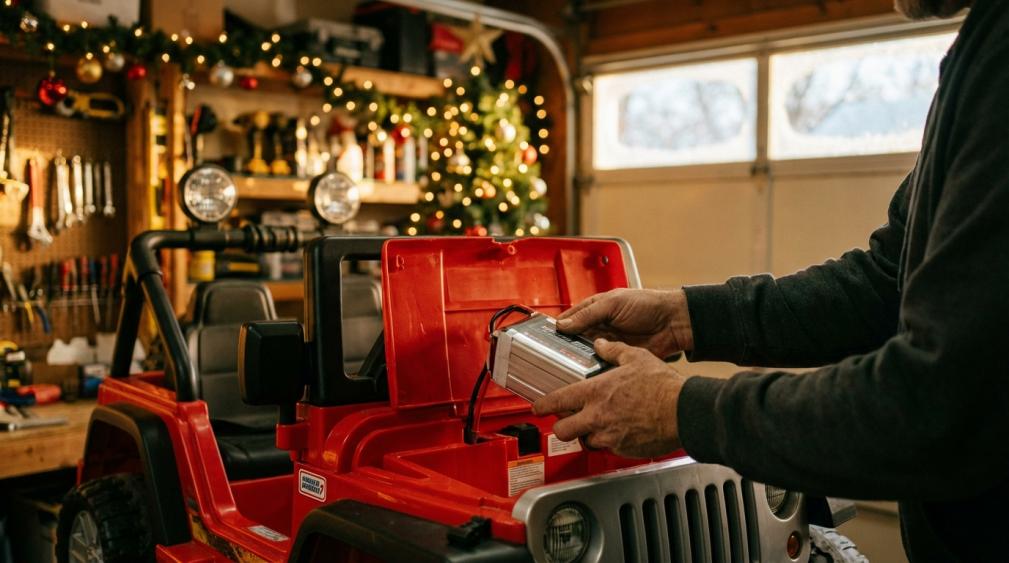
Once the pack and lithium charger arrive, bench-test them away from your kid's eyes. Charge the battery fully, then install it in the car while the child is at school or asleep. Check that all wires are secure, the fuse is installed, and there is no play in the battery compartment that could cause cables to rub or chafe. Take the car for a quiet test drive yourself, listening for unusual noises and feeling for hot spots around the motors, switch, and wiring after a few minutes of hard acceleration.
In the days before Christmas, top the battery off to full, then disconnect the vehicle if possible to avoid phantom drains. On Christmas morning, you can let your kid discover that their "old" car suddenly leaps off the line and runs longer than they remember. After the first big day of driving, set the expectation that the car goes back on charge for only the recommended time and sleeps in a cool, dry spot in the garage or a similar area, not parked half-dead in a freezing driveway.
Over the rest of the winter and into spring, keep applying the same fundamentals that make off-grid lithium systems last: avoid running the pack absolutely flat, recharge after each play session, and store the battery at a partial charge during long breaks. A quick monthly check of terminals, wiring, and the charger light is enough to catch most issues long before they become safety problems.
Quick FAQ
How much extra runtime can a lithium upgrade deliver?
Lithium packs tuned for Power Wheels often advertise over 30% more playtime than stock lead-acid batteries at the same nominal voltage, largely because they combine slightly higher amp-hours with better voltage stability under load. That is consistent with examples of 12-volt upgrade packs moving from about 9.5 amp-hours to 12-15 amp-hours, along with lithium's flatter discharge curve that keeps speed up rather than sagging during a ride. Retailers that offer these 12-volt 15 amp-hour upgrades for popular Power Wheels models frame them as "longer ride" options because of this combination of capacity and voltage behavior, as described in their Power Wheels battery upgrade recommendations.
Is it safe to upgrade from 12 volts to 18 or 24 volts for more speed?
Higher voltage absolutely means more speed and torque, but it also means more stress on switches, wiring, and plastic gears. Performance-focused Power Wheels upgrade guides only recommend 18- or 24-volt setups when you also upgrade to stronger motors, add proper fusing and soft-start electronics, and match the build to an older, experienced driver. Some conservative voices in the ride-on community advise staying at the factory voltage—and simply using a fresh, high-quality battery—unless you are ready to redesign the powertrain. The cautious position is captured in discussions comparing lithium and SLA in ride-on cars, where staying within the original voltage envelope is seen as the safest default for families, as in the SLA versus lithium debate for children's ride-on cars.
When does it make more sense to stay with sealed lead-acid?
If you want the simplest possible swap, have no interest in custom wiring, and your kid is happy with the car's speed, a high-quality sealed lead-acid replacement remains a valid choice. Specialists that sell both lithium and lead-acid options note that AGM and other sealed lead-acid batteries are cheaper and straightforward to maintain, especially when you follow good charging habits and store them properly. At the same time, they highlight lithium as the better long-term value once you factor in faster charging and greater cycle life. The trade-offs between AGM, flooded lead-acid, and lithium chemistries are laid out in detail on sites that supply Power Wheels replacement batteries.
A lithium upgrade, done right, turns a fading Power Wheels into a little workhorse that feels brand-new every holiday season, not just this one. Spec the pack conservatively, wire it as carefully as you would a small off-grid system, and charge it smart, and that Christmas surprise will keep delivering strong launches and long driveway adventures long after the decorations come down.