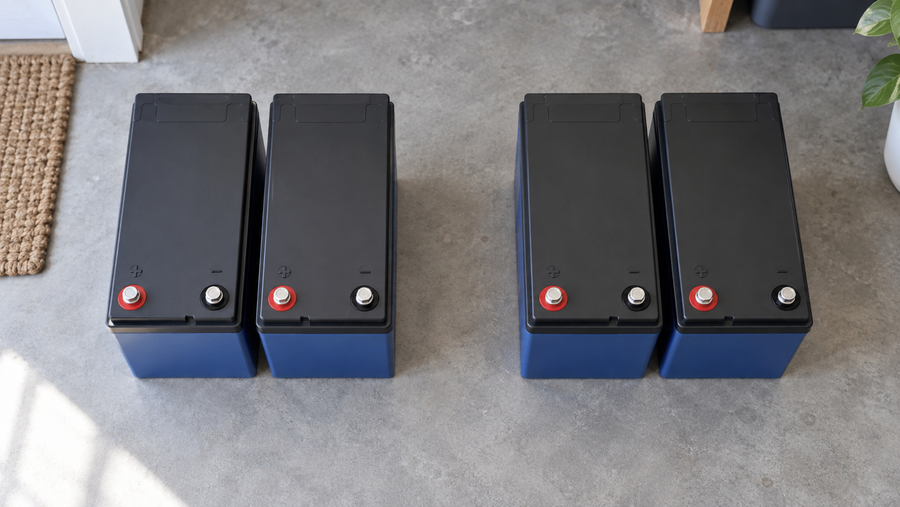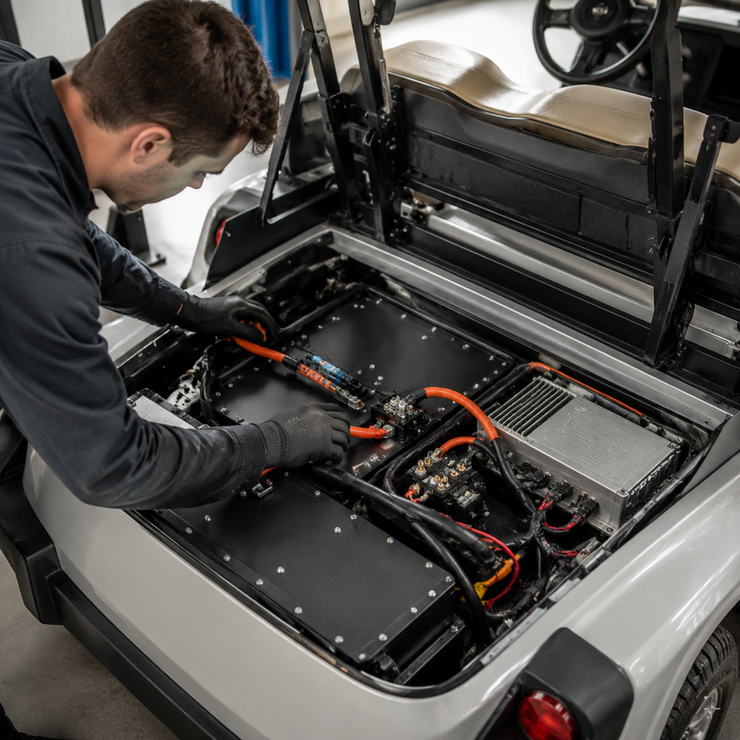

A lithium golf-cart battery is a go only when the controller's documented, programmed current and regenerative settings stay within that exact battery's BMS discharge, charge, and voltage limits. If they do not, derate the controller or pause the installation until the battery and drive system are properly matched.
The motor's amp label alone does not answer this question. A golf cart can have separate motor-current and controller battery-current settings, and their meanings vary by controller model. Confirm the controller manual's terminology before comparing any number with the battery specification.
Compare the Limits That Can Trigger a Battery Disconnect

A lithium battery's battery-management system, or BMS, can disconnect the pack when cell voltage is too low or too high, or when charge or discharge current exceeds its limits. That makes the controller's actual programmed settings---not assumptions based on a stock motor or battery capacity---the starting point for a compatibility check.
Build a simple worksheet before installation:
| Item to Verify | Document It From | What to Compare |
|---|---|---|
| BMS continuous-discharge limit | Exact battery specification | Controller's documented battery-current setting |
| Any short-duration discharge limit | Exact battery specification | Expected brief demand and the stated duration |
| Controller maximum-current setting | Controller setup software or manual | Confirm whether the label means battery current or motor/phase current |
| Motor-current setting | Controller documentation | Use it to understand the controller's motor-side programming; do not substitute it for battery-current verification |
| Cart voltage and intended use | Vehicle and build details | Confirm the battery, controller, and operating plan use the same system assumptions |
The controller maximum-current setting should remain below the BMS discharge-current threshold to help avoid an over-current disconnect. But do not assume that a setting called "max amps" is battery current. On some controllers, a motor or phase-current setting is a different measurement and must be interpreted using that controller's documentation.
A larger amp-hour battery does not, by itself, prove that the cart can supply more discharge current. The relevant limit is the exact battery's documented BMS discharge capability, including any conditions attached to a short-duration rating.
Make the Go/No-Go Decision
Compatible as documented: The programmed controller battery-current limit is identified and remains below the battery's applicable BMS discharge limit. Any stated short-duration demand also fits the battery documentation.
Potentially compatible after correction: The battery-current setting can be reduced, or another documented configuration issue can be corrected, without changing the intended use of the cart.
Requires a matched upgrade: The cart's intended controller settings or operating demands exceed the battery's published limits. Choose a battery and drive-system combination designed around those requirements rather than expecting the BMS to absorb repeated overloads.
Also verify the ratings and condition of the fuse, contactor, disconnect, cables, lugs, and connectors as part of the same power-system review. Battery, controller, and protection hardware are separate components with separate limits.
For a broader controller-focused setup review, see this guide to a golf cart controller lithium upgrade.
Treat Regenerative Braking as a Charge-Side Check

If the cart uses regenerative braking or can generate power while moving downhill, the battery is receiving charge current. That means regeneration is not only a driving-performance setting; it is also a battery compatibility setting.
Review these two items before the first drive:
| Controller Setting | Battery Limit to Check |
|---|---|
| Regenerative-braking current limit | BMS maximum charge-current rating |
| Controller over-voltage limit | BMS maximum charge voltage |
Regenerative-braking current should be limited below the battery BMS's maximum charge-current rating. Likewise, setting the controller over-voltage limit below the battery's maximum charge voltage can reduce the chance of a high-voltage BMS disconnect.
Use the exact terms in the controller documentation. A controller may label these controls differently, and the battery manual establishes the applicable charge-current and charge-voltage limits.
Speed and gearing matter during motor-generating conditions. They affect the voltage risk associated with regeneration, so a modified cart or a cart used on steep descents deserves the same documented review as a cart with an upgraded motor or controller.
If regeneration is enabled but its current limit or the battery's permitted charge limit is unknown, do not treat the setting as harmless. Pause and resolve the configuration before using the cart in conditions where regeneration may occur.
Do Not Treat a BMS Trip as Normal Overload Protection

A BMS trip is a signal that the system has crossed a battery limit. It is not a routine substitute for matching the battery to the controller and operating plan.
During high discharge demand, a BMS disconnect can create controller-damaging voltage spikes in some systems. At higher vehicle speed, the motor may act as a generator, which can increase the consequences of a disconnect. The actual risk depends on the controller design, speed, gearing, and voltage conditions; damage is not guaranteed in every event.
Regenerative braking creates another conditional risk. If the BMS disconnects because charge current is too high, high voltage can appear at the controller terminals. The likelihood of damage depends on factors including speed, gearing, and how close battery voltage is to the controller's maximum-voltage rating.
If the cart cuts out under acceleration, heavy load, or regenerative braking:
- Stop using that operating condition.
- Record what happened: vehicle speed, terrain, load, state of charge, and whether regeneration was active.
- Document the controller's programmed current and voltage settings.
- Compare those settings with the battery's published BMS discharge, charge-current, and charge-voltage limits.
- Correct the mismatch rather than bypassing the BMS, fuse, contactor, or other protection.
A cutout while climbing, towing, or carrying a heavier load is not proof of one specific failed part. It is a reason to verify the complete documented system before continuing.
Pre-Installation Compatibility Checklist
Before connecting the new lithium battery, confirm:
- [ ] Cart system voltage matches the battery and controller.
- [ ] The exact battery model's BMS continuous-discharge limit is documented.
- [ ] Any published short-duration discharge limit includes its stated duration and conditions.
- [ ] The controller's actual programmed battery-current setting is known and is below the applicable BMS discharge threshold.
- [ ] Motor-current and battery-current settings have not been treated as interchangeable.
- [ ] If regeneration is used, its current limit is below the battery's maximum permitted charge current.
- [ ] The controller's over-voltage setting is below the battery's maximum charge voltage.
- [ ] Fuses, contactors, disconnects, cables, lugs, and connectors have been reviewed as part of the power system.
- [ ] The intended duty cycle---including grades, speed, gearing, payload, and performance modifications---has been considered.
Verify the exact Vipboss battery model's published limits against the controller's actual programmed battery-current setting and the cart's intended duty cycle. If any value is unknown, mismatched, or affected by regeneration or performance modifications, pause the installation until model-specific technical guidance confirms the setup.