
Flexible solar panels are invaluable in tight or curved spaces, but they almost always wear out years sooner than framed glass panels because of weaker materials, higher heat, and constant mechanical stress.
Flexible solar panels can be a smart upgrade in tight spaces, but in harsh off‑grid reality they often deliver only a fraction of the service life that framed glass panels do. The big gap comes from materials, heat, and mechanical stress, not from bad luck or marketing hype.
Picture this: you finally dial in your RV or cabin system, park under a clear sky, and a few summers later your lifetime flexible panels are chalky, weak, and barely charging your lithium bank. After enough boat, RV, and cabin retrofits where owners watched flexible modules fade in just a handful of seasons while glass panels on the same site kept producing for decades, one pattern stands out: the failures are predictable and largely avoidable. You are about to see why that happens, when flexible panels still make sense, and how to specify and install either type so your next power upgrade actually lasts. Choosing between flexible and rigid panel types directly affects how well your solar array serves your battery bank over the long term.
Lifespan Reality Check: Glass vs. Flexible
Quality rigid glass‑and‑aluminum panels routinely deliver 25–30 years of usable output, with many residential‑grade modules warrantied beyond 20 years of service and degradation of only a fraction of a percent per year. That combination makes them the default choice for permanent rooftops and ground mounts in most climates. Flexible panels aimed at RVs, boats, and curved roofs, by contrast, are commonly rated for about 5–15 years of life, and many products ship with much shorter product warranties, especially in the budget tier, reflecting the limits of their lightweight construction and coatings as they age in sun, heat, and weather. Palmetto's buying guide and BobsRepair's lifespan overview both emphasize that flexible modules trade years of durability for portability and easy mounting.
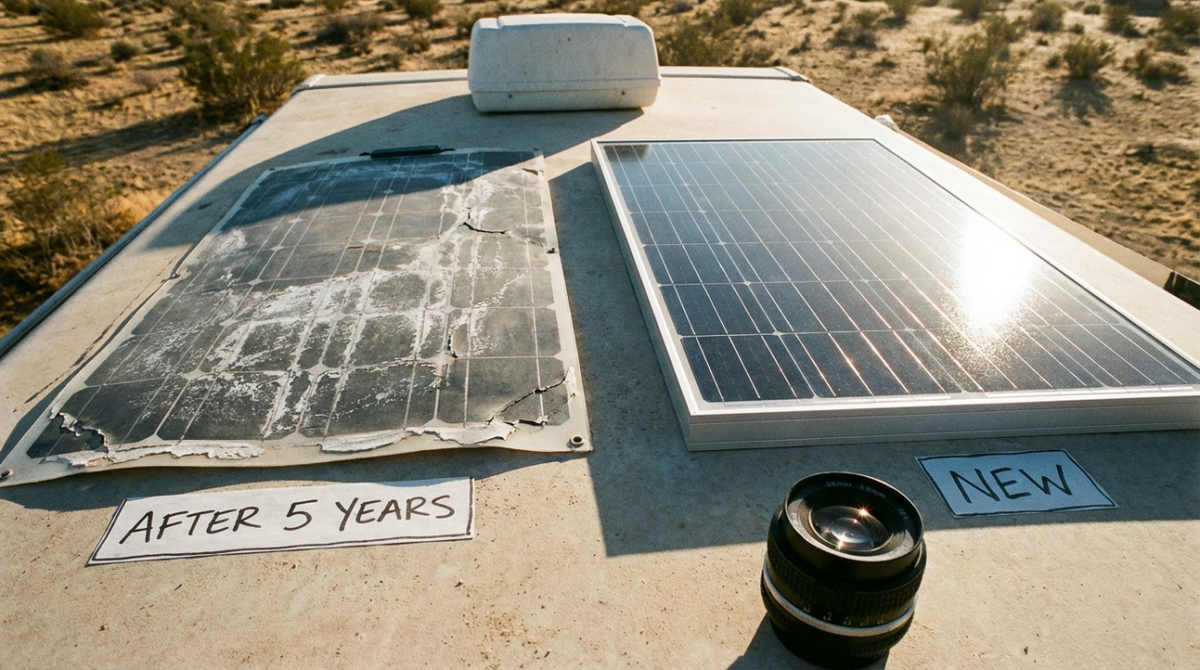
Real‑world anecdotes from narrowboats, RVs, and small off‑grid craft regularly show flexible panels glued straight to metal roofs failing in three to five years, often with severe output loss or outright open‑circuit failures despite clean appearances, while framed crystalline panels on brackets above the same roofs keep working toward the 20–25‑year mark. A widely cited narrowboat discussion describes roof‑mounted flexible panels that fell off a cliff in under four years, contrasted with framed modules expected to last around two decades with roughly 75–80% of their original power still available. That kind of gap—three to five years versus twenty‑plus—is where the "one‑tenth the life" rule of thumb comes from in tough marine and vehicle environments, as echoed by boat owners on Canal World.
Flexible modules can do better than the horror stories when they use higher‑grade materials and careful installation. Manufacturers that build around ETFE top sheets and robust encapsulation systems report flexible lifespans of roughly 10–15 years under reasonable conditions, which narrows the gap but still leaves glass modules clearly ahead for any system you expect to run for multiple decades, as summarized in Neexgent's lifespan analysis.
What That Gap Means in Real Projects
Take a 1,000‑watt roof array feeding a lithium bank on a small cabin or full‑time RV. A glass array that runs 25 years effectively lets you amortize the panels over a quarter century of boondocking or off‑grid living. A flexible array that needs a major refresh after about 7–10 years will ask you to re‑buy panels at least once, maybe twice, over the same span.
Layer in inflation, labor to remove old adhesive‑bonded panels, risk of roof damage, and downtime when your system underperforms, and the cheaper, easier flexible option can cost more over the life of the homestead or rig even before you factor in lost solar harvest. That is why long‑term stationary systems overwhelmingly end up with glass, while flexible panels are used where there is simply no way to get framed modules to fit or stay put.
The Four Big Reasons Flexible Panels Wear Out Faster
1. Weaker Armor: Plastic Skins vs. Tempered Glass
Rigid panels are built like safety glass windshields: cells are locked behind tempered glass and sealed in a sturdy aluminum frame, so UV light, hail, and grit do very little structural damage for years. Flexible panels wrap their cells in thin polymer laminates and lightweight substrates instead. Over time, those polymers lose the fight with sun, moisture, and abrasion.
Entry‑level flexible modules often use PET or PVC‑type outer films that yellow, micro‑crack, and delaminate in just a few seasons of strong sun, which blocks light from reaching the cells and opens pathways for moisture. Higher‑end panels use ETFE, a tougher fluoropolymer that can tolerate UV and weather for 10–15 years under good conditions, as detailed in material‑focused breakdowns and Neexgent's coating comparisons. When that top film clouds or peels, output drops and hot spots can develop, forcing early replacement even though the silicon cells themselves might still be capable of producing power.
That is why two flexible panels with the same wattage and brand reputation can age very differently in the field: one built with ETFE and quality encapsulants may keep your loads running for over a decade, while a PET‑skinned budget sheet chalks over and becomes a trickle‑charger in just a few summers.

2. Heat and No Air Gap: Flush Mounting Cooks the Panels
Glass panels almost always sit on racking with a noticeable air gap under them. Wind washes through, pulling heat away, which keeps cell temperatures closer to their tested ratings. Flexible panels are commonly bonded directly to an RV roof, boat deck, or metal skin with adhesive or tape, which traps heat against an insulated sandwich of roof and insulation.
Manufacturers and installers consistently flag this flush mounting as a prime reason flexible modules run hotter and degrade faster, with hot‑day performance often sagging 10–20% below nameplate because there is no airflow to carry heat off the back of the sheet and long‑term aging accelerates at those elevated temperatures, as described in Battle Born's comparison and Couleenergy's discussion of overheating and air gaps.
On metal roofs—narrowboats, vans, trailers—the effect is even more brutal.

The roof itself soaks up sun and radiates heat back into the panel; owners on inland waterways report flexible sheets glued to hot metal roofs fading badly or failing electrically in three to five years, while framed glass modules raised above the same deck go on working toward the two‑decade mark, as the user experience on Canal World illustrates. In other words, flexible panels are not just made of more vulnerable materials; they are routinely installed in the hottest possible way.
3. Bending, Vibration, and Micro‑Cracks
Silicon cells are thin and brittle. The flex in a flexible panel comes from the backing and encapsulant, not from the silicon becoming rubber. Every time a panel is bent, walked on, rolled, or slammed by waves and potholes, the cells and their fine conductors see microscopic strains that eventually form micro‑cracks and high‑resistance bottlenecks. Those cracks isolate parts of the cell, turning them into dead spots that no longer contribute current and, in worse cases, create localized heating where current is forced through tiny remaining pathways.
Flexible panel specialists specifically warn that over‑bending beyond the manufacturer's rated curve radius, folding panels for storage, or letting them flap in the wind are fast tracks to early failure. They recommend instead that nominally flexible modules be bonded to a thin rigid sheet to keep them from flexing in service wherever possible. Newer designs with shingled cells and multi‑busbar layouts are engineered to better ride out these micro‑cracks, but even then they need careful handling and installation to reach the upper end of their 10–15‑year life expectations discussed in Neexgent's technology overview.
On the road, a flexible module on a vibrating RV roof or bimini top sees more bending, shock, and thermal cycling than a glass panel locked into an aluminum frame on a stationary rack, which again compounds the lifespan gap no matter how careful you are in day‑one installation.
4. Wiring, Adhesives, and Water
Rigid modules sit in frames that protect not only the cells but also the junction boxes, wiring terminations, and edges of the laminate where water and dust try to sneak in. Flexible panels push that protection into the same thin laminate or small glued junction box on the back, often mated with adhesives and sealants that age quickly under UV and motion.
If the adhesive layer under a flexible panel breaks down, the sheet can dish between attachment points, forming shallow bowls that collect water and grime and place extra mechanical stress on cells and conductors. Over time, that pooling can work moisture into small weaknesses in the laminate and wiring, especially around edge terminations or grommets, which accelerates corrosion and delamination and shortens the real‑world life to the lower end of the typical 5–15‑year range outlined by BobsRepair and Palmetto.
By contrast, a framed glass module has a deeper toolkit of design defenses—drainage paths, thicker backsheets, better potting in the junction box, and a sturdy frame for strain relief—so even if the roof sealant ages, the panel internals keep humming for decades.
When Flexible Panels Are Still the Right Upgrade
Despite their shorter life, flexible panels earn their keep in the right jobs. Their low weight, low profile, and ability to hug curved or cluttered surfaces make them ideal for RV roofs full of vents, boat decks and dodgers, pop‑up campers, and portable kits where a rigid frame either does not fit or would be constantly at risk from impacts and snags. Guides aimed at mobile and specialty installs highlight flexible modules as the go‑to choice for light, curved, or temporary surfaces that would struggle with the 30–50‑pound weight of traditional panels, especially when every pound counts on vehicles and trailers, as outlined in Battle Born's flexible vs. rigid overview and Bettsun's durability guide.
Rooftop coverage limits and aerodynamics matter as well. On a van or narrowboat where glass racks would push you over height restrictions, or on a curved fiberglass roof where drilling and reinforcing for racks is not acceptable, flexible sheets that bond tight to the skin solve real problems even if you know you will be swapping them out in a decade. In those cases, your lithium bank becomes the long‑lived asset and the panels are treated more like a medium‑term consumable that you budget to replace on a known cycle.
How to Specify Flexible Panels That Don't Self‑Destruct
If you decide flexible is the right physical fit, you can dramatically change the outcome by choosing better materials and mounting them like you want them to last. Start with the laminate: look for ETFE‑topped panels, not generic PET or PVC films, and favor products that publish realistic lifespan expectations and testing in high‑UV conditions. ETFE models consistently land in the 10–15‑year band under reasonable usage instead of the three‑to‑five‑year cliff common to cheap PET sheets, a distinction highlighted in Couleenergy's PET vs. ETFE comparison and Neexgent's coating lifespan table.
Next, protect them from heat. Even a quarter‑inch air gap under a flexible panel makes a difference. Rather than gluing a sheet straight onto hot metal, bond it to a thin rigid board or use strips of thermally conductive material under the panel that allow air to move between channels. Several field guides recommend sacrificing a bit of low‑profile appearance to gain that airflow, since overheating not only costs you up to roughly 20% of power on hot days but also shaves years off the panel's service life, a pattern described in both Battle Born's hot‑roof tests and Couleenergy's notes on flush‑mounted efficiency loss.
Then limit the actual flex. Treat a flexible panel as a panel that can conform once to a gentle curve and then stay that way, not as a yoga mat you roll and unroll. Respect the manufacturer's maximum bend radius, avoid walking on the surface unless the product is specifically designed as walkable, and use strain relief on the wiring so the cells are not being tugged by every bump the vehicle or hull feels. Lifespan studies that break applications into marine, RV, and portable categories consistently show that panels left in a semi‑fixed curved mount tend to reach the upper half of their lifespan range, while frequently folded and handled portable sheets land in the three‑to‑five‑year band summarized in Neexgent's application expectations.
Finally, store and shield them when you can. Removable flexible panels that spend long stretches in a garage or cabin when not in use, or that get covered when the rig is in storage, simply see fewer UV hours and less thermal cycling. That alone can effectively add several seasons to their useful life and is one of the easiest wins for RV and boat owners called out in Palmetto's care recommendations.
Example: Smarter RV Roof Upgrade
Imagine upgrading a 30‑ft RV roof with space for 400 watts of solar. Route one is four 100‑watt budget flexible panels glued flat to the aluminum roof. You save height and drilling, but in hot desert boondocking those PET laminates run very hot, chalk over, and deliver steadily less output until by year five or six you are pricing a full replacement. Route two uses three slightly larger ETFE‑topped flexible panels bonded to thin composite boards, mounted with a small air gap and mechanical fasteners around existing roof features.

Upfront cost per watt is higher and the install is more involved, but your panels run cooler and are realistically good for a decade or more, aligning much better with the lifespan of a quality lithium bank and the rest of your off‑grid system, in line with the 10–15‑year expectations that Neexgent and BobsRepair describe for higher‑quality flexible modules.
Why Glass Rigid Panels Still Win for Full‑Time Off‑Grid
When the goal is to power a cabin, homestead, or full‑time cruiser for decades, rigid glass panels are still the workhorses. Their higher efficiency means more watts per square foot and better performance on limited roof area, and their proven 25‑plus‑year track record means you can design the array once and focus your maintenance on inverters, charge controllers, and batteries instead of budgeting for panel replacement halfway through the project.
Boat and narrowboat owners who switched from semi‑flexible roof sheets that failed in three to five years to framed crystalline modules report getting more wattage in the same or smaller footprint, at lower cost per watt, and with warranties that guarantee around 80% output after 20–25 years, a combination that strongly tilts the math toward frames for fixed installs described by long‑term users on Canal World. For a remote cabin or shop where access is a hassle and every truck roll costs time and gas, that reliability margin is worth far more than the clean lines or lower weight of flexible sheets.
In practical terms, the lithium and balance‑of‑system gear in a serious off‑grid build already expects careful planning, ventilation, and protection. Adding rigid racking is usually a small incremental step that pays back over and over in stable, predictable production and fewer surprises on hot afternoons when your loads are heavy and your batteries need every amp you can feed them.
How to Help Any Panel Last Longer
Whether you go glass, flexible, or a mix, maintenance and monitoring are levers you control every season. Regular visual checks for dirt, shading, and physical damage, paired with gentle cleaning once or twice a year using soft brushes and mild soap when the modules are cool, help keep light reaching the cells and prevent hot spots or corrosion, a simple routine echoed across maintenance guides EA Global and Green Wave Solar.
Watching energy production with an app or monitoring portal is just as important. When you know what a sunny day typically yields in spring and summer, you can quickly spot a 10–20% unexplained drop that might indicate soiling, wiring issues, or early panel degradation. Several professional O&M providers emphasize that catching these issues early not only recovers lost kilowatt‑hours but also protects inverters and wiring from running at abnormal temperatures, as highlighted in Energyware's commercial maintenance advice.
After storms or high‑wind events, a quick walk‑around or binocular check from the ground is worth the time. Look for cracked laminates, cloudy or discolored areas, loose mounting hardware, and chewed or dangling wires. Seasonal chores like trimming trees to avoid new shading, clearing leaves in fall, and gently removing snow loads in winter all contribute to keeping your array working near its design capacity, reinforcing the year‑round efficiency strategies laid out by West Texas Solar.
If you treat your solar array like the critical power plant it is rather than a set‑and‑forget accessory, you turn both glass and flexible panels into long‑term allies instead of surprise failures.
FAQ
Do flexible panels ever make sense on a house roof?
For most homes, no. The roof is usually strong enough and accessible enough for framed glass modules on racking, which offer better efficiency, longer warranties, and lower cost per watt over 25–30 years, as reinforced by rigid‑panel lifespan data in Palmetto's comparison. Flexible sheets start to make sense only when the roof cannot support the weight or drilling needed for racks, or when you are solving a niche problem like a curved canopy or temporary structure where you already expect to replace the array in under 15 years.
Can you mix glass and flexible panels in one system?
Yes, provided you match panel voltages and currents appropriately to your charge controller and wiring, and you mount each type in a way that suits its strengths. Many off‑grid users successfully run rigid glass arrays as their primary power source and add a flexible overflow array on RV roofs or boat decks, using the portables when parked or anchored in ways that expose extra surface area, a hybrid approach described in Battle Born's systems overview.
Why do warranties for flexible panels seem so short?
Manufacturers know their laminates and adhesives are working much harder than tempered glass and frames under UV, heat, and motion. As a result, flexible modules often carry only two‑to‑five‑year product warranties and more modest performance guarantees, versus 20–25‑year output warranties for rigid panels, a contrast that Palmetto and BobsRepair both highlight. The warranty lengths are essentially an honest reflection of how often flexible panels are expected to need replacement in real‑world use.
A well‑designed power upgrade starts with a blunt question: do you need minimum profile and weight, or maximum lifespan and output? If the answer is decades of reliable power, glass is your friend. If the answer is get solar anywhere you can squeeze it in, flexible stays on the table—but only if you respect its limits and build it into your long‑term replacement plan.