
This guide explains how to use conduit, loom, and disciplined routing so off-grid wiring survives vibration without chafing through its insulation.
Protecting off-grid wiring from vibration comes down to pairing the right conduit and loom with thoughtful routing and support so insulation never has a chance to rub, chafe, and fail.
You know the feeling: after a season of washboard roads or generator rumble, lights flicker, a charge controller resets, and you open a compartment to find black dust, nicked cables, and mystery shorts. Many otherwise solid lithium and off-grid upgrades die early because wires were left to saw against sharp metal or flop inside loose plastic tubing instead of being locked in place. By the time you finish reading, you will know how to choose and install protective tubing and cable looms so your wiring shrugs off vibration instead of slowly grinding itself to death.
Why Vibration Quietly Destroys Cables
Every time a vehicle hits a pothole or a generator starts, cables move a little relative to the structure around them. Over thousands of cycles, that small motion turns a panel edge, conduit mouth, or bracket into a file that gradually cuts through insulation. Failures rarely appear where a cable is visible and straight; they show up at transitions, tight bends, and unsupported spans.

Electrical conduit is a protective tubing system that houses and routes wiring to shield it from impact, heat, moisture, and chemicals while helping you meet code and safety requirements. In off-grid cabins, garages, and battery sheds, it adds a hard shell around DC runs that would otherwise rub on studs, masonry, or equipment frames. In vans and trailers, you often cannot open up every cavity, so surface-mounted conduit is often the only realistic way to protect long exposed runs.
Looms and harnesses solve a different part of the problem. Instead of enclosing the outside environment, they manage what happens inside the wiring bundle: they group conductors in a defined path, keep relative positions stable, and add a sacrificial outer layer between individual cables and whatever they brush. Split convoluted tubing, braided sleeving, and taped harnesses all play that role when they are designed and secured properly, rather than being thrown in as an afterthought.
Good harness and loom work starts on the drawing board. Professional harness builders treat a loom as a custom component, built from detailed layouts, wiring diagrams, and a structured process that includes risk reviews before production so weak points are eliminated early. The same approach pays off in a DIY retrofit: when you deliberately plan branch points, supports, and breakout angles, you avoid the “spaghetti in a box” that vibration loves to exploit.
Conduit vs. Loom: Who Does What Against Vibration
Conduit and loom are complementary tools, not competitors. Conduit is the hard armor: metallic or nonmetallic tubing that protects wires from physical damage and environmental exposure while keeping runs organized in homes, shops, and industrial spaces. Metallic options like EMT, IMC, and RMC offer strong impact resistance and inherent grounding, while nonmetallic PVC, HDPE, and fiberglass conduit trade some mechanical strength for corrosion resistance and light weight in demanding locations described in this complete guide to conduit pipes.
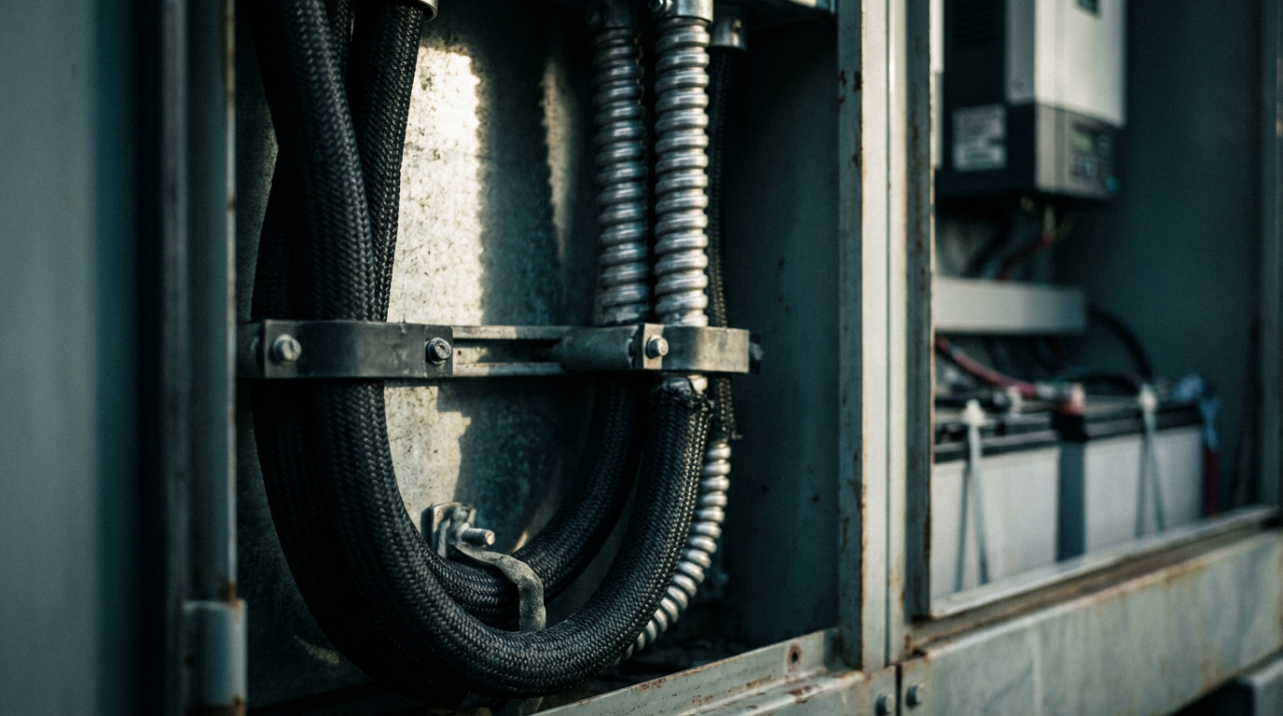
In tight spaces and around equipment that moves or vibrates, flexible metal conduit is specifically recommended because it can bend around corners and machinery while absorbing motion that would otherwise be transferred directly into the wire. Flexible metal and liquid-tight versions are highlighted for these vibration-heavy spots in overviews of conduit types and uses aimed at industrial and commercial environments, where machinery and motors are common sources of continual movement in the wiring system.
Wire loom, sometimes called split or corrugated tubing, shines once multiple conductors leave a junction box or conduit and start traveling together toward devices. It bundles cables into a single organized run, adds abrasion resistance to the entire group, and turns a handful of vulnerable individual jackets into one more robust outer layer. In campervan and leisure-vehicle wiring, pre-engineered looms built for 12 V systems deliberately route cables away from sharp edges, use tie mounts every few inches, and include branch points for loads to keep the bundle stable through years of vibration.
A simple way to decide which tool you need is to look at what threatens the run more: external abuse or internal movement.

Where cables are exposed to kicks, cargo, rocks, or tools, conduit is the primary defense. Where the risk is relative motion between tightly packed wires and nearby edges, loom and harnessing techniques take the lead.
Protection method |
Best use in vibration |
Key advantages |
Main limitations |
Areas with high impact and traffic |
Maximum mechanical protection and EMI shielding |
Heavy, higher cost, needs bending and threading |
|
PVC / HDPE conduit |
Underground or damp environments |
Corrosion resistance and low cost |
Less impact-resistant and limited temperature |
Flexible conduit |
Short runs to moving/vibrating gear |
Bends easily and absorbs motion |
Lower mechanical strength, usually short segments |
Wire loom / harness |
Inside cabins, vans, enclosures |
Bundles and stabilizes multiple conductors |
Needs correct support or it will still flap |
Choosing the Right Conduit for Off-Grid Vibration Hotspots
Rigid Steel Where Hits Are Brutal
In workshops, garages, and exposed battery rooms, galvanized steel conduit is engineered to last as long as modern buildings and to resist common forms of wear in electrical distribution systems. This type of steel conduit is described as preserving its mechanical integrity even under impacts from equipment while also maintaining long-term electromagnetic shielding that protects sensitive electronics in data-heavy environments, as outlined in durability discussions from the steel conduit industry. Around inverters, switchgear, and shore-power inlets where tools, cargo, or vehicles can strike, rigid metal conduit remains the benchmark when you want to forget about physical damage for decades.
The tradeoff is weight, cost, and the need for proper cutting, threading, and support. Rigid conduit is best reserved for relatively short, high-risk runs such as the drop from a ceiling to an inverter stack, the exposed leg of a DC trunk across a wall, or the vulnerable section of an outdoor run where a vehicle might contact the conduit.
PVC and HDPE Where Corrosion and Moisture Win
For underground feeds from a remote array to a power room or for long exterior runs along a wall, rigid PVC conduit offers a corrosion-proof, low-cost way to protect wiring when sized and installed correctly. Guides to PVC conduit emphasize planning routes, complying with code articles for rigid PVC, and selecting fittings, supports, and joints that match the environment while delivering a typical service life of more than 50 years in normal conditions, provided installation is careful and joints are sound, as explained in a comprehensive PVC electrical conduit installation reference.
When conduits are buried across driveways or yards, design decisions go beyond just picking a plastic pipe diameter. Underground installation resources stress that burial depth, bedding, backfill, expansion fittings, and support spacing all affect long-term reliability because improper installation can lead to excavation, downtime, and code violations in residential and industrial systems. In one underground design discussion, PVC is the most common choice thanks to its balance of cost and corrosion resistance, while HDPE conduit is called out as a slightly more expensive but more flexible option with superior impact and chemical resistance in areas with freeze-thaw cycles or contaminated soil, making it well suited to fragile off-grid sites described in an underground electrical conduit guide.
A practical rule for vibration is to use PVC or HDPE for long, straight segments where soil or moisture is the main stress, and to focus your anti-chafe effort at the entry and exit points where cables leave the ground and start moving with structures or vehicles.
Flexible Sections Where Things Move
Flexible metal conduit is designed for tight spaces and areas subject to vibration, such as connections to motors, HVAC units, and other machinery. Overviews of conduit types explain that this spiral-shaped steel or aluminum tube bends easily around obstacles and is specifically recommended for equipment subject to movement or vibration, while liquid-tight versions add a protective plastic jacket for use in wet or oily environments, according to descriptions in electrical conduit overviews. Flexible nonmetallic tubing extends that idea to watertight, chemical-resistant settings where metal is undesirable, an option highlighted in broader conduit type comparisons.
For off-grid builds, flexible sections are ideal between a rigid conduit and a vibrating component: the last few feet to an inverter bolted on a frame, the connection into a generator enclosure, or the short run from a junction box to a roof-mounted combiner on a van. Codes and best practices generally expect these flexible segments to be relatively short between solid pull points, so a typical layout might use rigid PVC or steel for most of the distance and only a few feet of flex where motion actually occurs.
Installation Details That Actually Stop Chafe
Route With the Vibration in Mind
Protective hardware cannot compensate for poor routing. Professional conduit installation guidance starts with careful layout: measuring routes, planning bends, and mounting straps before pulling any wire to minimize unnecessary length and sharp direction changes. Detailed how-to resources underscore planning routes, installing mounting straps or clamps at regular intervals, then cutting and bending conduit accurately before pulling wires, emphasizing that this planning and measurement is what delivers neat runs that resist mechanical stress in the long term, as described in comprehensive electrical conduit installation guides.
Support spacing is crucial in vibrating environments. Recommendations for strap spacing often call for supports every few feet and within about a foot of boxes or fittings to prevent sagging and movement. Underground design examples talk about maximum support distances for plastic conduit, while surface-mounted advice suggests placing straps roughly every 3 to 4 feet and close to each box so the conduit cannot pump up and down with vibration, a pattern repeated across conduit installation best practices. On a 20-foot run from a battery cabinet to an inverter, that means planning for around six supports instead of three and making sure they are tight and aligned.
Treat Bulkheads and Panel Edges as Saw Blades
Most vibration failures occur where cables touch an edge. Campervan wiring workflows explicitly call for drilling clean holes, fitting rubber grommets, cleaning metal shavings, and coating cut edges with rust preventer before routing any loom or cable because unprotected edges can cut into insulation over time. Those same steps apply to every bushed penetration in an off-grid power system: battery boxes, steel frames, combiner boxes, and enclosure entries.
Conduit installation tips also stress cutting conduit square, removing debris with a vacuum or compressed air, and deburring any sharp edges before pulling conductors so insulation is not scraped during installation or later movement, a step that is front and center in professional conduit installation advice. At each end of a conduit, bushings, grommets, or purpose-made fittings should protect the cable jacket; leaving raw pipe or knockout edges exposed is a direct invitation to vibration damage.
When a cable must leave a conduit and travel freely for a short distance, adding a short piece of split loom over that span and securing it at both ends with ties turns a fragile jump into a protected mini-harness. The key is to anchor the loom so it cannot slide back and reveal the very points you are trying to protect.
Build Looms That Lock the Bundle in Place
A loom that just hides clutter will still fail if the wires inside are free to rub against each other and nearby hardware. Harness manufacturers describe a fully documented process: starting with pin-out mapping, creating harness drawings that define bundle geometry and branch points, then building and testing the loom against those documents so every branch has the right length, strain relief, and protection. That mindset translates directly to off-grid builds: think of the main DC bundle from your lithium bank as a harness with defined branches for the inverter, solar controller, alternator charger, and DC loads, not as a random cluster of cables.
Wire-loom “cable taming” methods recommend unplugging devices, grouping cables by destination, then using a loom tool to feed bundles into split tubing, trimming any excess, coiling extra length, and tying it neatly so cords do not tangle or form hanging loops that can whip around. Campervan wiring guides echo this by setting tie mounts at roughly 6-inch intervals along routes, then routing the loom through those anchors to keep the entire bundle snug against walls or furniture and away from pinch points.
In practice, a robust power-train loom for an off-grid van or cabin will combine both worlds: sections of conduit where the bundle crosses exposed areas or passes under floors, transitioning to split loom or taped harnesses inside cabinetry and compartments. What matters most is that every change in direction, support, or environment has been deliberately handled so there is no point where vibration can concentrate on a bare edge.

Inspection and Upgrades: Catching Wear Before It Fails
Even the best installation needs occasional attention. Home electrical maintenance advice emphasizes that keeping systems reliable over the long term depends on periodic checks of protective devices, cables, and moisture exposure, with complex issues handed off to a qualified electrician when necessary to maintain safety. The same principle applies to off-grid and vehicle systems: regular inspection of conduits, looms, and terminations prevents small mechanical issues from turning into dangerous electrical faults, a priority highlighted in discussions of maintaining electrical installations.
When you open a battery bay or inverter compartment for other work, take a minute to run your fingers along loom and conduit runs. Feel for flat spots, sharp transitions, or places where a cable can move relative to an edge. Look for dust from abraded insulation, discoloration, or moisture tracks around conduit ends. If you find movement, add or tighten supports; if you find bare edges or scuffed jackets, add bushings, grommets, or extra loom and consider rerouting the segment.
It also pays to keep an eye on the big picture. Guidance on conduit lifecycle and sustainability points out that material choice, installation quality, and proactive inspection all contribute to decades of safe service. Choosing durable conduits such as rigid metal where needed, corrosion-proof plastics in damp locations, and UV-resistant or low-smoke materials where appropriate, then periodically inspecting and cleaning these systems, aligns your wiring with the long life you expect from your lithium bank and solar hardware, a strategy reinforced in long-term PVC conduit performance discussions.
FAQ: Fast Answers on Vibration and Cable Protection
Is conduit always better than loom for vibration?
Not always. Conduit is superior when the main threat is external impact or environmental exposure, which is why it dominates in walls, underground runs, and exposed shop wiring according to many conduit installation guides. Loom excels for internal routing inside vehicles, cabinets, and enclosures, where bundles need to be stabilized relative to each other and nearby structures while still staying flexible.
How much support does a conduit run really need in a vibrating installation?
Best-practice recommendations point to supports every few feet and close to boxes and fittings to prevent sagging and movement, with specific spacing depending on material and code in your area, a pattern summarized in conduit layout advice. In a vibration-prone off-grid build, erring on the side of more frequent supports and carefully aligned straps is inexpensive insurance against long-term chafing and fatigue.
Can I skip professional help if I only change routing and protection, not the circuits themselves?
Changing how cables are protected can still affect grounding, moisture protection, and code compliance. New-construction wiring overviews stress that even when the basic circuits are straightforward, permits, inspection stages, and correct installation techniques are what keep a system safe and reliable over time, with professional electricians recommended whenever there is uncertainty about codes or design details in new home wiring. For complex rerouting, underground work, or anything near mains connections, involving a qualified electrician is a smart part of the upgrade.
A lithium or off-grid system should be boringly reliable, not a constant hunt for intermittent shorts after every rough road or storm. When conduits take the hits, looms lock bundles in place, and every edge and transition is treated like a potential saw blade, vibration becomes a design condition you have already solved, not a surprise you discover when the lights go out.