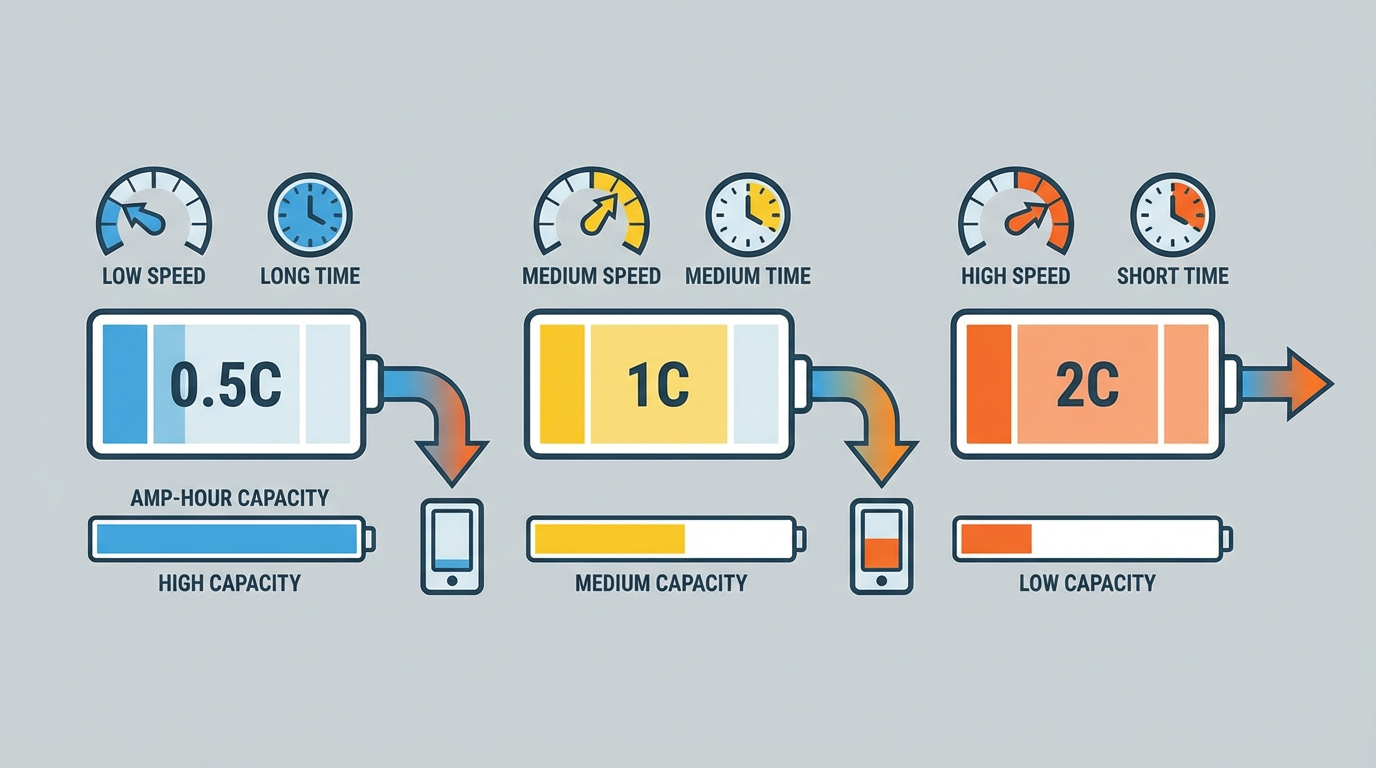

1C, 2C, and 0.5C describe how fast a battery can safely charge or discharge relative to its size. Ignore them and a battery bank that looks big on paper can still sag under real-world loads or wear out years early.
Ever watched a new solar battery bank fall flat the moment you start a coffee maker, air conditioner, or well pump, even though the label promised hours of run time? That same failure shows up again and again in cabins, RVs, and off-grid homes where the numbers on the spec sheet looked impressive but the batteries are being pushed far beyond what they were built to handle. By the end of this guide you will be able to read 1C, 2C, and 0.5C on any datasheet, translate them into real amps and hours, and choose or retrofit batteries that actually keep the lights on when it counts.
The Simple Meaning of 1C, 2C, and 0.5C
Battery engineers and grid-storage designers use the C-rate as shorthand for current relative to capacity. Battery engineering courses and off-grid storage guides explain it in the same simple way: the C-rate is the discharge or charge current divided by the battery's amp-hour rating.
If a battery is rated at 100 amp-hours, then 100 amps is 1C, 50 amps is 0.5C, and 200 amps is 2C. At 1C, the ideal run time is about one hour. At 0.5C, it is about two hours. At 2C, it is around half an hour. Battery ratings guides and technical notes from utility-scale storage providers show the same pattern for larger systems: 1C means "full in about an hour," 0.5C means "about two hours," and 2C means "about half an hour," whether the battery is 100 amp-hours in an RV or 100 megawatt-hours on a substation.
Here is what that looks like for a 100 amp-hour battery:
C label |
Current on a 100Ah battery |
Approximate full-discharge time |
0.5C |
50A |
About 2 hours |
1C |
100A |
About 1 hour |
2C |
200A |
About 30 minutes |
The relationship is always the same: C-rate equals current in amps divided by capacity in amp-hours, and a higher C-rate means more power but shorter duration. The key insight is that 1C, 2C, and 0.5C are not magic marketing terms; they are simply a speedometer for your battery.

To see this in off-grid terms, imagine a 12.8-volt, 100 amp-hour lithium iron phosphate battery. At 1C (100 amps), it can support roughly 1,280 watts of load for about an hour. At 0.5C (50 amps), it is closer to 640 watts for about two hours. At 2C (200 amps), it is around 2,560 watts but only for roughly half an hour. The same math scales straight up to home battery walls and containerized storage.
How C-Rate Changes Runtime and Battery Life
C-rate does more than set run time; it quietly controls how much of the rated capacity you actually get and how long the battery lasts.
Lead-acid batteries are the worst offenders here. Guides from manufacturers and professional exam material note that lead-acid capacity drops dramatically at high discharge currents. When a lead-acid battery is tested over twenty hours at a very low C-rate, it might deliver its full rated amp-hours. Push it at higher current and you can lose roughly a third of that usable capacity. In other words, a "100Ah" lead-acid battery that looks fine on paper at 0.05C can feel more like a 60–70Ah battery in real, high-draw use.
Lithium iron phosphate deep-cycle batteries behave much better. Testing on 100Ah lithium batteries shows that you get essentially the full rated capacity even as you increase current through typical off-grid ranges. That is one of the reasons modern lithium packs have become the default for serious off-grid systems: they hold their capacity across a wide range of C-rates, especially in the moderate 0.5C to 1C band.
Runtime is only half of the story. Higher discharge rates and deeper discharges also shorten cycle life. Every time you ask a battery to do a 2C sprint instead of a gentler 0.5C jog, you create more heat and more electrochemical stress. Research that pulls together lab testing and field data shows that high C-rate operation pushes ion movement and internal resistance close to the limits of the materials, which accelerates degradation. Over years of daily cycling, those extra degrees of temperature and higher internal losses show up as fewer total cycles before the battery fades below its useful capacity.
A practical example makes this concrete. Take two 100Ah batteries feeding a 100 amp load at about 12.8 volts, or roughly 1,280 watts. One is a lead-acid unit rated at 100Ah over twenty hours; the other is a lithium iron phosphate unit rated at 100Ah with full capacity available at typical discharge rates. On the lead-acid side, you are operating well above the gentle 0.05C test rate; expect noticeably less than 100Ah before voltage sags and usable runtime ends, and expect a shortened life if you do this daily. On the lithium side, you are right at 1C, where testing from manufacturers shows that you still get essentially full capacity and a high cycle-life rating, provided you stay within the recommended depth of discharge.

Using 1C, 2C, and 0.5C to Size and Retrofit Off-Grid Systems
Once you understand that 1C, 2C, and 0.5C are just current divided by capacity, you can use them to bulletproof your system design.
Start with your worst-case load in watts. For many off-grid cabins and RV retrofits, that is a combination of a coffee maker, microwave, hair dryer, well pump, or air conditioner. Add up the nameplate watts for the devices you might run at the same time. For example, a microwave at 1,000 watts and a coffee maker at 800 watts put you at about 1,800 watts.
Next, look at your system voltage. On a 12.8-volt lithium bank, 1,800 watts divided by 12.8 volts is roughly 140 amps. If you have a 100Ah battery, 140 amps is about 1.4C. If the battery's datasheet says "maximum continuous discharge 1C," you are already over the line. That is how people burn through "big" batteries surprisingly quickly: the amp-hour number looked fine, but the C-rate at real loads was out of spec.
There are three main ways to bring that C-rate back into a healthy zone without changing your lifestyle. One is to increase capacity at the same voltage. Two identical 100Ah batteries in parallel give you 200Ah; the same 140-amp load then becomes 0.7C instead of 1.4C. Another is to increase system voltage. A 24-volt, 100Ah bank delivering 1,800 watts only has to supply about 75 amps, which is 0.75C instead of 1.4C. A third is to reshuffle loads so heavy hitters do not stack on top of each other; that is more behavioral than electrical, but it is free.
Manufacturers show this in their own product specs. A lithium iron phosphate battery such as a 12.8-volt, roughly 105Ah unit with a relatively high continuous discharge rating and strong surge capability is designed to power heavier loads in RV and trailer use than many similar-size batteries, but those ratings are still expressed in terms of C-rate once you divide the allowable amps by capacity. When you size your inverter and your parallel battery strings, you want your real operating currents to sit comfortably below those limits rather than right on the edge.
The same thinking applies when charging from solar. Modern lithium power stations and standalone LiFePO4 packs often specify both a maximum charge power and a charge C-rate. If your solar array can theoretically dump a full 1C into the battery on a bright day but the battery is only rated for 0.5C charging, you need to limit charge current in your charge controller settings. Overshooting the charge C-rate will not give you free speed; it just makes the battery run hot, triggers the battery management system to shut down, or accelerates wear.
C-Rate, Chemistry, and Temperature
C-rate never acts in isolation. Chemistry and temperature control how much current a battery can really tolerate, even if the labels look similar.
Technical material on lithium-ion cells shows that they are happiest in a moderate temperature window, roughly around typical indoor room temperatures in Fahrenheit. At cooler temperatures, you must reduce charge current because the ions move more slowly and plating risks increase. At hotter temperatures, a battery might appear stronger in the short term, with slightly higher apparent capacity and higher possible C-rate, but degradation speeds up quickly. That is why serious grid-scale battery energy storage systems pair their C-rate choices with active thermal management; the battery rooms are designed like oversized, climate-controlled engine bays.
Lead-acid chemistry has its own quirks. Discussions of depth of discharge show that recommended operating ranges are quite different across chemistries. Lithium-ion chemistries used in home and grid storage are often designed for 80 to 90 percent regular depth of discharge, while common lead-acid batteries are typically limited to around half that before life drops sharply. Combine deep discharges with high C-rates and elevated temperature and you hit all three stress levers at once.
One grid-scale example from Pacific Northwest National Laboratory makes this clear. A 32 megawatt, 8 megawatt-hour lithium system can discharge at full power for about fifteen minutes, which corresponds to a 4C discharge rate. That kind of design is optimized for fast services like frequency regulation. For off-grid homes and cabins, you rarely need that sort of sprint; you want longer, steadier output. That means aiming for lower C-rates in your design and reserving the top end of the spec for occasional brief surges, not everyday operation.
In small systems, the battery management system is your bodyguard.

Lithium batteries from major off-grid brands include integrated management electronics that cut off charge or discharge if current, voltage, or temperature move outside safe windows. You still need to respect the published C-rates, but a well-designed battery management system gives you a safety net against wiring mistakes, unexpected surges, and extreme weather conditions.
FAQ: Common C-Rate Questions in Off-Grid Retrofits
Is a higher C rating always better?
A higher C rating means a battery can safely deliver more current for its size, which is valuable for short, heavy loads. C-rating guides and storage-system analyses both point out the tradeoff: pushing cells to the top of their C-rate range generates more heat and can shorten life if done frequently. For most off-grid systems, the sweet spot is choosing batteries with enough C-rate headroom for your worst-case loads, then operating daily loads well below the published maximum, especially for long-duration discharges.
Can you mix batteries with different C ratings in one bank?
Mixing batteries of different capacities, ages, or internal electronics is risky. Even two batteries of the same brand and size need careful wiring to share current evenly. When you mix batteries with different C-rates or different internal battery management systems, you create a situation where one pack may hit its limits and shut off earlier, forcing the others to carry more than their share. For retrofits, the most robust approach is to build each parallel string from identical batteries and identical C-rate specifications.
What C-rate should you aim for when charging lithium from solar?
There is no single magic number, because designs differ, but serious sources agree on the same principle: stay within the manufacturer's stated charge C-rate, and if in doubt, err on the low side. Lithium battery providers publish maximum recommended charge currents, often expressed as a fraction of C. Keeping regular charge currents below that limit, especially in hot weather, reduces stress and helps you reach the cycle-life numbers promised in the warranty.
Bringing It All Together
Treat 1C, 2C, and 0.5C as the speed limits for your batteries, not as mysterious extra ratings. When you translate your real loads into C-rate, compare that number with your battery's datasheet, and give yourself some margin, you stop guessing and start engineering. Do that, and your next lithium retrofit or off-grid power upgrade will feel less like rolling the dice on a new battery bank and more like installing a dependable, long-distance fuel tank for your entire energy system.
References
- https://docs.nrel.gov/docs/fy19osti/74426.pdf
- https://courses.ems.psu.edu/ae868/node/896
- https://gridpiq.pnnl.gov/v2-beta/doc/technologies/es/es-energy-power/
- https://www.pmkprycal.com/understanding-battery-ratings-ah-voltage-cca.html
- https://www.ansys.com/blog/important-battery-metrics
- https://www.powertechenergy.com.au/a/understanding-c-rate-for-battery-energy-storage-systems
- https://www.gridcog.com/blog/how-big-is-a-battery-understanding-battery-size-capacity-and-power
- https://www.power-sonic.com/what-is-a-battery-c-rating/
- https://www.pretapower.com/battery-c-ratings-guide-unlocking-the-science-behind-performance-and-efficiency/
- https://relionbattery.com/blog/understanding-your-battery-terms-to-know?srsltid=AfmBOoo0c-ACD9ys0BszzlXo7hEaiu7_9XvecyC8FU-5k6wA9xuO41gi