
By 2030, solid-state batteries will reshape premium EVs and niche storage, but LiFePO4 will remain the workhorse for off-grid and mainstream solar systems.
Picture this: your cabin finally runs quietly on solar power, the generator is just a dusty backup, and then every headline warns that next-generation batteries will make your brand-new bank “instantly outdated.” After comparing how today’s lithium iron phosphate banks and emerging solid-state prototypes perform in real systems and independent testing, a clear pattern emerges: the smartest upgrades balance proven hardware today with targeted bets on what is actually coming by 2030. This guide explains what solid-state really changes, where LiFePO4 is still the smarter play, and how to plan upgrades so you can plug into tomorrow’s tech without stalling your project now.
Solid-State vs LiFePO4: What Really Changes
LiFePO4, or lithium iron phosphate, is a lithium-ion chemistry built around an iron-phosphate cathode. It is already known for strong thermal stability, long cycle life, and very low fire risk, which is why it has become the default choice for residential solar, off-grid cabins, RVs, and industrial backup according to multiple manufacturers and market analyses. Typical LiFePO4 packs land around 90–180 Wh/kg of energy density and deliver roughly 2,000–5,000 full cycles, with many solar products rated for 4,000–10,000 or more cycles and service lives around 10–15 years when operated correctly, as reported by solar-focused suppliers and market research groups.
Solid-state batteries replace the flammable liquid electrolyte used in conventional lithium cells with a solid electrolyte made from ceramic, glass, or polymer materials. This opens the door to metallic lithium anodes and more aggressive cathode chemistries. Reviews in the journal Batteries and technical summaries from groups such as the International Energy Agency and Greenlancer describe lab and pilot solid-state cells reaching about 250–500 Wh/kg at practical scale, with thin-film variants up to 900 Wh/kg in niche formats, along with cycle life projections in the 10,000–20,000 range for some designs. Operating windows as wide as about -58°F to 257°F are reported for certain solid-state chemistries, much broader than typical liquid-electrolyte lithium-ion.
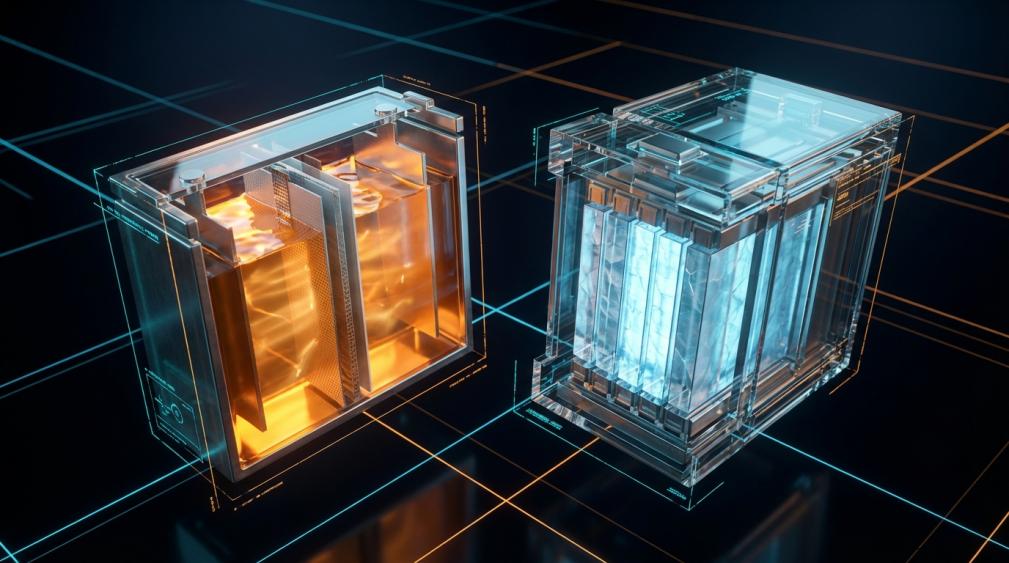
Side by side, the direction of travel is clear: solid-state promises much more energy in the same weight, longer life, and even higher safety by removing nearly all flammable liquid from inside the cell. Yet LiFePO4 already starts from a very high baseline for safety and durability. Large-scale testing cited by industrial suppliers shows LiFePO4 cells tolerating temperatures up to about 662°F before thermal runaway, compared with roughly 392°F for many other lithium chemistries, and achieving 95–98% round-trip efficiency in stationary systems. Solid-state simply pushes those gains further, at the cost of much greater manufacturing complexity.
A simple example makes this contrast concrete. Take a 12 V 100 Ah LiFePO4 battery that holds about 1.2 kWh of energy. At a mid-range rating of 3,000 full cycles, daily cycling would give you more than eight years of use before hitting that cycle count, and many real products are rated higher. A future solid-state module with double the energy density and 10,000 cycles would store the same energy in roughly half the weight while lasting more than three times as many cycles on paper. However, that future module still has to be built affordably and at scale, which is where today’s gaps lie.
The comparison below captures the practical differences that matter for system planning.
Metric |
LiFePO4 today (solar/off-grid) |
Solid-state (lab and early prototypes) |
Energy density |
About 90–180 Wh/kg |
About 250–500+ Wh/kg; thin-film cells reported up to 900 Wh/kg |
Typical cycle life |
Roughly 2,000–5,000 cycles, often 4,000+ |
Projections and tests in the 8,000–20,000+ cycle range |
Electrolyte |
Liquid, but very stable in LiFePO4 |
Solid ceramic, glass, or polymer (non-flammable) |
High stability up to about 662°F; weaker in deep cold |
Some chemistries near -58°F to 257°F with good stability |
|
Commercial status |
Mature, mass-produced, falling total costs |
Pilot lines, niche products, low yields, high cost |
These figures come from a combination of industrial white papers, peer-reviewed reviews, and solar integrator guides, and they illustrate a key point: on performance potential solid-state wins, but on real-world readiness LiFePO4 is far ahead, especially in off-grid and stationary roles.

Where Solid-State Will Lead By 2030
By 2030, solid-state batteries are expected to have real commercial traction, but mainly in segments that can afford bleeding-edge tech and tolerate higher costs.
Premium EVs and High-Performance Applications
Automotive companies have poured billions into solid-state research. Toyota, for example, has publicly described an all-solid-state pack design aiming for roughly 40 years of life while retaining around 90% of original capacity, versus a target closer to 10 years at similar capacity retention for its current lithium-ion packs. Other players such as QuantumScape, Solid Power, and European and Asian cell makers have demonstrated multi-layer prototypes in the roughly 350–400 Wh/kg range, often paired with high-nickel NMC cathodes and lithium-metal anodes.
Industry analyses from EV-focused publications and technical organizations converge on a similar picture: first solid-state deployments in high-end or niche EVs in the later 2020s, expanding into broader markets through the 2030s as yield, reliability, and cost improve. Some forecasts suggest solid-state could power about 10–15% of EVs by 2030, with conventional lithium-ion (including LiFePO4) still handling the majority.
Imagine a work truck that currently manages 250 miles of range using a conventional pack around 250 Wh/kg. A solid-state pack at 400 Wh/kg would, in principle, allow roughly 400 miles of range at similar weight, or the same 250 miles with a substantially lighter pack and less chassis and suspension mass. That kind of improvement is exactly what automakers are chasing, and it is why solid-state will show up there first rather than in a cabin battery room.

Niche and High-Duty Stationary Storage
For stationary storage, solid-state is attractive not just for density but for extreme cycle life and safety. Technical guides from solar and storage specialists describe targets of 15,000+ cycles and greatly reduced fire risk for future solid-state solar batteries. Peer-reviewed assessments in journals such as Batteries note that moving from conventional lithium-ion packs to all-solid-state designs can shrink pack size and weight by roughly 40% at the same usable energy while eliminating most flammable components.
However, those same sources emphasize hard engineering barriers. Solid electrolytes must be extremely thin, dense, and free of defects. Maintaining intimate contact between rigid solids across thousands of cycles is difficult; small voids at the electrode–electrolyte interface can grow, driving up resistance and cutting capacity. Many designs also need mechanical pressure to keep interfaces tight, complicating large battery rack designs, and current manufacturing yields lag far behind the roughly 90% or better typical of conventional lithium-ion.
For an off-grid project, this means that even by 2030 solid-state is most likely to appear first as premium, compact rack modules for commercial or utility-scale systems, sold at a significant price premium and installed in carefully engineered environments. Mainstream cabin and small commercial systems will still lean heavily on LiFePO4 for cost reasons, even if solid-state options begin to show up in brochures.
Where LiFePO4 Will Still Win Through 2030
LiFePO4 has already earned its place as the workhorse chemistry for off-grid and solar storage. Independent market research projects the global LiFePO4 market growing from roughly $15.28 billion in 2023 to more than $120 billion by 2033, driven largely by renewable energy storage and industrial uses. That kind of growth does not happen for a technology on the verge of being “wiped out”; it reflects continuing investment and learning curves that keep pushing costs down and reliability up.
From a performance standpoint, LiFePO4 does exactly what most off-grid and backup users actually need. Solar-focused brands and integrators consistently report that LiFePO4 provides very long cycle life, typically in the 2,000–5,000 cycle range, with many products rated higher when operated within recommended depth-of-discharge ranges. Service lives of 10–15 years are common in specifications, and real systems regularly achieve a decade of daily cycling when properly sized and managed.
Its safety margin is unusually high. Testing summarized by industrial suppliers shows LiFePO4 tolerating much higher temperatures before thermal runaway than many other lithium chemistries, and solar guides regularly highlight that LiFePO4 packs can be abused (overcharge, mechanical impact) with far lower fire and venting risk than typical NMC or NCA packs.
The chemistry avoids cobalt and nickel, easing some environmental and ethical mining concerns. Analyses from sustainability-focused organizations indicate that optimized LiFePO4 recycling can reduce emissions and improve profitability compared with older methods, making it a solid long-term choice for large fleets of batteries.
The main downside is bulk. At roughly 90–180 Wh/kg, a LiFePO4 bank that stores 20 kWh of usable energy will be noticeably heavier and larger than an equivalent future solid-state bank. In a fixed installation—say, a basement room or equipment shed for a homestead—this rarely matters. For a compact van conversion or a small sailboat, that footprint can be more limiting.
Consider a small off-grid home that needs about 10 kWh of usable storage. A LiFePO4 bank sized for 80% depth of discharge would be around 12.5 kWh nominal. Using mid-range figures from industrial data (about 140 Wh/kg), that is roughly 200 lb of batteries. That is not trivial, but in a dedicated equipment corner it is rarely a deal-breaker. The same bank in future solid-state form might weigh close to half that, but until the cost per kWh is comparable, the weight savings alone will not justify waiting for most homeowners.
This is why solar guidance from companies that sell both LiFePO4 and newer technologies continues to recommend LiFePO4 as the default choice for today’s home and off-grid storage, with solid-state framed as a compelling upgrade path later in the 2030s.
Will Solid-State Obsolete LiFePO4 By 2030?
Looking specifically at the 2030 horizon, the answer is no. The evidence across technical papers, industry roadmaps, and energy-agency reports points instead to coexistence.
Forecasts from international agencies and industry analysts repeatedly state that lithium-ion, including LiFePO4, is unlikely to lose its dominant role before the mid-2030s. Even bullish solid-state roadmaps from manufacturers themselves show a staged rollout: lab research through the early 2020s, pilot lines and large-format prototypes around 2023–2025, limited commercial use in premium EVs around 2025–2027, and broader EV adoption into the 2027–2030 window. Residential solar and small commercial storage generally lag EVs by several years because they are more cost-sensitive and less tolerant of experimental hardware.
There are also structural reasons LiFePO4 will not be swept away quickly.
First, manufacturing scale and yields. Reports from battery manufacturers and market analysts note that only about 50–60% of solid-state cells currently meet quality standards, compared with around 90% for conventional lithium-ion. Solid electrolytes, high-purity materials, and new production methods drive costs up and yields down. It will take time and enormous capital to close that gap.
Second, system compatibility. Many solid-state developers explicitly design their modules to integrate with existing pack architectures, including familiar voltages and interfaces, so they can slot into EVs and stationary racks without a total redesign. Solar providers emphasize that future solid-state home batteries will likely be drop-in compatible with standard inverters and modular systems. That means a LiFePO4-based system installed today should not be locked out of solid-state upgrades later; instead, it becomes a bridge.
Third, application fit. Analyses from organizations focused on energy storage strategy repeatedly recommend using LiFePO4 and other lithium-ion chemistries where cost and maturity matter most, and targeting solid-state first at high-value niches such as long-range EVs, aerospace, and safety-critical systems. In other words, even the most optimistic pro–solid-state voices do not expect LiFePO4 to disappear; they expect it to specialize.
By 2030, you can reasonably expect to see solid-state packs in some premium vehicles, in select industrial or military systems, and possibly in early, expensive residential products from leading brands.

You can also expect LiFePO4 to continue to dominate cabins, homesteads, small commercial solar, RVs, and many industrial backup installations. The ecosystem will be richer, not obsolete.
Upgrade Strategy: How To Decide Between LiFePO4 and Waiting for Solid-State
For someone planning retrofits or new builds over the next few years, the key question is not who “wins” in theory; it is when waiting actually pays off.
If your primary goal is reliable off-grid or backup power in the next three to five years, high-quality LiFePO4 remains the rational choice. Solar and battery specialists repeatedly advise against postponing projects for future chemistries, pointing out that LiFePO4 can already deliver immediate gains in energy security and utility-bill savings, while solid-state remains mainly a promise. With storage costs having fallen by more than 90% over the past decade and a half largely thanks to lithium-ion, the biggest life-changing step is often moving from no storage to a well-designed LiFePO4 system, not waiting for the perfect cell.
On the other hand, if you are designing a system intended to be expanded or upgraded around the 2030 timeframe, it is smart to make it “solid-state ready.” Industry roadmaps and solar guides suggest several practical choices that align with both LiFePO4 today and solid-state tomorrow: use standard system voltages widely supported by equipment makers, favor modular inverters and rack-mount battery enclosures, and avoid vendor-locked communication protocols where possible. That way, when solid-state modules become cost-competitive, you can swap or add them without rebuilding the rest of the power system.
As for EVs, the calculus differs. Someone buying an EV in the late 2020s may see solid-state options in higher-end models, with the promise of longer range, faster charging, and longer pack life. But even there, most surveys and expert commentary indicate that conventional lithium-ion will remain the volume leader through 2030, and solid-state-equipped vehicles will command a premium. For an off-grid builder, the more relevant implication is that in the 2030s a growing stream of second-life EV packs—both lithium-ion and solid-state—may become available for stationary reuse, complementing fresh LiFePO4 products rather than displacing them.
FAQ: Key Questions For Off-Grid and Solar Projects
Should you wait for solid-state before installing or upgrading a solar battery bank?
Unless your project is purely speculative and your timeline extends comfortably beyond 2030, the evidence does not support waiting. Guides from solar equipment providers and analyses from agencies such as the International Energy Agency agree that mature LiFePO4 systems deliver immediate, reliable benefits today, while solid-state will remain more expensive and less widely available for years. Installing LiFePO4 now, with a system architecture that allows future module swaps, gives you real resilience and cost savings while keeping the door open for solid-state later.
Will you be able to retrofit solid-state batteries into a LiFePO4-based system?
Most likely yes, provided the system uses standard voltages and open or widely supported communication protocols. Multiple manufacturers and technical roadmaps explicitly plan solid-state modules that work with existing pack designs and inverters, especially in residential and commercial solar. By choosing modular racks and mainstream inverters now, you position your system to accept future solid-state modules as drop-in replacements or expansions.
How will you know solid-state is truly ready for your off-grid application?
Watch for three signs in the late 2020s: repeated, independent cycle-life testing showing durable performance over thousands of cycles; commercial products targeting solar storage rather than just EVs or gadgets; and pricing per kWh that is within a reasonable premium of quality LiFePO4, not multiples of it. Reports from organizations such as the U.S. Department of Energy, the International Renewable Energy Agency, and established battery manufacturers will be good indicators that these conditions are being met.
When you zoom out to 2030, the picture is clear: solid-state batteries are a powerful upgrade in the making, especially for long-range, fast-charging vehicles and extreme-duty storage. LiFePO4, however, remains the practical backbone of off-grid and solar power for the foreseeable future. Build confidently with LiFePO4 today, design your system so it can accept tomorrow’s modules, and you will get the best of both worlds instead of waiting on the sidelines for a “perfect” battery that is always a few years away.
References
- https://en.wikipedia.org/wiki/Solid-state_battery
- https://ieeexplore.ieee.org/document/10436512/
- https://iopscience.iop.org/article/10.1088/1742-6596/2608/1/012013/pdf
- https://citylabs.net/solid-state-batteries-vs-lithium-ion/
- https://www.autoblog.com/news/china-just-defined-what-solid-state-batteries-are-before-anyone-else-could
- https://www.evsahihai.com/expert-corner/the-future-of-solid-state-batteries-for-electric-vehicles
- https://www.greenlancer.com/post/solid-state-batteries
- https://www.grepow.com/blog/semi-solid-state-battery-vs-lifepo4-battery-what-is-the-difference.html
- https://www.infinitypv.com/roll-to-roll-academy/solid-state-lithium-ion-batteries-advantages-production-and-future-prospects
- https://www.lipowergroup.com/why-are-solidstate-batteries-becoming-the-next-generation-mainstream-industry-trend/