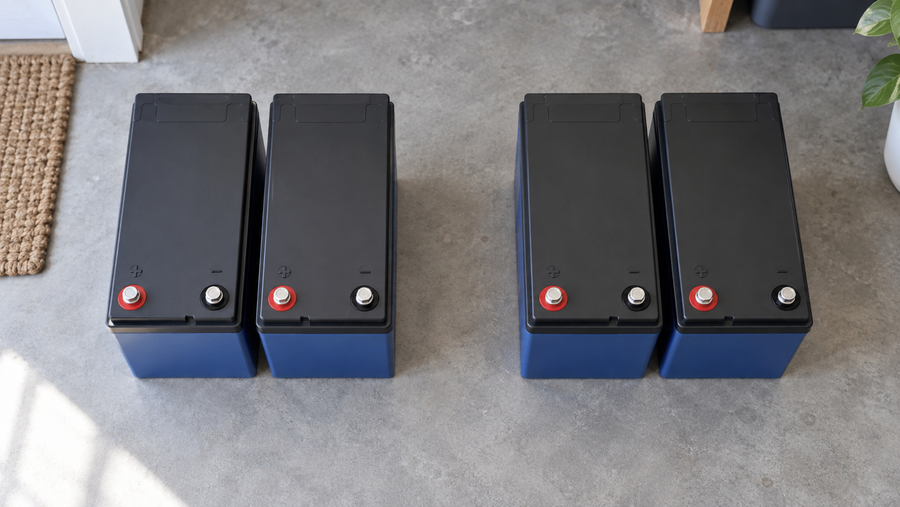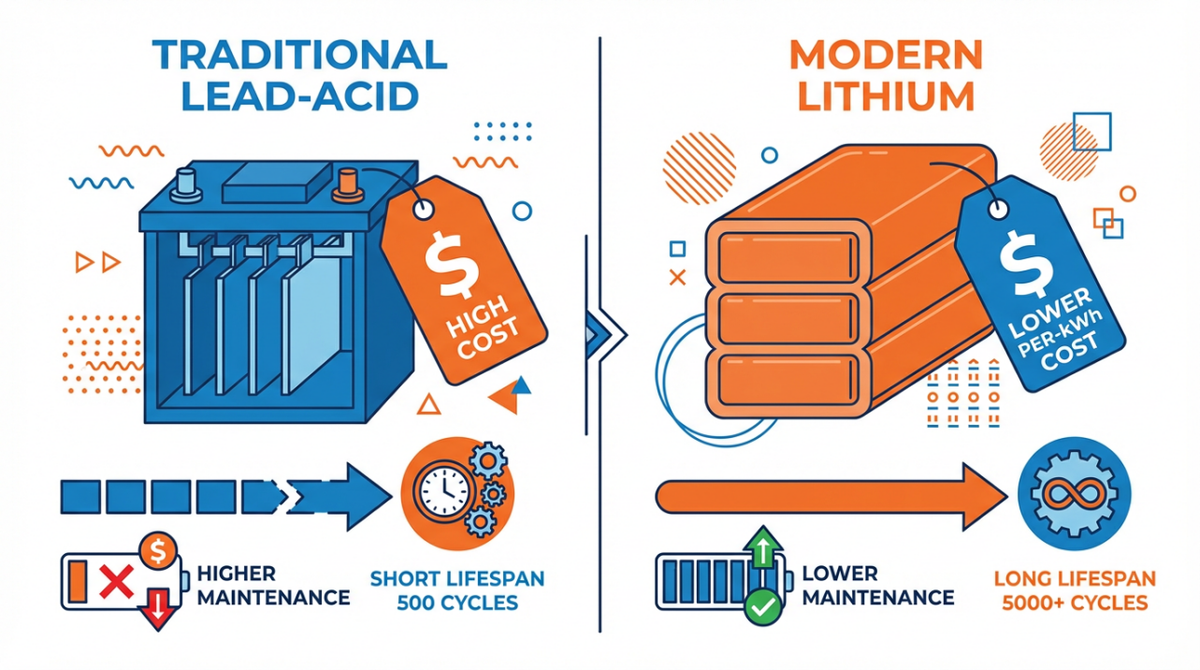

When you look at lifetime cost per usable kWh instead of sticker price, quality lithium banks usually beat lead-acid by a wide margin in off-grid and other high-cycle systems.
You get a quote for a lithium battery bank and your stomach drops: it costs two or three times more than the chunky lead-acid bank on the same proposal. Yet when this comparison is run properly on real homes and cabins, the lithium option usually delivers the same usable energy for a fraction of the lifetime cost. By the end of this walkthrough you will know how to run that math yourself, see lithium-versus-lead examples, and know when paying more upfront actually protects your budget.
Why Cost per kWh Beats Sticker Price
The crucial number is not "How many dollars for this battery bank?" but "How many dollars for each kilowatt-hour the bank delivers over its life?" That lifetime energy cost, often called cost per kWh, is the same logic used in professional evaluations of battery chemistries for home storage and grid projects, where total lifetime cost is divided by total lifetime energy delivered. You will see this approach in practical energy cost comparisons of battery chemistries.
Once you think in cost per kWh, it becomes obvious why lithium is so strong. Lithium banks usually allow deeper regular discharge, lose less energy as heat, and survive many more cycles before they are worn out. Lead-acid often starts cheaper per kWh of nameplate capacity but wastes much of that on limited usable depth of discharge, lower efficiency, and frequent replacements. On a high-cycle off-grid cabin, you can easily end up buying the lead-acid bank five or six times over the period one lithium bank keeps running, as shown in detailed cycle and replacement analyses for home systems in battery cost per cycle studies.
Power vs Energy: kW and kWh in Plain Language
It is easy to get lost in specs if you do not separate power from energy. Power, measured in kW, is how hard the battery can push at any moment; energy, measured in kWh, is how much it can deliver over time. A simple way to picture it is that kW is the width of the pipe and kWh is how much water comes out of the pipe over an hour.

Practical examples of this distinction, such as how long TVs or chargers run before using 1 kWh, are laid out clearly in explanations of kW versus kWh.
Why does this matter for cost? Many quotes still talk only in dollars per kWh of installed capacity and ignore that the same pack can be used gently or heavily. Utility-scale studies show that installed capital cost per kWh falls as duration increases and that you need to track both $/kW and $/kWh because one system might be optimized for power and another for energy. This is built into modern cost modeling for large lithium storage, where a 4-hour system is treated as the standard configuration and costs per unit of energy capacity are calculated explicitly in utility-scale battery cost assumptions.
From Price Tag to Lifetime Cost per kWh
Once you separate power and energy, you can convert any battery quote into a lifetime cost per kWh with a simple structure:
Lifetime cost per kWh ~ total lifetime cost / total lifetime kWh delivered.
Total lifetime cost should include the initial battery purchase, any expected replacements, and realistically any repeat labor or transport if that will be a factor for your site. Total lifetime kWh is the usable capacity per cycle multiplied by the number of cycles the bank will survive, adjusted for system efficiency. This is the same kind of logic used by designers who compute cost per cycle and then normalize it to energy delivered for different chemistries, as described in battery cost per cycle analysis and in residential energy cost comparisons of chemistries.
To get your daily kWh, you first work out how much energy your loads actually use. A practical sizing method is to list each appliance, multiply its wattage by hours used per day, and divide by 1,000 to get kWh. Summing those numbers gives your daily energy usage, a technique explained in detail for home backup and off-grid systems in home battery sizing guidance. Once you know daily kWh and your target days of autonomy, you know how much usable storage you need and can evaluate how efficiently different chemistries deliver that usable energy over their life.
Lithium vs Lead-Acid: What Happens When You Do the Math?
Usable Capacity: Why Nameplate kWh Misleads
The first trap in cost-per-kWh comparisons is using total nameplate capacity instead of usable capacity. Lead-acid batteries suffer badly if you regularly pull them down too far, so they are usually limited to about half their rated capacity in daily cycling. Lithium iron phosphate (LiFePO4) can usually run much deeper while still achieving long life. One practical comparison shows that a 100 kWh lead-acid AGM bank often provides only around 50 kWh of usable energy, while a 50 kWh lithium bank can deliver almost all 50 kWh because of much higher allowable depth of discharge. This usable capacity difference is laid out with real examples in home storage battery capacity calculations.
That alone doubles the effective cost of lead-acid on a per-kWh basis. If you buy 100 kWh of lead-acid to get 50 kWh of usable storage, any simple "dollars per kWh of battery" comparison is silently hiding a 2x penalty. By contrast, a lithium bank sized to provide the same usable energy is physically smaller, lighter, easier to locate in a conditioned space, and easier to expand as loads grow, which also cuts installation and transport costs over the system's life.

A concise way to see this is in the following simplified comparison:
Bank type |
Nameplate capacity |
Typical usable share |
Usable capacity |
Lead-acid AGM bank |
100 kWh |
About 50% |
About 50 kWh |
LiFePO4 bank |
50 kWh |
90-100% |
About 50 kWh |
Both deliver roughly the same usable energy, but the LiFePO4 system does it with half the nameplate kWh and a fraction of the physical size.
Cycle Life and Cost per Cycle
The second trap is ignoring how many times you can actually cycle the bank. To understand why lithium wins here, look at a real off-grid design for a small home with a steady 14 kWh per day load and two days of autonomy, analyzed across flooded lead-acid, AGM, and LiFePO4 banks. In that scenario, the flooded lead-acid bank costs about $5,278.80 and is rated for 1,150 cycles at 50% depth of discharge, giving a cost of roughly $4.59 per cycle. The AGM option costs $10,800 and is rated for 2,050 cycles at the same depth, for about $5.27 per cycle. The LiFePO4 bank costs $13,450 but is rated for 10,000 cycles at 80% depth of discharge, yielding a dramatically lower $1.35 per cycle. These numbers come directly from battery cost per cycle analysis.
If the home uses one full cycle per day, that flooded lead-acid bank lasts a bit more than three years before it needs a complete replacement, AGM lasts around five and a half years, and LiFePO4 keeps running for roughly twenty-seven years. Over that span, matching the LiFePO4 lifetime requires replacing the lead-acid bank many times over, driving total battery purchases into a range that can exceed three times the lithium investment even before labor is included.
To connect cost per cycle back to cost per kWh, divide by the energy delivered in each cycle. In the same 14 kWh per day example, the lead-acid bank's $4.59 per cycle works out to about $0.33 per kWh delivered, while the LiFePO4 bank's $1.35 per cycle translates to roughly $0.10 per kWh delivered. In other words, the lithium bank delivers the home's daily energy at about one-third the storage cost per kWh of the seemingly "cheaper" lead-acid design.
Deep Off-Grid Example: Lead-Acid $0.42 vs Lithium $0.15 per kWh
A second case study looks at a standalone home needing 50 kWh of usable storage and cycling roughly once per day over about 3,000 cycles. To hit 50 kWh usable at a safe depth of discharge, the lead-acid AGM design must install 100 kWh of capacity and then replace that entire bank five more times over the 3,000-cycle life of the system. The LiFePO4 system installs only 50 kWh once, runs at close to full depth of discharge, and covers all 3,000 cycles without replacement. When you add battery cost, installation, and transport across the full life of the project, the lead-acid path ends around 2.8 times more expensive than the LiFePO4 path on a cost-per-usable-kWh basis, yielding about $0.42 per usable kWh for lead-acid versus about $0.15 for lithium in the same duty cycle, as quantified in home storage battery capacity calculations.
This is the heart of why lithium "wins" despite a higher purchase price per kWh. If a lithium bank costs, for example, 20-40% more upfront but lasts three to six times as many cycles at deeper depth of discharge, its lifetime cost per usable kWh falls sharply. That advantage shows up repeatedly in battery cost analyses and in real pricing ranges for LiFePO4 that reflect their longer life and higher usable capacity, including comparisons where lithium packs are more expensive per kWh on day one but cheaper in the long run as laid out in lithium-versus-lead cost comparisons and chemistry cost evaluations.
When Lead-Acid Still Makes Sense and When Lithium Is a No-Brainer
There are narrow cases where lead-acid can still be a rational choice. If your battery bank sits full most of the time and only discharges during occasional grid outages, you are not logging thousands of cycles, so cycle life matters less. In that situation, a modest, inexpensive lead-acid bank sized for a few hours of backup can be fine, as long as you accept lower efficiency and more maintenance. This tradeoff is noted in comparisons that point out how lifetime cost calculations change significantly between daily-cycled off-grid systems and low-duty UPS-style backup, including observations in home storage capacity guides. For equipment that cycles hard every shift—commercial floor scrubbers and similar machines—the calculus heavily favors lithium.
However, as soon as you plan to cycle the bank daily or close to it, lithium becomes the default choice. That includes off-grid cabins, grid-tied solar with heavy time-of-use arbitrage, and participation in programs where your battery is dispatched frequently as part of a virtual power plant. In these use cases, the ability of lithium systems to store excess solar and discharge into evening peaks, while cycling thousands of times with high round-trip efficiency, makes them both a financial and technical fit, matching the way customer-sited storage is expected to help balance renewables in energy storage for solar-heavy grids.
Lithium's efficiency advantage also matters. A well-designed storage system with modern lithium cells and quality inverters can achieve round-trip efficiencies on the order of 90% or better, meaning only about 10% of stored energy is lost as heat. Analysis of home battery performance and inverter losses confirms how improving efficiency directly boosts usable output and reduces cost per kWh, as outlined in home battery sizing guidance. Lead-acid banks, especially as they age, tend to run less efficiently, which increases the amount of solar or generator output you must buy just to cover storage losses.
Finally, do not overlook non-battery costs. Replacing a heavy lead-acid bank every few years means repeat labor, disposal, and sometimes structural or ventilation work if you decide to move or right-size the bank. Those soft costs often do not show up in the initial quote and can be substantial in remote or tight sites. By contrast, a compact lithium bank that you install once and monitor electronically fits neatly into the kind of integrated battery energy storage systems used at commercial and even utility scale to deliver decades of flexible operation, as the broader architecture of battery energy storage systems is described in battery storage system overviews.

How to Run the Numbers for Your System
To decide which chemistry is truly cheaper for your project, you only need a small set of numbers from each quote and a calculator. Start by pinning down your daily energy use and target days of autonomy using the appliance-based method mentioned earlier, which is the same approach used in professional home battery capacity calculations. That gives you the usable kWh you care about.
Then, for each battery option, collect the upfront bank cost, the usable fraction of its capacity at your intended depth of discharge, the rated cycle life at that depth of discharge, and an estimate of round-trip efficiency. Multiply usable kWh by cycle life and efficiency to get total lifetime kWh delivered, then divide total lifetime cost by that number. If the batteries you are comparing have obviously different expected replacement counts over your planning horizon, scale the costs accordingly, as is done in the multi-replacement lead-acid scenarios in battery cost per cycle analysis.
When you actually compute those numbers side by side, you will almost always find that, in any system that cycles regularly, a well-engineered lithium bank provides each stored kilowatt-hour for less money over its life than a cheaper lead-acid bank. The more you cycle, the more overpowering lithium's advantage becomes.
A practical closing thought: do not be scared off by the sticker price of a lithium upgrade if your system will work every day. Put every candidate bank through the same lifetime cost-per-kWh calculation. In most serious off-grid and heavy time-of-use applications, that exercise turns "expensive" lithium into the obvious budget-protection move—and can even boost resale value when it's time to sell the RV.