
The short answer
Front and rear battery mounting can both work, but the position changes more than appearance. It changes how the bike carries mass, how quickly the steering responds, how much load reaches a rack or fork, and how convenient the battery is to remove.
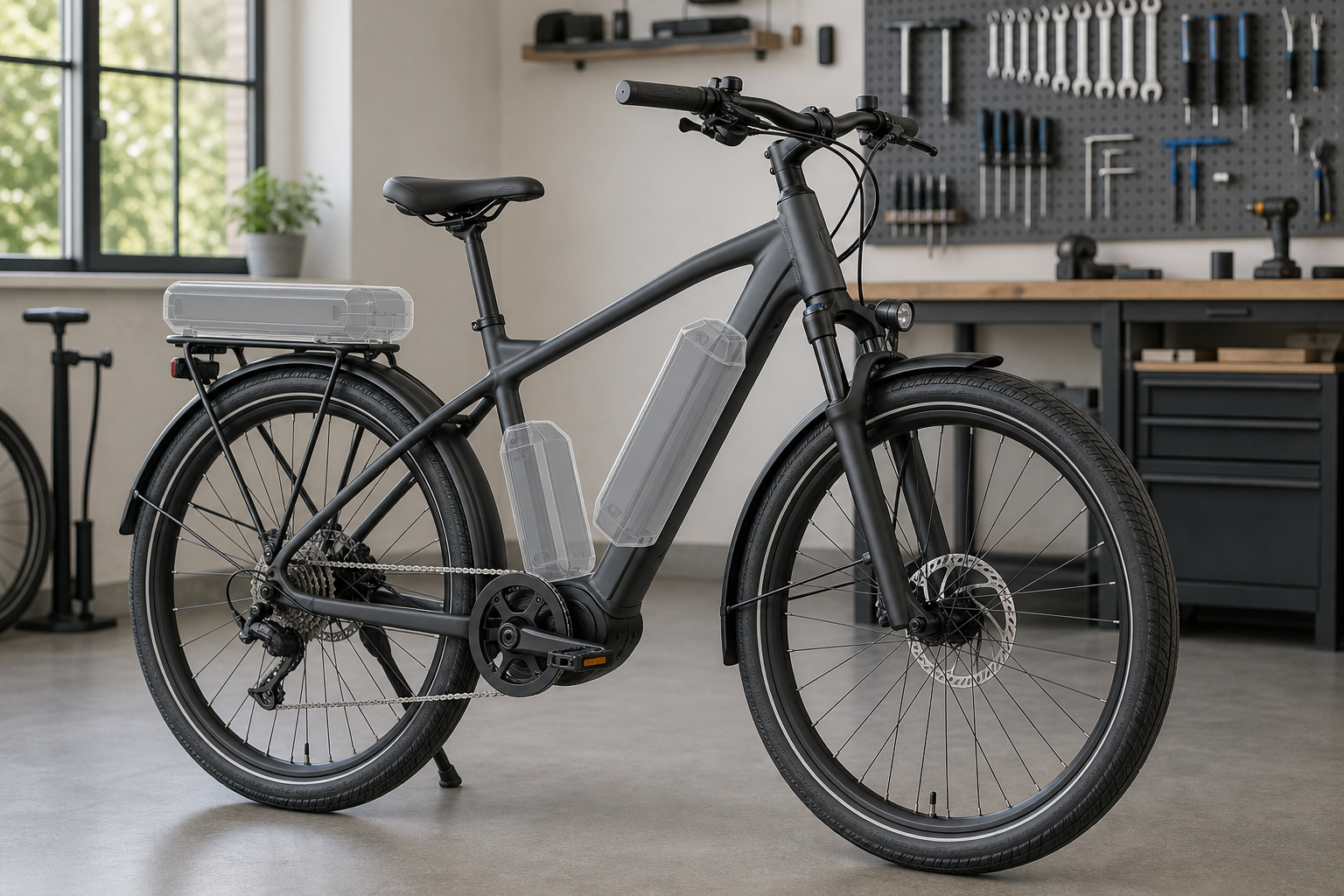
As a rule, a battery is easiest to live with when it is low, close to the bike’s center, securely supported, and compatible with the frame and electrical system. That usually favors a low frame or downtube position over a high rack position. But a rear rack battery may be the sensible choice on a step-through, utility, or conversion bike where frame space is limited. A front position can also be reasonable when its added steering load and mounting structure are deliberately designed for it.
The important comparison is not simply “front versus rear.” Ask four questions:
- How high is the battery?
- How far is it from the front and rear axles?
- What other weight—rider, motor, panniers, or cargo—is already at that end?
- Can the mount, wiring, and surrounding structure handle real road vibration?
What battery position changes on the road

A battery adds mass wherever it is mounted. The farther that mass sits from the bike’s center and the higher it sits above the ground, the more noticeable it tends to be when the bike leans, turns, or is lifted. A centrally mounted battery keeps the load nearer the middle of the wheelbase; a rack-mounted battery puts it high and close to one axle.
That does not make every rear or front design unstable. The complete bike matters: frame geometry, wheel size, suspension, battery mass, rider position, tire pressure, and cargo all contribute. Still, location produces predictable tendencies:
- Low and central: generally a more settled, natural response when cornering and maneuvering.
- High and rearward: can make the rear feel heavier and the bike more pendulum-like when pushed around or ridden over bumps.
- High and forward: can make steering feel heavier or more reluctant to change direction.
- Additional rear load: may improve rear-wheel grip, but can reduce the share of load on the front wheel when the bike is already rear-heavy.
These are handling tendencies, not guarantees. A well-designed rack-bike can ride confidently, while a poorly secured central battery can still be a problem.
Front mounting: what you gain and what you give up
“Front mounted” can mean a battery low on the front portion of the frame, attached to a front rack, or carried in a bag near the handlebar. Those arrangements are not equivalent. The higher and farther forward the battery sits, the more it affects steering and the front structure.
Benefits of a front position
A front battery can help a bike that already carries substantial rear weight, such as a rear hub motor, rear panniers, or a loaded cargo area. Splitting the load between the two ends may feel more balanced than adding every heavy component behind the seat.
Front placement can also preserve room inside a step-through frame or leave the rear rack available for luggage. On some conversions, it is simply the position that fits without interfering with the crank, seat tube, or folding mechanism.
Tradeoffs to check
Extra weight on the steering end can make low-speed turns feel heavier. If the battery is attached to a handlebar-mounted bag or a rack that moves with the fork, it increases steering inertia; the effect is usually more noticeable than with a battery fixed to the frame.
A front rack and its mounting points also experience braking forces, bumps, and steering movement. The rack must be designed for the battery—not merely convenient because it has space. Wiring needs enough controlled movement for steering without rubbing, pulling, or forming a snag hazard. Keep the battery clear of the tire, brake hardware, cables, and suspension travel.
A front battery is a poor match when the bike already feels front-heavy, the fork or rack has no stated provision for the load, or the battery cannot be restrained against bouncing. Do not assume a generic basket or fork eyelet is a battery mount.
Rear mounting: why it is popular—and where it becomes demanding

Rear batteries are commonly mounted on or under a luggage rack, or low within the rear portion of the frame. A rack battery is usually high above the rear wheel; a frame-mounted rear battery can sit lower and closer to the bike’s center. That height difference matters.
Benefits of a rear position
The rear triangle and luggage-rack area often provide a practical installation zone, especially when the downtube has little room. A rear rack battery can be easy to reach while standing and can leave the main frame open for step-through access or other equipment. Bosch describes rack batteries as higher on the e-bike and convenient to remove while standing, while its frame-battery guidance highlights the low center of gravity associated with frame mounting (compare the manufacturer’s frame and rack placement descriptions).
Rearward weight can also add load to the driven rear wheel on some e-bike layouts, which may be useful on loose surfaces. But that benefit depends on the entire load plan, not just the battery.
Tradeoffs to check
A high rear battery raises the rear load and can make the bike feel less composed when you lift it, turn tightly, or cross uneven ground. If panniers, a child seat, a spare battery, or a heavy rear hub motor are also present, the combined rear load may matter more than the battery alone.
The rack is a structural component, not just a shelf. Check its stated load rating, the battery mount’s fasteners, and whether the rack is intended to carry a battery. Repeated vibration can loosen hardware or fatigue a structure that was never designed for the load. Keep the battery from contacting panniers, straps, the tire, or moving drivetrain parts.
The rear position is especially questionable when the front wheel already feels light, the rack has visible flex, or the battery can rattle in its cradle. A mount that moves under hand pressure deserves correction before a test ride.
Front versus rear: a practical comparison
| Decision factor | Front mounting | Rear mounting |
|---|---|---|
| Steering feel | More likely to add steering inertia, especially on a fork or handlebar mount | Usually leaves the steering end lighter, but can make the bike rear-heavy |
| Traction balance | Can share load with a heavily loaded rear end | Can add rear-wheel load, but may further unload the front on climbs or acceleration |
| Best height | Low, frame-fixed placement is preferable to a high moving rack or bag | Low frame placement is preferable to a high rack position |
| Structural concern | Fork, rack, steering clearance, and cable movement | Rack, rear stays, rack mounts, tire clearance, and combined cargo load |
| Access | Depends on the mount; may be awkward if near the steering assembly | Often convenient to remove while standing |
| Cargo compatibility | Leaves the rear rack available, but consumes front carrying capacity | Can compete with panniers and other rear cargo |
| Typical fit | Bikes with rear-heavy layouts or limited central frame space | Step-throughs, utility bikes, and frames with limited downtube room |
The “winner” depends on the bike’s existing balance and the rider’s priorities. For handling alone, a low central location generally has the fewest compromises. Between two end-mounted options, choose the one that produces the better complete load distribution and has the stronger, purpose-built mount.
A decision method that works better than a rule of thumb

1. Map the complete load
Before choosing a location, list the battery, motor, charger or accessories carried on the bike, panniers, locks, child seats, and typical cargo. Note whether the motor is front, mid-drive, or rear; battery placement and motor placement are separate decisions.
A rear battery may be fine on a lightly loaded commuter and a poor choice on a delivery bike with full rear panniers. Likewise, a front battery may balance a rear-heavy build but feel cumbersome on a bike that already has a heavy front rack.
2. Prefer the lowest suitable location
When two compatible mounts are available, the lower one usually reduces the leverage of the battery during leaning and handling. A low frame mount is not automatically correct: it still needs adequate clearance, frame support, and compatibility with the battery system.
3. Check the mount, not just the position
Confirm that the battery and cradle are made for each other and that the frame, rack, fork, or other support is rated for the load. The battery should not rock, slide, or rely on a strap as its only restraint. Inspect fasteners and locking hardware according to the maker’s instructions.
4. Test the bike in stages
With the battery installed, first walk the bike and operate the steering. Then ride slowly in an open area, brake progressively, make controlled turns, and cross a small amount of uneven pavement. Repeat with the usual panniers or cargo. Stop if the battery shifts, the wiring pulls, the rack flexes excessively, or the steering feels difficult to control.
Do not use a short, empty test ride to approve a setup that will later carry substantially more rear or front load. The realistic configuration is the one that needs testing.
Installation and maintenance checks
Regardless of front or rear location:
- Verify voltage, connector, charger, battery-management compatibility, and the manufacturer’s mounting instructions before connecting anything.
- Keep the battery locked into its cradle and protected from direct impact, water exposure beyond its stated rating, heat, and loose cargo.
- Route cables away from tires, spokes, chain, brake rotors, suspension movement, and sharp edges.
- Recheck the mount after the first few rides and after riding rough roads. Look for loosened fasteners, cracks, rubbed cable insulation, and marks showing that the battery is moving.
- Remove the battery for charging or storage only as the system instructions allow; do not improvise a charger or connector.
- If a rack, fork, frame, or battery case is cracked or deformed, stop riding until it has been assessed and repaired or replaced by a qualified professional.
The exact limits are system-specific. A rack’s general luggage rating may not be the same as an approved battery-mount rating, and a battery that physically fits is not necessarily electrically compatible.
Bottom line
Choose by height, distance from the center, total load, and mount integrity, not by “front” or “rear” alone. A low, central frame position is usually the easiest handling baseline. A rear mount is practical when the rack or frame is designed for it and the rest of the rear load stays reasonable. A front mount can solve space and balance problems, but it deserves closer attention to steering feel, fork or rack capacity, cable movement, and clearance.
If you cannot verify compatibility or structural support, do not solve the uncertainty with a tighter strap or a trial ride. Have the mounting system checked before using the bike.