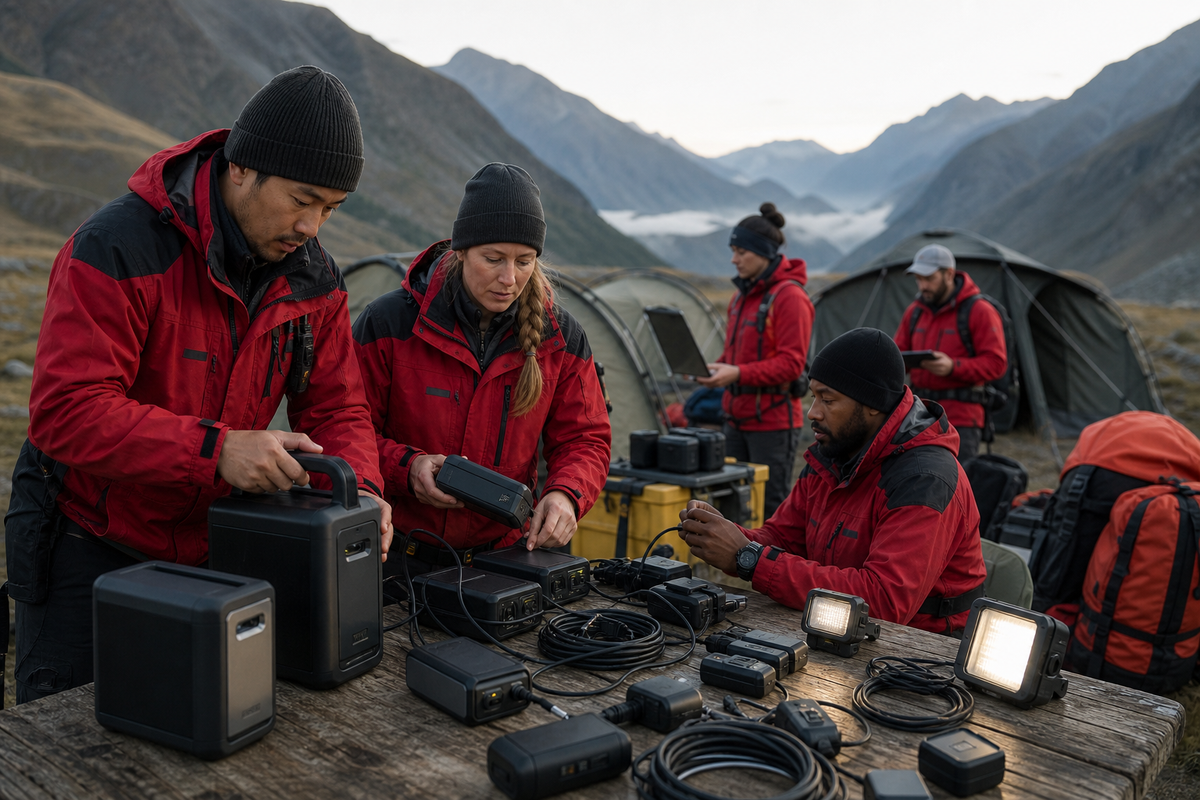

Search-and-rescue teams do not need “a big battery” in the abstract. They need power that stays available at the point of work, for the length of the operational period, without creating a new burden for the crew.
That makes field power a mission-design problem. A system must support the loads that matter—communications, lighting, navigation, medical equipment, mapping devices, radios, drone batteries, and phone charging—while fitting the team’s transport, weather, charging, and accountability procedures. The right choice may be a battery power station, a vehicle-based system, a generator, or a deliberately redundant combination.
Start with the mission, not the power source
Before comparing battery chemistries or outlet counts, write down what the team must keep running and where it will run. The same rescue organization may need a compact kit for a hasty search, a communications cache at base, and a higher-output source for a prolonged incident.
Build a simple load register with five fields:
- Device: radio charger, headlamp charger, satellite terminal, laptop, medical device, lighting, drone charger, or other load.
- Input and connector: voltage, plug type, USB requirement, AC adapter, or any manufacturer-specific supply.
- Power behavior: continuous draw, intermittent draw, charging surge, and whether the device is sensitive to interruptions.
- Quantity: how many units may operate or charge at once.
- Operational priority: what must stay on, what can be scheduled, and what is merely convenient.
This list prevents a common mistake: sizing for the label on one device instead of the combined pattern of use. It also exposes compatibility problems early. A system with ample stored energy can still fail the mission if it lacks the right outputs, cannot handle a startup surge, or requires adapters that the team did not pack.
The U.S. Department of Homeland Security describes portable generators as deployable electric power for remote response operations and as a way to replace damaged infrastructure. That framing is useful beyond generators: field power is infrastructure that must be deployed, positioned, protected, and operated—not just carried into the incident. DHS’s emergency-response generator overview provides a starting point for agencies building a power capability.
Design around an operational period
Runtime claims are only meaningful when the assumptions are visible. Estimate energy for the planned period, then add a reserve that reflects uncertainty in weather, travel, patient care, search duration, and resupply—not an arbitrary promise that the system will last “all day.”
A practical estimate is:
required energy ≈ Σ (device watts × hours used) + charging losses + reserve
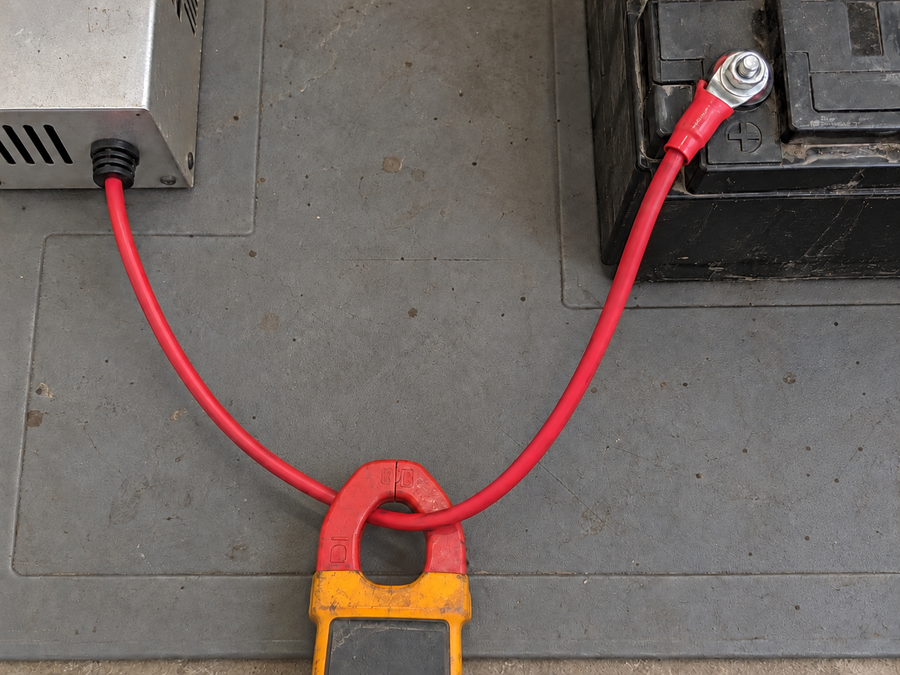
For devices rated in volts and amps, watts are approximately volts multiplied by amps. For equipment that cycles on and off, use its expected duty cycle rather than assuming it runs continuously. If the manufacturer gives only a battery rating in watt-hours, treat that as stored energy, not automatically as energy available at every output under every condition.
Then test the plan against three cases:
- Normal shift: expected loads and ordinary charging.
- High-demand shift: extra lighting, more radio traffic, additional personnel, or a delayed extraction.
- Degraded shift: reduced solar input, vehicle access lost, cold or wet conditions, or one power source unavailable.
The result should be a dispatchable plan: which source goes to which load, what gets charged first, and when the team switches to reserve. A spreadsheet or paper card is more useful than a single headline capacity number if it helps a team make those decisions under pressure.
The field-ready requirements that matter
Portability is more than weight
A rescue crew may move power by vehicle, boat, stretcher, pack, or hand carry. Assess handles, tie-down points, lifting limits, footprint, balance, and whether one person can safely place it where it is needed. A lighter unit that requires fragile accessories or frequent repositioning may be less useful than a heavier unit that can be secured and managed properly.
Separate transport portability from point-of-use portability. A base-camp source can be larger if it serves many loads from one protected location. A forward team may need smaller distributed sources so that a cable failure or relocation does not take down the entire operation.
Environmental protection must match the exposure
“Rugged” is not a specification. Ask for the actual limits and test conditions relevant to the mission: rain, dust, mud, salt exposure, vibration, drops, temperature, and storage. Confirm whether a device may be operated outdoors, whether its outlets need covers, and what the charging instructions say in wet or cold conditions.
Keep power off the ground where flooding or runoff is possible, protect connectors from contamination, and route cables so they do not become trip hazards or snag points. Environmental protection is partly an equipment feature and partly a placement and housekeeping discipline.
Interfaces and power quality are operational compatibility
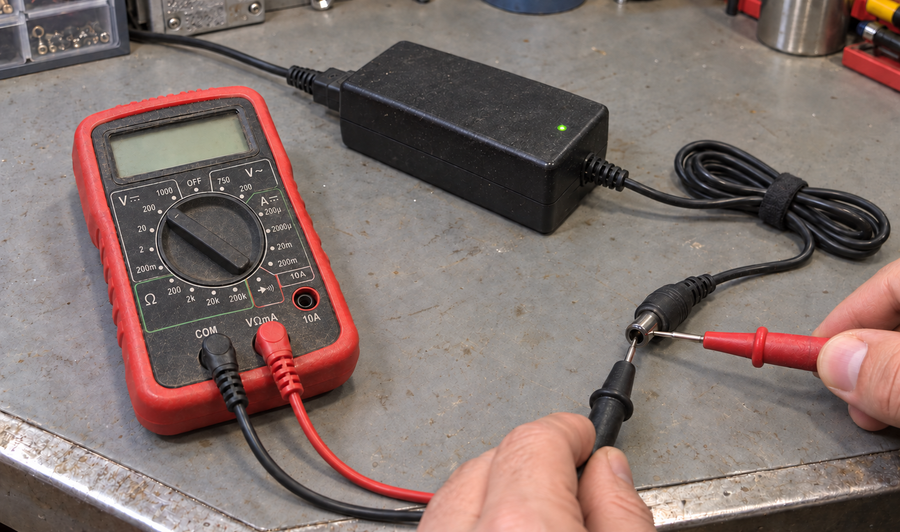
Inventory every connector before procurement. Include AC, DC, USB, vehicle charging, solar charging, and any required adapters. Standardize where possible, label cables, and carry spares for mission-critical connections.
Ask whether sensitive communications, computing, or medical equipment has specific input requirements. Do not assume that an inverter or outlet is suitable merely because its nominal voltage looks correct. Follow the equipment manufacturer’s instructions and have qualified personnel resolve uncertain electrical compatibility.
Noise, emissions, and heat affect placement
A fuel generator can provide substantial output, but it also brings fuel logistics, exhaust, noise, heat, maintenance, and a carbon-monoxide hazard. A battery system can simplify some of those constraints, but it still needs ventilation or clearances specified by its manufacturer, protection from damage, and a safe charging plan. Neither option is automatically right for every task.
For night operations, quiet power may help teams communicate and avoid adding noise to the search environment. That is an operational consideration, not proof that a particular technology is safer or more reliable. Match the source to the load, location, duration, and team’s ability to service it.
Build a power layout, not a pile of outlets

Place sources according to the work pattern. A communications node may need stable, protected power and a short cable run. A charging station may belong in a supervised, weather-protected area. Lighting may be distributed so that a single source or cable does not control the whole scene.
Use a simple layout drawing showing:
- each source and its rated output;
- essential and nonessential loads;
- cable routes and protected crossings;
- charging, fuel, and battery-storage areas;
- fire extinguisher and emergency-isolation locations;
- a reserve source and the person responsible for it.
This layout makes failure visible. If one source trips, the team should know which loads are affected and what can be moved. It also reduces the temptation to daisy-chain extension cords or place a power unit wherever there happens to be space.
For a vehicle or remote communications node, the emergency communications vehicle power guide may help with the adjacent problem of supplying communications equipment from a mobile platform.
Charging and battery safety are part of readiness

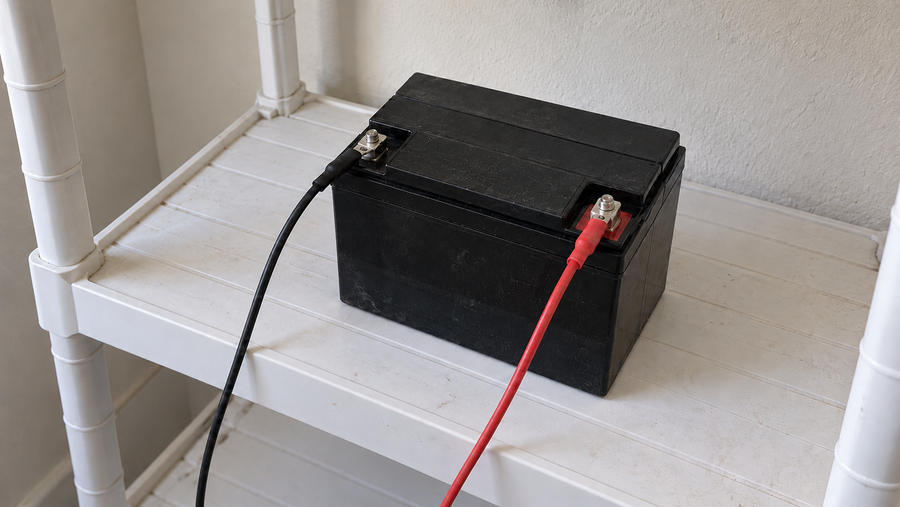
A battery that is empty, damaged, overheated, or stored without a charging plan is not a reserve. Assign responsibility for state-of-charge checks, charger inspection, cable inspection, and recording faults before deployment.
For rechargeable lithium equipment, follow the specific product manual and your agency’s fire and hazardous-material procedures. As a baseline:
- inspect for swelling, cracks, punctures, leaks, unusual odor, heat, or impact damage;
- isolate and remove suspect equipment from service rather than returning it to the charging rack;
- use the approved charger and cable, and do not cover a charging device;
- charge in the location and temperature range specified by the manufacturer;
- keep charging and storage areas away from exits, combustible clutter, and uncontrolled vehicle movement;
- protect terminals and connectors from short circuits;
- use an approved disposal or recycling route—do not put lithium batteries in ordinary trash.
Palm Beach County Fire Rescue notes that lithium batteries can become a serious fire hazard when damaged, improperly handled, or disposed of incorrectly. Its battery safety guidance is a useful public reference, but it does not replace the instructions for the particular battery, charger, or power system your team uses.
Plan recharge and redundancy before deployment
Stored energy is only one part of endurance. Identify how the system will be replenished if the incident extends: vehicle alternator, shore power, solar input, spare battery modules, fuel delivery, or a second generator. Confirm the recharge time and the conditions under which each method is usable. A solar panel may be valuable for maintaining a low continuous load, but it should not be treated as guaranteed recovery during shade, storms, or heavy demand.
Redundancy should protect the mission’s critical functions, not simply duplicate capacity. Examples include:
- separate sources for communications and general charging;
- a small reserve dedicated to medical or command loads;
- spare chargers and connectors rather than only spare energy;
- a fallback charging method at the vehicle or base;
- a manual power-allocation procedure if demand exceeds supply.
Test the failure you are planning for. Disconnect one source, move the kit in gloves or poor light, and operate it with the cables and adapters actually packed for deployment. A tabletop demonstration of a power station is not a field test.
Procurement questions for a rescue team
Ask vendors or internal fleet staff to answer these questions in writing:
- What are the continuous and peak output ratings, and how were they measured?
- What usable energy is available at the outputs the team will use?
- Which loads can run or charge simultaneously?
- What are the operating, charging, and storage temperature limits?
- What ingress, impact, vibration, and transport protections are documented?
- What happens when the source overloads, overheats, or loses input power?
- How is the unit charged in the field, and how long does recovery take?
- Can the team obtain replacement chargers, cables, fuses, and service?
- What inspection, storage, disposal, and incident-reporting procedures apply?
- What training and documentation will be supplied to every operator?
Require evidence that maps to the mission. A brochure’s “outdoor” language is not a substitute for an operating limit; a capacity figure is not a runtime plan; and a compliance mark is not permission to ignore local electrical, fire, transport, or agency rules.
A field-ready power checklist
Before dispatch, the power lead should be able to confirm:
- loads and priorities are documented;
- runtime is calculated for normal and degraded scenarios;
- outputs, adapters, and surge requirements are compatible;
- sources and cables have assigned locations;
- reserve energy and recharge methods are identified;
- batteries, chargers, and cords have passed inspection;
- weather, trip, heat, exhaust, and fire controls are in place;
- operators know how to isolate a failed source;
- state of charge and faults are recorded;
- the entire kit has been tested together.
The best field-power setup is not the one with the most features. It is the one the team can carry, place, operate, recharge, protect, and troubleshoot while the search remains the priority. Define the mission loads first, design for the worst plausible operational period, and make power accountability part of the incident plan rather than an afterthought.