
When treatment requires electricity close to an anxious or injured animal, a non-combustion battery power setup is often the better care-side option—provided its verified output and available energy match the planned equipment load. The reason is practical: wildlife guidance emphasizes minimizing noise and disturbance, while combustion generators produce carbon-monoxide exhaust. A battery system is not automatically silent, however; its fan behavior, placement, and cable routing still belong in the treatment plan.
Quiet Power is Part of the Treatment Environment

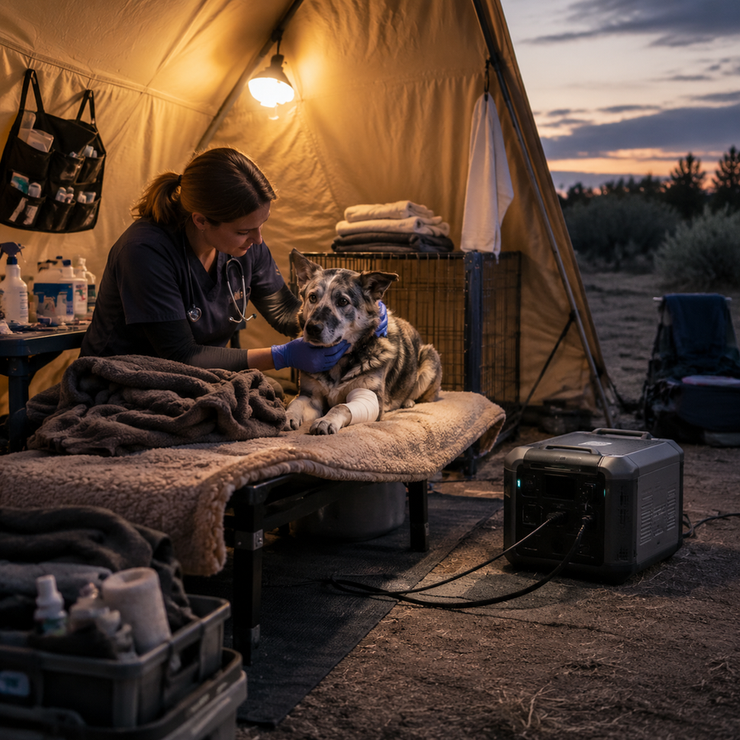
For mobile veterinary teams, wildlife rescuers, livestock-care crews, and disaster-response personnel, the power source is part of the environment an animal experiences. It may sit near a kennel, treatment table, vehicle, temporary shelter, or field enclosure while staff assess and stabilize an animal.
South Dakota wildlife guidance for injured raptors calls for a dark, quiet, warm environment and avoiding loud noises during transport. It also advises minimizing noise and disturbance when an injured or orphaned animal is transported in a closed container, when transport has been directed by wildlife authorities. Those instructions do not establish a decibel limit for field treatment, but they support a sensible operational principle: avoid adding unnecessary disturbance around an already stressed animal. See the state’s wildlife rehabilitation guidance.
Before placing a power source near care, ask:
- How close will it be to the animal? A source positioned beside a kennel or treatment surface deserves more scrutiny than one located outside the immediate care area.
- What disruption does it add? Consider operating sound, vibration, heat, exhaust, movement by staff, and the need to refuel or reposition equipment.
- Can it stay out of reach? The animal should not be able to pull, chew, strike, or become entangled with the unit or its cords.
Quiet electricity does not replace trained handling, veterinary judgment, species-specific welfare practice, or a clinical protocol. It can, however, remove one avoidable source of disruption.
Choose the Care-Side Source Before Building the Load Plan
Start with the location where treatment will happen, then decide what source can safely serve that location.
A battery power station is a care-side candidate when its published continuous output, available energy, ports, and operating limits fit the actual requirements of every device in the plan. It operates without a combustion engine, so it does not produce generator exhaust at the care location. That can simplify placement in a vehicle-adjacent work area, temporary treatment zone, or other setting where exhaust and engine activity would be unwelcome.
A combustion generator may still be necessary when the documented treatment load exceeds what the battery setup can support or when the deployment requires a different charging strategy. But it should be treated as a remote supply source, not as equipment to place beside the animal.
Verify the Equipment Instead of Assuming Compatibility
Do not select a power station based on a device category alone. A laptop, examination light, pump, warming device, refrigeration unit, diagnostic tool, or oxygen-related device may each have different requirements.
For every item that could be used during treatment, document:
- Its manufacturer-stated power requirement.
- Its continuous operating demand.
- Any startup demand or other operating restrictions identified by the manufacturer.
- How long it must operate during the deployment.
- Whether the team has a backup if that device cannot be powered.
Then compare that worksheet with verified specifications for a Vipboss power station or any alternative. A broader battery-versus-generator planning guide can help frame the source-selection question, but equipment documentation and operational protocol remain the decision point.
Build an Animal-Proof Temporary Power Zone

A quiet source still needs a disciplined layout. Before energizing the care area, establish a controlled temporary-power zone that keeps the power unit, connections, and cord path away from animals and the busiest parts of treatment.
Use this pre-treatment check:
- Place the power unit where animals cannot reach it and handlers will not need to step over it.
- Route only necessary cords into the work area.
- Protect cords from pulling, crushing, pinching, and traffic. Temporary-power guidance calls for hard- or extra-hard-usage flexible cords, such as types S, ST, SO, or STO, and warns against routes where cords can be damaged by doorways or windows.
- Keep cords organized so an animal, handler, carrier, or equipment cart cannot snag them.
- Consider ground-fault protection where it is required or appropriate for the temporary installation. OSHA requires approved GFCIs for specified 120-volt, single-phase, 15- and 20-amp temporary receptacle outlets on construction sites.
- Check the planned placement against the power equipment instructions and the team’s site protocol before treatment begins.
The aim is not to create a complicated electrical installation. It is to prevent a routine power setup from becoming another source of animal movement, handler distraction, or cord damage.
Treat Generators as a Separated Outdoor Exception

Portable generators emit carbon monoxide, a colorless, odorless, toxic gas. They should not be used indoors or in enclosed spaces, and they should not be placed near doors, windows, or ventilation openings where carbon monoxide can accumulate, according to OSHA portable-generator safety guidance.
If a generator is necessary, keep it outdoors and separated from the treatment enclosure and animal-care area. OSHA’s alert also specifies 3 to 4 feet of clear space on all sides and above a generator for ventilation. That clearance is not permission to operate a generator near an animal, vehicle, tent, or enclosed treatment space; it is only one ventilation condition within the broader requirement to keep generators out of enclosed areas.
Switch plans before treatment if:
- The generator would need to operate inside, under an enclosed shelter, or near an opening that could draw exhaust inside.
- The generator’s location would introduce avoidable noise or activity beside the animal.
- The cord route cannot be protected from damage or access by animals.
- The team cannot document a suitable primary source and fallback for the planned care.
Make Backup Power an Operational Decision
A calm care-side setup is only useful if the team can maintain it through the treatment window. Before deployment, identify the reserve plan: a charged second battery, an approved alternate supply, a safe charging opportunity, a remotely located generator if conditions permit, or a transfer and triage procedure if essential power cannot be maintained.
The readiness standard is simple. If the team can document essential loads, startup demand where applicable, required runtime, charging access, noise conditions, safe placement, cable protection, and backup procedures, it can evaluate a verified Vipboss setup alongside alternatives. Compare published specifications only after confirming the requirements of the animal-care equipment and the operating protocol.