
Test for parasitic draw by first defining the battery bank and shutdown conditions relevant to the question you are investigating. Decide which power sources and loads belong in that test, account for paths that remain connected, and follow the documented conditions for your RV system. The reading describes current only within that scope. Where a documented branch-isolation method applies, a repeatable decrease can point to a contributing branch, not a confirmed failed component. There is no universal normal-current cutoff for every RV.
Define the shutdown state

-
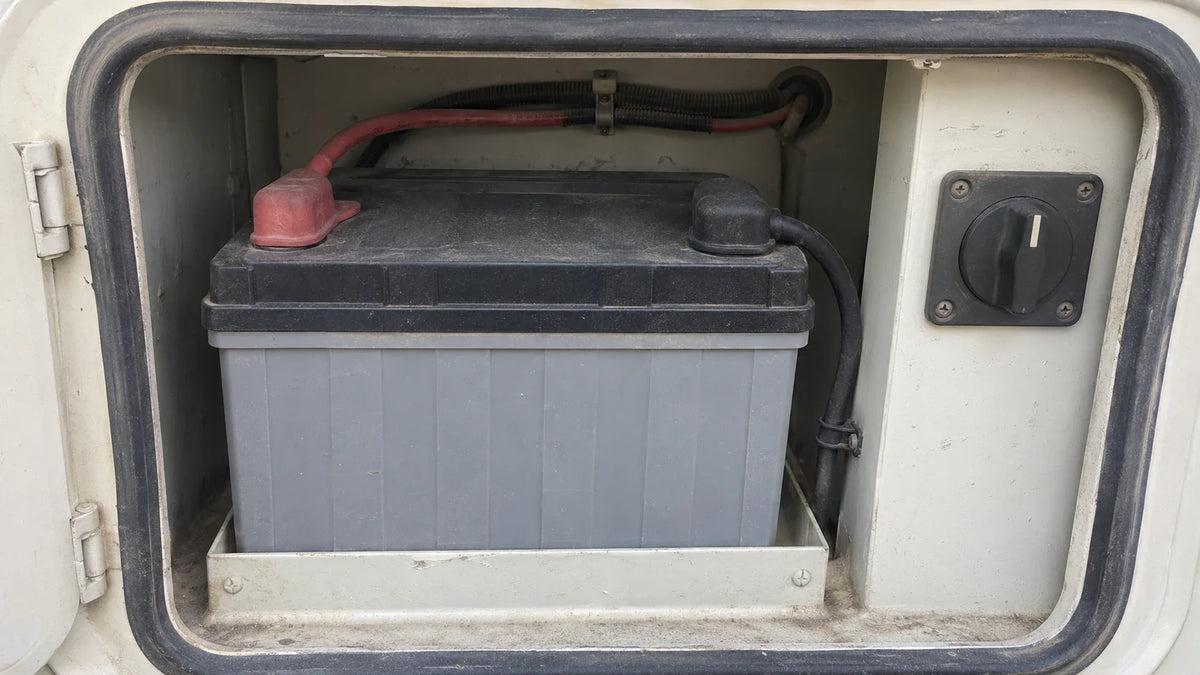
Identify the bank. House batteries and the chassis battery may supply different circuits and have separate charging paths. Decide which bank the question concerns and keep its reading distinct from the other bank. The chassis and house battery systems serve different circuits, so a result for one does not describe the other.
-
Choose what the test includes. A shutdown state is not simply every switch turned off: it is the set of operating conditions whose current you want to assess. For example, if you are investigating current with the RV parked under its intended standby conditions, identify which charging sources should be active or excluded and which loads are expected to remain on in that state. Use the RV's documentation for the system-specific conditions; do not apply one source-disconnection sequence to every RV.
-
Account for connected paths. A battery disconnect may leave battery-side circuits energized, and a charging controller may have a path to the bank that the switch does not interrupt. Check which bank, circuits, and sources the disconnect actually controls. The circuits and charging paths that can remain active with a disconnect off help explain why switch position alone does not define the test state.
After setting the conditions for the question, allow equipment-specific time for electronics to settle before treating the reading as representative. Some equipment consumes power while switched off, and some vehicle electronics may remain awake temporarily after shutdown. Settling behavior depends on the specific vehicle and equipment, so there is no universal RV wait interval. RV service guidance on parasitic loads explains why judgments about expected draw depend on the equipment in the particular vehicle.
Interpret current within that scope
Residual current is the current flowing from or through the bank under the conditions you defined, including any sources and loads left in that scope. A nonzero reading alone does not establish a fault or show whether the draw is acceptable. Installed equipment and shutdown behavior vary, so the number has meaning only alongside the bank, included loads and sources, and the equipment's settling state. Do not apply one pass/fail threshold to every RV.
A controlled comparison can help narrow the search: compare readings before and after isolating a branch only when an RV-specific documented method applies to your system and the other test conditions remain comparable. This makes the change, rather than an isolated number, the useful observation.
Use an applicable branch-isolation method
First use the RV's system documentation or circuit information to determine whether a branch-isolation method applies to the system being tested. If the information does not describe an applicable method, or you cannot tell whether it applies, have an RV service professional identify an appropriate method before attempting branch isolation. Do not assume that removing fuses one by one is a generally applicable RV procedure.

A vehicle service bulletin's branch-isolation example describes trained technicians using that method for its specified vehicle models. It illustrates how a documented procedure can identify a contributing circuit, but it is not a substitute for RV-specific guidance or instructions for an unspecified RV.
When an applicable method lets you compare a branch under otherwise comparable conditions, a repeatable current decrease indicates that the branch contributes to the measured draw. It identifies a branch for further investigation, not the failed component within it. If isolating a branch makes no repeatable difference, that branch may not explain the observed current under those conditions; other branches or paths outside the method's scope remain possible. Changes in charging activity, loads, or electronic settling can also make readings incomparable, so keep the defined test state consistent when interpreting the result.
FAQs
What should you do if your RV documentation does not identify an applicable branch-isolation method?
Ask an RV service professional to identify an appropriate method before attempting branch isolation.
What does a repeatable current decrease during an applicable branch-isolation comparison show?
Under otherwise comparable test conditions, it indicates that the isolated branch contributes to the measured draw, but it does not identify a failed component.
What does it mean if isolating a branch makes no repeatable difference in current?
That branch may not explain the observed current under those conditions, while other branches or paths outside the method's scope remain possible.