
Choose SGT when a correctly sized cable with its stated insulation rating meets the installation requirements. Choose SGX when SGX is specified, or when the verified SGT candidate falls short of a required temperature or exposure rating that a verified SGX cable meets. Neither label alone determines wire gauge, current capacity, or suitability for every route.
What changes between SGT and SGX?
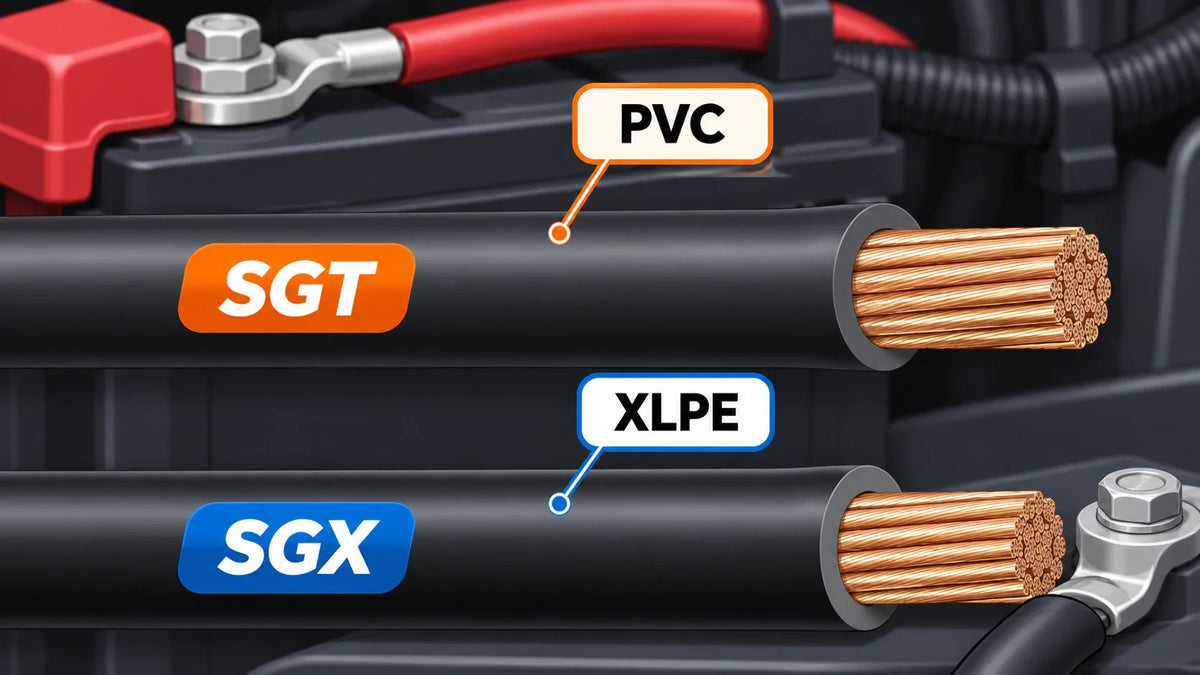
SGT and SGX are battery-cable type designations, not conductor sizes. Published automotive cable specifications commonly show SGT with PVC insulation and SGX with cross-linked polyethylene (XLPE). The latter is often offered with a higher temperature class. For example, Southwire lists an SGT cable in 80°C or 105°C classes and an SGX cable at 125°C. These figures describe those cables; do not transfer their ratings to a different product merely because its type label matches.
The practical distinction is insulation performance against the conditions of a particular installation. SGX is not automatically required for every vehicle, and SGT is not automatically adequate for every battery connection.
| Installation condition | Starting choice | Why |
|---|---|---|
| SGT is allowed and the actual SGT cable meets the specified temperature and exposure requirements | SGT | A compliant cable already meets the stated need. |
| SGX is specified, or the required temperature exceeds the candidate SGT cable's rating | A conforming SGX cable | The SGT candidate does not meet a stated requirement. |
| Fluid, abrasion or other exposure is specified as well as temperature | Whichever cable meets all requirements | A temperature class alone does not establish resistance to other conditions. |
| Requirements are unknown | Establish them before choosing | The SGT/SGX label cannot substitute for an equipment or installation specification. |
A decision method you can reuse

- Identify the governing requirement and route. Start with any cable type specified for the equipment. Note the required temperature class and relevant fluid, abrasion or mechanical exposure along the run. The SAE J1127 scope concerns low-voltage surface-vehicle battery cables under defined normal exposure; it is not blanket approval for every environment.
- Compare actual cable ratings. Check each candidate's markings or product specification for type, insulation, temperature and any exposure ratings the installation requires. If both candidates meet the requirements, SGT is a valid choice. SGX may offer extra rated margin, but only its own specification tells you what that margin is.
- Size and terminate the conductor separately. Select the required gauge for current, run length, voltage drop and applicable equipment requirements. Also confirm the cable fits the intended terminals and routing. Changing from SGT to SGX at the same gauge does not automatically increase the circuit's permitted current. For a golf-cart run, see this battery-cable sizing guide.
For example, if an installation requires at least a 105°C cable and permits either type, a candidate SGT rated 105°C and a candidate SGX rated 125°C both meet that temperature requirement. The remaining exposure, size and termination requirements still need to be met. A candidate SGT rated only 80°C would fail the 105°C requirement. The example illustrates a comparison, not a universal temperature threshold for vehicles.
Final choice: Use compliant SGT where its actual ratings meet the job. Use compliant SGX where SGX is required or its verified properties cover a requirement the available SGT does not. If neither candidate meets all requirements, choose a different suitable cable.
FAQs
Is SGX always better than SGT for battery cable?
No. SGX may offer a higher insulation temperature class, but a correctly specified SGT cable is sufficient when it meets all installation requirements. Extra temperature rating does not replace correct sizing or exposure checks.
Can I replace SGT with SGX of the same gauge?
Only when the replacement also meets the equipment's cable-type, conductor, termination and installation requirements. The matching gauge alone does not establish full interchangeability.
Does SGX carry more current than SGT at the same gauge?
Do not infer a higher permissible circuit current from the type label. Determine the cable size and applicable current limits for the complete installation; insulation temperature is one input, not an ampacity figure.