
The variables that matter most are the ones that change replacement timing and fleet availability: actual duty cycle, charging pattern, service-life metric, charger compatibility, replacement disruption, operating temperature, and end-of-life handling. Battery price, amp-hour ratings, and advertised cycle counts are not comparable until the operating conditions behind them are aligned.
For commercial motive-power fleets, a defensible total cost of ownership model starts with the operating system—not the battery quote.
Start with the Duty Cycle, Not the Battery Quote

Before comparing lead-acid and LiFePO4 options, define how each vehicle or machine actually uses energy during a shift. A battery that appears economical under one charging pattern can produce a very different replacement schedule under another.
Record these inputs for each site, equipment group, or shift pattern:
| Input | What to Record | Why It Changes TCO |
|---|---|---|
| Daily battery demand | Energy demand or equivalent battery units used per day | Determines whether the fleet’s workload fits the proposed operating approach |
| Charging pattern | Conventional, partial, opportunity, or fast charging | Determines which service-life metric is appropriate |
| Depth of discharge | Typical discharge before recharge | Affects whether a cycle-life comparison is comparable |
| Charging window | Available charging time between shifts or during breaks | Influences charger and battery system requirements |
| Equipment availability requirement | Whether a machine can be removed from service without disrupting work | Determines the value of replacement timing and spare capacity |
| Operating environment | Temperature exposure and site conditions | Identifies capacity and availability risk that may not appear in a room-temperature comparison |
For conventionally charged motive-power batteries, one cycle is defined as a full discharge and recharge within 24 hours at 80% depth of discharge. That definition should not be carried into an opportunity- or fast-charged fleet without adjustment.
One motive-power evaluation framework uses daily equivalent battery-unit demand as a technology-selection input. In that framework, fast-charged lead batteries are assigned to 1.25–1.6 equivalent battery units per day, while LiFePO4 is assigned to demand above 1.6. Treat those ranges as a planning prompt, not a universal selection rule. Battery suitability still depends on the specific equipment, charger, battery configuration, and duty cycle.
Match the Service-Life Metric to the Charging Pattern
Replacement cost is often the largest long-term assumption in a fleet battery model. It becomes unreliable when a supplier’s advertised life figure is applied to a different charging pattern than the one used on site.
Conventional Charging
For a conventionally charged fleet, use annual full-cycle equivalents only when the operating pattern matches the cycle definition behind the battery-life documentation. A practical approach is to divide the appropriately conditioned cycle-life figure by the fleet’s measured annual conventional cycles.
For example, a source illustration using 300 cycles per year converts 1,728 cycles into 5.8 years and 1,298 cycles into 4.3 years. The point is not the specific result; it is that the operating-life estimate changes directly with annual use.
Opportunity and Fast Charging
For opportunity- and fast-charged motive-power batteries, ampere-hour throughput is the more appropriate life metric rather than cycle count. Partial charging changes the relationship between charging behavior and battery life, so a cycle-based estimate can be misleading.
In this operating pattern, request supplier documentation that states the applicable throughput basis and confirm that it reflects the proposed duty cycle. Then use the fleet’s recorded energy use and charging behavior to establish the replacement horizon.
Charging discipline also belongs in the baseline model. For lead batteries, undercharging is associated with sulfation, while overcharging is associated with grid corrosion and electrolyte loss. These mechanisms do not provide a universal life penalty, but they are valid reasons to use maintenance records and charging history rather than assuming every installed battery reaches its headline life.
Treat the Charger and Battery as One Cost System

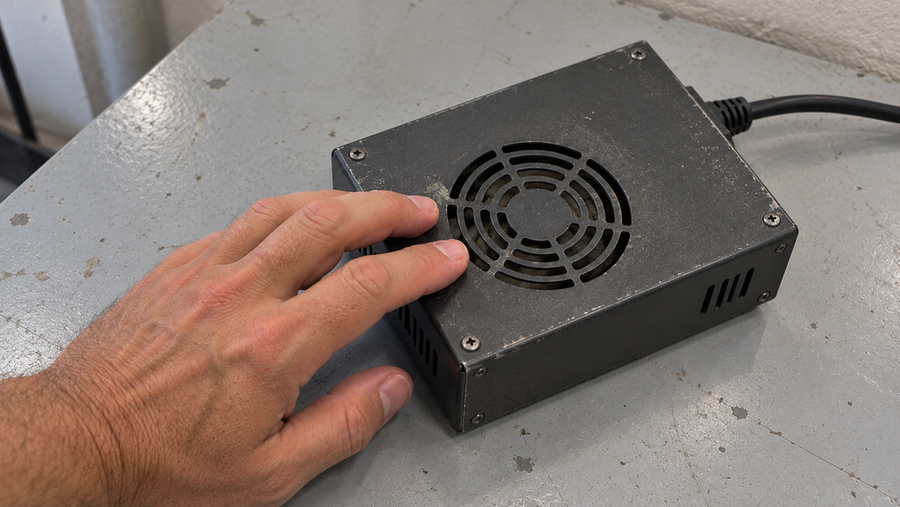
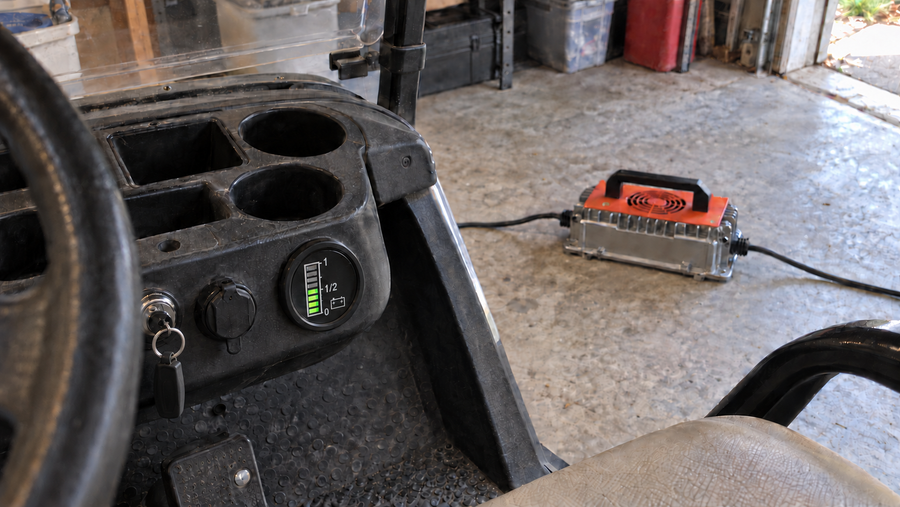
A battery migration is not only a battery procurement decision. Charger compatibility is a system variable because mismatched chargers are identified as a common source of premature battery failure.
Include a compatibility review before assigning any service-life or replacement-cost assumption. At minimum, document:
- Existing charger inventory and settings
- Proposed battery configuration
- Equipment and connector compatibility
- Required commissioning or controls
- Site-specific charging practices
- Responsibility for verifying the final battery-and-charger match
This review is especially important when comparing an existing lead-acid fleet with a proposed LiFePO4 configuration. Do not assume that an existing charger is appropriate simply because it connects physically or produces a similar nominal voltage.
A model-specific compatibility review should also confirm the battery fit, charging requirements, and installation conditions for the proposed Vipboss configuration.
Put Availability Losses in the Replacement Model
Battery replacement timing and operational disruption are separate TCO variables. A fleet can absorb a planned replacement event very differently from an unexpected failure during a busy shift.
For each battery-related interruption, record:
- The equipment affected
- The time the equipment is unavailable
- Labor required to diagnose, recover, swap, or replace the battery
- Whether a spare machine or battery was needed
- Whether the interruption changed shift coverage or scheduled work
Do not assign one universal downtime value across the fleet. Instead, use the site’s own labor, utilization, and operational records to test a range of disruption scenarios.
Temperature should be included in the same availability review. One motive-power source states that a battery operating at 32°F delivers approximately 65% of the capacity delivered at 77°F. Because that comparison does not specify chemistry, discharge rate, battery age, or test method, it should be treated as an exposure flag rather than a fleet performance forecast. Cold-storage, outdoor, and seasonally variable sites should be modeled separately from room-temperature operations.
Include End-of-Life Handling Before Approval
End-of-life handling is a scheduled replacement cost and compliance task, not an afterthought after procurement. Build the collection, storage, transport, recycler coordination, and site review process into the replacement plan.
Under U.S. federal rules, batteries are one of the categories covered by the EPA universal-waste regulations in 40 CFR Part 273. The federal framework distinguishes small quantity handlers accumulating less than 5,000 kg from large quantity handlers accumulating 5,000 kg or more. Materials properly managed as universal waste generally may be stored for one year under the federal program.
State adoption and requirements can differ. If a state has not adopted a federal universal-waste category, a material meeting the hazardous-waste definition may need to be managed under that state’s applicable hazardous-waste rules. Confirm classification, disposal location, and site obligations for the battery type and condition involved.
Use an Approval Gate, Not a Sticker-Price Comparison
Do not approve a fleet-wide migration based on purchase price or headline cycle life alone. Approve it only after the model has been tested against:
- Measured duty cycles and charging behavior by site
- Service-life documentation normalized to that operating pattern
- Verified battery-and-charger compatibility
- Replacement timing and disruption scenarios
- Temperature and availability exposure
- End-of-life logistics and jurisdiction-specific obligations
With those assumptions documented, the fleet has a usable basis for a verified Vipboss configuration review or a comparable procurement evaluation.