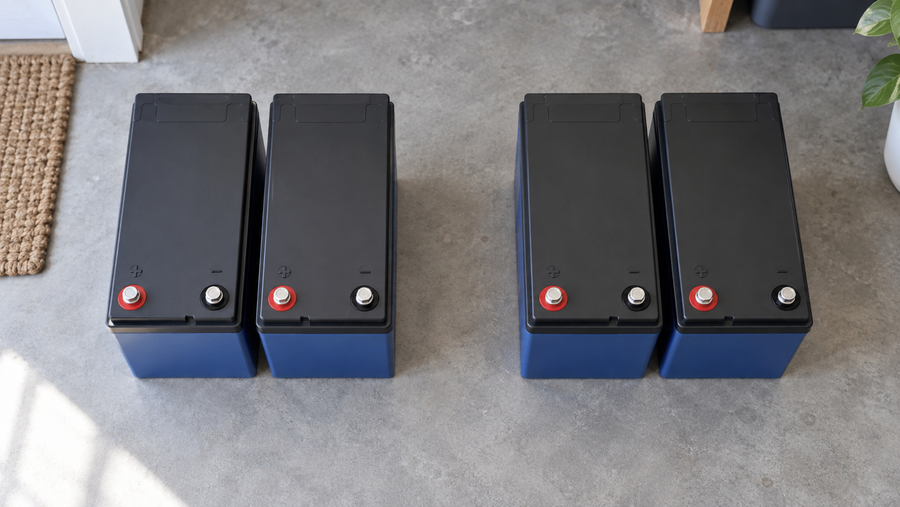

This article quantifies how lithium batteries' higher round-trip efficiency than lead-acid batteries translates into lower charging costs and total ownership costs for homes, vehicles, and small commercial systems.
Switching from an 80% efficient lead-acid bank to a lithium pack that approaches 98% round-trip efficiency can cut the electricity you buy for charging by roughly a quarter. Over thousands of cycles, that gap turns into real money instead of wasted heat.
Picture your generator or grid-tied charger running hard every evening while your batteries never seem to stretch as far as the energy you pour into them, and your power bill or fuel spend keeps creeping up. After refitting many tired lead-acid banks with modern lithium packs, I repeatedly see the same pattern: charging energy drops by double-digit percentages while usable runtime goes up. This guide shows in plain numbers how much that 98% versus 80% efficiency gap really saves, where it matters most, and how to design your system so you actually capture those savings.
Why Battery Efficiency Hits Your Power Bill So Hard
Every battery wastes some of what you put into it as heat and internal losses. Round-trip efficiency is simply the ratio of energy you get back out to the energy you have to feed in over a full charge–discharge cycle. In practical off-grid and solar systems, lithium packs usually land in the 90–95% range, while lead-acid banks often sit closer to 75–85%, so much more of what you buy from the grid or burn in fuel shows up as usable watt-hours with lithium than with lead-acid.
Residential solar testing consistently shows that lithium solar batteries waste far less energy in the charging process than legacy lead-acid banks. Lithium commonly delivers around 90–95% round-trip efficiency while lead-acid hovers around about 75%, which means a big slice of your paid-for power dies as heat in a lead-acid battery room instead of running loads at night lithium solar batteries. Detailed lab work on lithium iron phosphate (LiFePO4) packs pushes this further: under gentle charge and discharge rates and with good temperatures, round-trip efficiency can reach about 92–98%, so only a few percent of the energy is lost in each cycle.
On the industrial side, fleet data from material-handling equipment shows the same pattern. Lithium-powered forklifts and pallet jacks use around 30% less electricity than similar lead-acid fleets to do the same work, making lithium more than 50% more efficient in that context and cutting ongoing energy bills for warehouses and factories that cycle hard day after day the true cost of lithium vs lead-acid batteries. Commercial and industrial battery specialists echo this, often quoting up to roughly 95% round-trip efficiency for lithium-ion versus about 80% for lead-acid across demanding equipment fleets.
Those numbers are not marketing fluff; they show up directly on the charger's kilowatt-hour meter. If your bank cycles daily, that loss difference becomes one of the biggest line items in your long-term operating cost.

98% vs 80%: Turning Efficiency into Dollar Savings
Simple kWh Math for a Real System
Take the core question head-on: what does 98% versus 80% round-trip efficiency really mean for your bill?
Imagine you want your battery to deliver 10 kWh of usable energy to your loads each day. With a 98% efficient lithium bank, the charger needs to push in roughly 10.2 kWh to get that 10 kWh back out. With an 80% efficient lead-acid bank, you must feed in about 12.5 kWh to deliver the same 10 kWh of usable power. That means the lead-acid system draws about 2.3 kWh more per day from the grid or generator for exactly the same work.
If your electricity rate is $0.15 per kWh, the lithium bank's daily charging energy costs about $1.53, while the lead-acid bank costs about $1.88 to support the same loads. That does not sound dramatic until you scale it to a full-time off-grid home running 10 kWh per day every day of the year, where the lithium system spends roughly $560 per year on charging energy and the lead-acid system spends about $685, a difference of around $125 every year from efficiency alone.
Bump the daily usage to 20 kWh, which is common for a comfortable off-grid house with refrigeration, water pumping, electronics, tools, and some HVAC, and the gap roughly doubles to about $250 per year in energy savings just from charging losses, even before you account for generator wear or upsized solar arrays needed to feed a less efficient bank.
Example: 40 kWh Rack Pack vs. Lead-Acid
Now tie this into a concrete rack-mount example using a 40 kWh storage block, a common size for small businesses and larger off-grid homes. At a retail electricity price of $0.15 per kWh, a perfectly lossless system would cost $6.00 in electricity to put 40 kWh of usable energy into storage. Real lithium systems, however, are closer to 90% efficient at typical C-rates, so they actually draw about 44.4 kWh from the grid and cost about $6.66 per full charge for that 40 kWh of usable energy cost to charge a 40kWh battery.
If that same 40 kWh of usable energy were delivered by an 80% efficient lead-acid bank, the charger would have to pull about 50 kWh from the grid, costing $7.50 per full charge at the same rate. If you instead optimized your lithium design and operation to approach 98% efficiency under slower, controlled cycling, the grid would supply only about 40.8 kWh, costing about $6.12 per full usable charge.
Battery type |
Round-trip efficiency |
Energy drawn from grid (kWh) |
Cost per full usable 40 kWh |
Lead-acid |
80% |
50.0 |
$7.50 |
Lithium (typical) |
90% |
44.4 |
$6.66 |
Lithium (optimized) |
98% |
40.8 |
$6.12 |
Against an 80% lead-acid bank, a 98% lithium system saves about $1.38 in electricity every time you cycle the full 40 kWh. If a business cycles that bank once per day, that is roughly $500 per year in direct charging-cost savings; at two cycles per day for a busy shop, the savings push past $1,000 annually, before counting reduced downtime and maintenance.

For smaller batteries in EVs and electronics, the math is the same: a 60 kWh EV battery charged through a 90% efficient system draws about 66 kWh from the grid, costing around $7.92 at $0.12 per kWh. A modest efficiency bump or smarter charging strategy quickly shows up in the monthly statement, as explained in detailed breakdowns of EV and device charging costs understanding the costs of charging lithium-ion batteries.
What This Means for Homes, RVs, and Off-Grid Shops
In a full-time off-grid residence, a high-efficiency lithium bank means your solar array or generator does not have to work as hard to deliver the same usable kWh each night. Real-world comparisons of lead-acid banks that are limited to about 50% depth of discharge and only 80–85% efficiency, against lithium banks that safely use 80% or more of their capacity at over 95% efficiency, show that the lithium system can deliver the same usable energy with fewer batteries, less charging time, and a smaller energy tax on every kWh that passes through it.
That difference is even more pronounced in RV and marine setups where alternator or generator runtime is precious. With lithium iron phosphate packs commonly achieving well over 95% efficiency and offering 80–100% usable capacity, owners report shorter generator runs, faster top-ups from alternators, and more hours of refrigerator, lights, and devices for every gallon of gas, while old lead-acid banks waste 15–20% of their input as heat and must be oversized to avoid deep discharge in high-duty-cycle camping and boating setups cost savings with lithium batteries over traditional options.
In small commercial systems, such as shops with 40 kWh rack-mount banks tied to solar and time-of-use tariffs, high-efficiency lithium allows you to exploit cheap off-peak power far more effectively. By scheduling charging during low-rate windows and combining compact rack-mount lithium modules with short cable runs and smart control, operators can trim energy losses by about 10% compared with old, resistive-heavy layouts, which adds up over thousands of cycles in modular lithium battery systems that run every day for years.
Beyond Bills: Other Ways Lithium Cuts Total Cost
Efficiency is only one lever; the long-term economics tilt even further once you add depth of discharge, cycle life, and maintenance. Lead-acid banks in solar service are usually limited to around 50% depth of discharge to avoid rapid degradation, while lithium banks can regularly discharge to about 80% or even deeper without crushing lifespan in typical off-grid usage. That means you get more usable kWh per installed kilowatt-hour of capacity from the lithium side.
Cycle life compounds that advantage. Many lithium packs in stationary and vehicle applications deliver roughly 2,000–5,000 cycles or more, while lead-acid banks often reach only 300–800 cycles before practical end-of-life, especially under deep discharge or high current operation, as described in chemistries comparisons of lithium-ion and lead-acid batteries comparison of chemistry lithium-ion and lead-acid batteries. When you divide purchase price by usable kWh over the full cycle life, lithium frequently comes out two to three times cheaper per kWh than lead-acid, even though the sticker price per battery is higher.
On top of that, lead-acid demands ongoing watering, cleaning, and careful full-charge routines, which adds labor cost and downtime and can shorten life if neglected. Lithium systems, by contrast, are essentially maintenance-free and can be opportunity charged during breaks without penalty, which has proven to boost uptime and cleaning coverage in scrubbers and material-handling fleets that switch from lead-acid to lithium across multi-shift operations what’s the cost difference between standard lead-acid and lithium-ion batteries?. Those same traits carry over to solar-plus-storage systems on homes and small businesses, where no-maintenance packs with integrated battery management systems quietly manage charging and discharging for years while old flooded cells need regular attention.
Finally, system-scale analyses of solar microgrids that swap lead-acid storage for lithium show that higher efficiency, longer life, and a much smaller number of batteries deliver a lower long-run cost of energy, even when the lithium hardware is more expensive up front, particularly when you account for repeated replacement, transport, and installation events in the lead-acid scenario over thousands of cycles in long-life lithium storage designs.
When Lead-Acid Still Makes Sense
There are narrow situations where the efficiency gap does not justify a lithium upgrade. Vacation cabins, lightly used backup banks, and emergency-only storage that cycles a few dozen times per year simply do not push enough energy through the batteries for the extra 10–20% loss to dominate the economics, especially when budgets are tight and owners are willing to maintain flooded lead-acid banks with water checks and equalization. In that world, the lower upfront price of sealed or flooded lead-acid batteries still has a place as a low-cost, low-duty option that can sit idle for long stretches when used properly in occasional-use systems.
The same nuance appears in backup-only UPS applications, where discharges are rare and shallow. In those cases, a large efficiency advantage for lithium does not translate into many real kWh saved over the life of the system, so careful project analysis is essential before assuming lithium is always cheaper. What is crucial is matching chemistry to duty cycle rather than chasing efficiency alone in UPS-style systems.
How to Actually Capture Lithium's Efficiency Advantage
Getting a spec sheet that lists 98% round-trip efficiency is one thing; seeing that performance in your logs is another. To get close to best-case numbers, you need to size the lithium bank and chargers so they operate at moderate C-rates, keep pack temperature in a reasonable band, and avoid hammering the cells down to empty or holding them at 100% state of charge for long periods. Those are the same conditions that deliver long life and stable efficiency in measured LiFePO4 pack tests on lithium solar batteries.
In practice, that means choosing a lithium bank large enough that your typical charge and discharge rates stay at a fraction of the rated capacity, pairing it with a charger that supports proper constant-current/constant-voltage profiles for lithium, and letting the integrated battery management system do its job with cell balancing, overcharge protection, and temperature monitoring, as laid out in detailed lithium and lead-acid chemistry comparisons. For grid-tied systems, aligning charging with off-peak windows and using time-of-use tariffs can amplify the raw efficiency gains, since each kWh saved is worth more when bought during a low-rate period and used during an expensive peak period in modern rack-mount lithium storage systems that use smart scheduling and monitoring.
Once the system is in service, a good battery monitor that tracks watt-hours in and out becomes your scoreboard. Over a few months of daily cycling, you should see the ratio of delivered energy to charging energy settle into the mid-90% range for a healthy lithium bank and much lower for any lead-acid bank under a similar load profile.

That gives you hard proof of the upgrade's impact on your bills in real-world lithium versus lead-acid comparisons.
Quick FAQ
Does efficiency alone pay for a lithium upgrade?
Efficiency alone can pay back a lithium upgrade in systems that cycle heavily, such as off-grid homes, RVs, marine setups, and shops that use their batteries daily, because shaving roughly 20–30% off the charging energy for thousands of cycles translates into hundreds or thousands of dollars saved. The strongest payback, however, comes when you stack efficiency with deeper usable capacity, much longer cycle life, and near-zero maintenance, which is why long-horizon cost-of-ownership comparisons repeatedly show lithium beating lead-acid on cost per delivered kWh even with higher upfront prices.
How close to 98% efficiency can you really expect?
In the field, most well-designed lithium banks running at moderate rates land in the 90–95% range, while 98% is a best-case number reached under controlled test conditions with gentle C-rates and ideal temperatures. That means it is achievable but not guaranteed. The practical takeaway is that even if your lithium bank only reaches the low-90s, it will still beat an 80% lead-acid bank by a wide margin, and the gap will show up in both reduced charging energy and longer service life across typical solar and storage applications.
A well-optimized lithium upgrade turns your battery room from a hidden energy tax into a power multiplier: you buy less electricity or burn less fuel, you get more usable kWh from every charge, and your system runs longer with less hassle. That is exactly how a serious off-grid or backup power system should behave.