
One 105Ah lithium battery can replace a Group 31 lead-acid battery only if its energy meets the intended need, it fits the tray and connections, its voltage and output meet the system's demands, and the existing charging equipment matches the lithium battery's documented charging requirements. The Group 31 label describes a size class, not equal capacity or guaranteed compatibility; use the same checks for Group 24 and Group 27 replacements.
Compare capacity and energy

Read the lead-acid battery's label or specification sheet and compare its amp-hour (Ah) rating with the candidate's rating under the stated test conditions. Compare watt-hours (Wh) when available. If a Wh rating is not given, estimate nominal energy by multiplying nominal volts by Ah. Ratings measured under different conditions may not be directly comparable, and Ah alone does not establish usable energy or runtime.
Group numbers do not determine capacity. Group 24, 27, and 31 batteries can have different ratings, so compare each candidate's actual label and available space rather than assuming a higher group number means more energy. For another way to compare Group 24, 27, and 31 marine batteries, use specific battery ratings and dimensions, not the group label alone.
Check physical fit

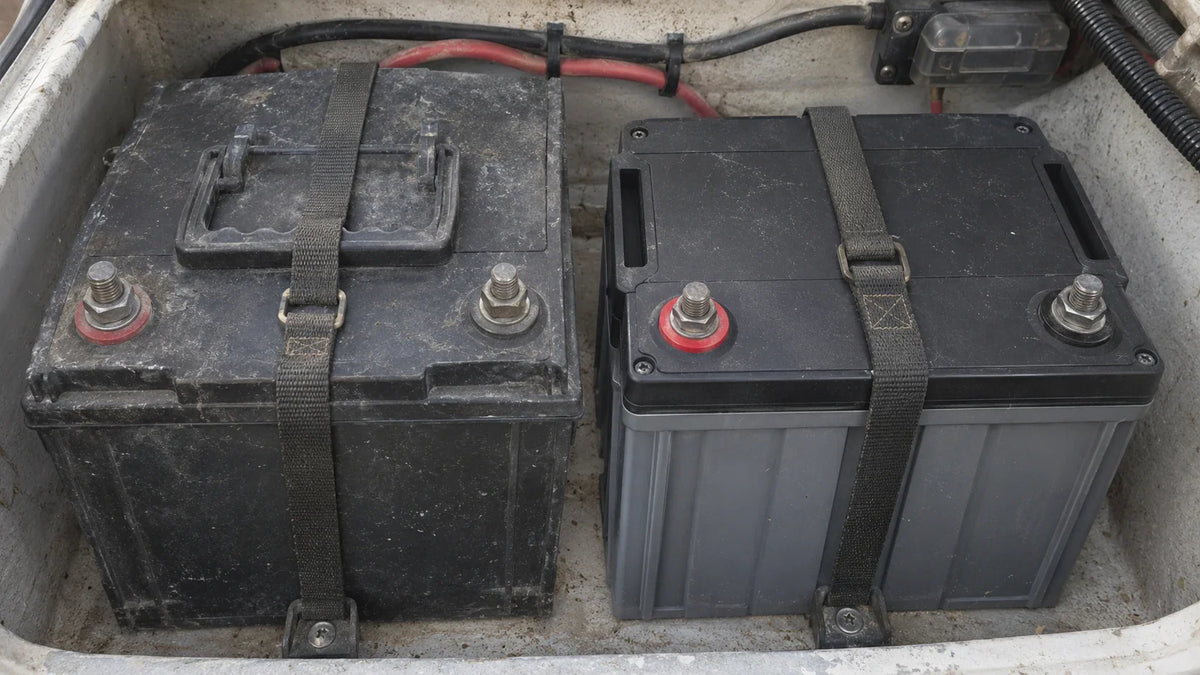
Measure the tray's usable length, width, and height, accounting for obstructions and clearance for terminals and cables. Compare those measurements with the candidate's case dimensions and terminal positions, and check that the existing hold-down and connections fit. BCI group classifications include case dimensions and terminal arrangements, but the group label alone does not confirm that a particular battery fits; compare the candidate's dimensions and terminal layout with the tray. For further Group 31 fit checks, account for clearance, hold-downs, and connections.
For a concrete Group 31 example, the Vipboss 12V 105Ah battery is rated at 12.8V and 1,344Wh and measures 12.95 x 6.77 x 8.42 inches. Compare those dimensions with your available space; the example does not replace checking the actual tray and connections. If you are checking an RV house or chassis battery, use the RV tray and system checks.
Check voltage, output, and charging
Confirm that the candidate's voltage matches the system. Then compare the system's continuous load and startup demand with the candidate's applicable output ratings, including its BMS rating. If the system voltage, loads, or candidate ratings are unknown, gather those values before choosing. A Group 31 fit or 105Ah capacity does not establish that the battery can supply the required output.
Compare the existing charger's supported battery profile and actual charging parameters and stages with the chosen lithium battery's documented requirements. Check the charger's settings and behavior, not just a mode name or voltage label; do not assume that either one establishes suitability. Use the battery's requirements for this comparison rather than applying a universal charging setting.
A 105Ah lithium battery is a possible Group 31 replacement, not an automatic one. Choose it only when the energy comparison, physical fit, voltage, output, and charging-equipment checks all meet the application's requirements; apply the same criteria to Group 24 and Group 27 replacements.
FAQs
Does a Group 31 label mean a 105Ah lithium battery has the same capacity as a Group 31 lead-acid battery?
No. Group 31 is a size classification, not a capacity rating, so compare the batteries’ stated amp-hour or watt-hour ratings under their test conditions.
Can the same checks be used for Group 24 and Group 27 lithium replacements?
Yes. Group numbers do not establish capacity or compatibility, so compare each candidate’s actual energy rating, dimensions and terminals, voltage, output, and charging requirements with your system.
What should I compare to tell whether one 105Ah lithium battery can replace a Group 31 lead-acid battery?
Compare whether its energy meets your needs, whether its case and terminals fit, whether its voltage and output meet the system’s demands, and whether the charger’s profile and actual settings and stages match the battery’s documented charging requirements.