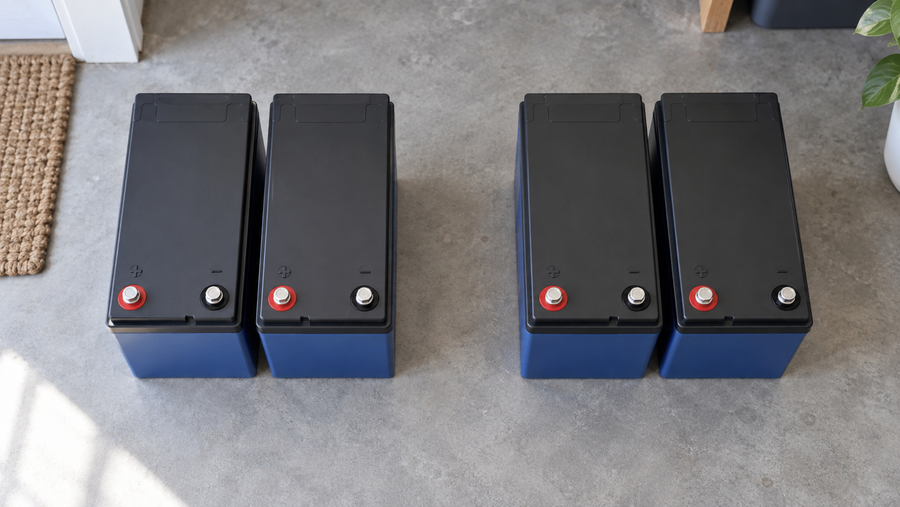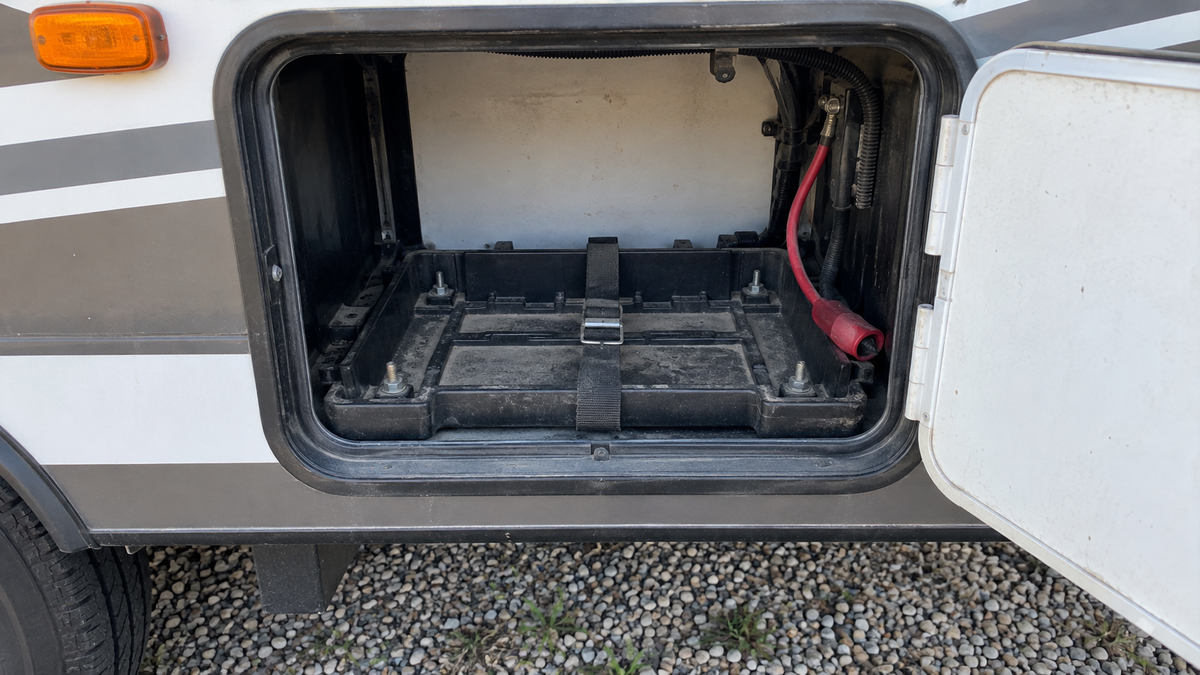

A Group 31 lithium battery may replace an RV house battery only after the exact battery specifications, compartment, system voltage, terminals, charging equipment, and required output have been checked against the applicable RV and battery manuals. Start by measuring the tray and checking the existing battery label; if the battery is a chassis starter battery or the manuals do not support the LiFePO4 charging setup, do not treat the Group 31 label as approval to swap it.
What Group 31 tells you, and what it does not

The Group 31 label is not enough to approve an RV battery replacement. Compare the exact battery specifications with the available compartment, including the space needed for cables and the battery hold-down. Use the battery and RV manuals to confirm the terminal position, connection requirements, and restraint requirements for the intended installation.
Measure the available length, width, and height, including clearance for cables and the battery hold-down. Compare those measurements with the exact battery specification. Check that the terminals are on the correct side and that the existing restraint can secure the replacement. Approve the physical match only when the measured space, terminal arrangement, and stated installation requirements agree.
Confirm that it is the RV house battery
A 12V LiFePO4 battery can be considered for an RV house-battery bank only when the existing battery's purpose and the RV manufacturer's or battery manual's requirements match that use. Before considering a chassis or generator starter-battery replacement, use the RV wiring diagram, the original battery label, and the relevant manufacturer manuals to confirm the battery's purpose. Consider starter use only when the target product documentation and the RV or engine manual explicitly support it and the stated starting requirements match.
Check the label, wiring diagram, and cable connections before disconnecting anything. Do not infer the battery's purpose from a cable path alone. If the documentation identifies an engine or generator starter application, verify the starting requirement and the target battery's approved use before choosing a replacement.
Check voltage, terminals, and charging equipment
Compare the RV system's rated voltage with the target battery and the voltage requirements in the RV equipment manuals. Confirm the polarity and terminal arrangement against the battery documentation before connecting the cables.
Then identify every charging source that can reach the battery: shore-power converter or charger, solar controller, alternator charging system, and any inverter-charger. Compare the target battery manual with each RV equipment manual for the required LiFePO4 charging voltage, current, configuration, and limits. Use those manuals to decide compatibility rather than treating the battery-management system as a substitute for the required charger checks.
For the Vipboss 12V 105Ah Bluetooth LiFePO4 Lithium Battery, charging stops below 32°F (0°C) and resumes at 41°F (5°C). If the battery compartment can fall below that range, check the product documentation and the RV charging equipment manual for a setup and operating plan that respects the stated limit.
Check capacity and output for your actual loads
Physical fit is only half of the decision. Capacity must cover the loads you expect to run between reliable charging periods, and the battery must deliver enough current for those loads.
List the devices powered from the house battery and estimate each device's watts and daily run time. Use:
watt-hours = watts x hours
Add the results, include inverter losses when applicable, and compare the total with the battery's usable energy rather than its nameplate number alone. If you use an inverter for a high-power appliance, check the inverter's continuous and startup demand separately. A battery can have enough stored energy for the day but still shut down when a high-current appliance starts.
The Vipboss 12V 105Ah battery is a Group 31-size, 12V battery with 1,344Wh of stored energy and a 100A battery-management system. It is a candidate for a moderate 12V RV house-battery setup only when its physical dimensions, output limits, charger compatibility, and your actual loads match. Those specifications do not establish that it fits every Group 31 tray or can replace every RV battery.
For a direct product option, see the Vipboss 12V 105Ah Bluetooth LiFePO4 battery. Verify the exact product documentation and your RV's charging setup before ordering.